


Table of Contents
- Are Motorized Shades Worth It for Commercial Offices? The Core Question
- Energy Efficient Office Window Treatments: How Motorized Shades Cut HVAC Costs
- Commercial Window Automation Benefits: Glare Control and Employee Productivity
- Motorized vs. Manual Shades: What Facility Managers Actually Need to Know
- Smart Building Integration and Occupancy-Based Scheduling
- Durability, Lifespan, and Total Cost of Ownership
- Making the Decision: When Motorized Shades Deliver Real Value
- Frequently Asked Questions
Last Updated: October 4, 2026
Are Motorized Shades Worth It for Commercial Offices? The Core Question
Whether are motorized shades worth it for commercial offices depends on your specific operational priorities and budget constraints. The answer isn’t universal, it depends on energy costs, employee comfort needs, building automation goals, and how long you plan to occupy the space.
At The Window Fashion Store, we’ve worked with commercial clients across the Kansas City area to evaluate this decision. The real question isn’t whether motorized shades work, they do, but whether the benefits align with your facility’s actual pain points.
For most commercial offices, motorized shades deliver measurable value in three areas: reducing HVAC costs through heat-gain management, improving employee productivity by controlling glare, and enabling automated scheduling that adapts to occupancy patterns. But these benefits only materialize if your building has the right conditions and you commit to using the automation features effectively.
The tradeoff is upfront cost and complexity. Motorized systems require professional installation, integration planning, and ongoing maintenance. Manual shades cost less initially and require no infrastructure investment. The question becomes: do the operational savings and productivity gains justify that higher entry price over your ownership timeline?
Energy Efficient Office Window Treatments: How Motorized Shades Cut HVAC Costs
Motorized shades reduce HVAC load by automatically lowering during peak solar heat gain periods, which is especially valuable in offices with significant window exposure. When shades are deployed during the hottest parts of the day, they block solar radiation before it enters the building, reducing the cooling burden on your system.
The mechanism is straightforward: light-filtering or solar shades block 40-60% of solar heat depending on the fabric, while blackout shades block nearly all of it. Automated scheduling means this happens consistently, not just when someone remembers to close them manually.
Real-world impact varies by climate, window orientation, and building envelope quality. A north-facing office benefits less than a south or west-facing one. Buildings with poor insulation see more dramatic HVAC savings because the thermal load is already high. Modern buildings with reflective glass see less dramatic gains because the glass itself already rejects some heat.
The energy efficiency advantage compounds over time. If your office operates 250 days per year with consistent solar exposure, automated shading prevents heat buildup during 250 cycles annually, not just the days someone remembers to close blinds manually. Facility managers report that consistent deployment of shades during occupied hours produces measurable reductions in peak cooling demand, which can lower both utility costs and equipment strain.
For commercial spaces with significant glass area and high cooling costs, this is often the strongest financial argument for motorization. The payback timeline depends on your local energy rates and the size of the window bank.
Commercial Window Automation Benefits: Glare Control and Employee Productivity
Glare on computer screens is one of the most common productivity complaints in modern offices. When sunlight hits a monitor directly or reflects off glass surfaces, it forces employees to squint, reduces screen visibility, and causes eye strain and headaches. Motorized shades solve this by deploying automatically when glare conditions are detected.
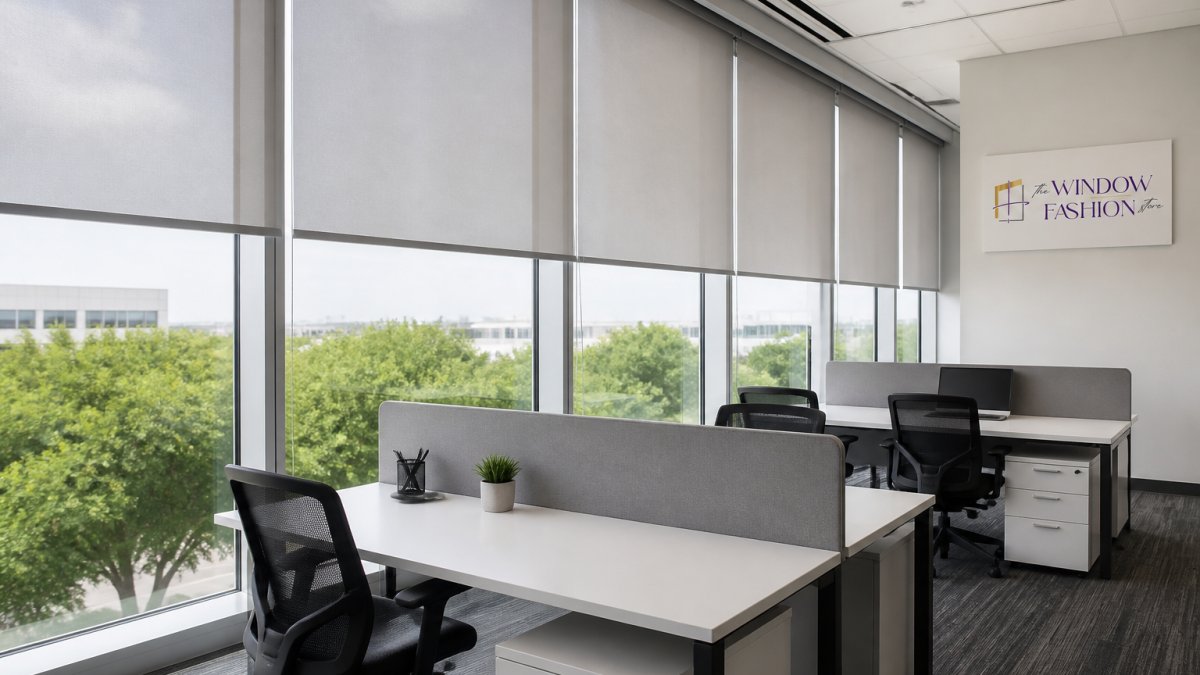
The productivity impact is real but often underestimated. Employees working in high-glare environments spend more time adjusting their position, closing manual blinds, or relocating to different desks. Some simply accept reduced screen visibility and work less efficiently. Automated shades eliminate this friction, the shades adjust without anyone asking, maintaining consistent lighting conditions throughout the day.
Occupancy-based scheduling is particularly effective here. Shades can be programmed to lower during typical work hours (9 AM to 5 PM) and raise during off-hours to preserve natural light and building aesthetics. This keeps employees comfortable without requiring manual intervention. Some systems integrate with daylight sensors that adjust shade position in real time based on actual sunlight levels, providing granular glare control.
The secondary benefit is daylighting, preserving access to natural light while controlling glare. Light-filtering fabrics allow diffused natural light through while blocking direct sun. This maintains circadian rhythm benefits and the psychological benefits of natural light without the glare penalty. Employees get the best of both: natural light exposure and screen visibility.
For open-plan offices or spaces with extensive glass, this becomes a competitive advantage for tenant retention. Employees notice when their workspace is comfortable and glare-free. In tight labor markets, this matters.
Motorized vs. Manual Shades: What Facility Managers Actually Need to Know
The comparison between motorized and manual shades is not just about convenience, it’s about consistency and control.
Manual shades require occupant action. Employees open and close them based on personal preference, time of day, or glare conditions. This is unpredictable. Some employees keep shades closed all day for privacy or glare control; others never touch them.
Manual shades also have a maintenance burden. Cords fray, mechanisms jam, and individual units fail at different rates. Replacing a single broken shade in a 40-window office is a one-off repair task. Over 10 years, you’re managing dozens of small failures.
Motorized shades deploy consistently according to a schedule or sensor input. All south-facing windows lower at the same time during peak heat hours. Glare-prone zones adjust automatically. The behavior is predictable and optimized for facility-wide goals, not individual preferences.
The tradeoff is that motorized systems reduce individual occupant control. Some employees want their shade fully open; motorized scheduling may override that preference. This can create friction if the system isn’t designed with override options.
Maintenance is different, not necessarily easier. Motorized systems have motors, batteries (in cordless models), and control infrastructure that can fail. But failures are usually whole-system issues caught during routine testing, not scattered individual failures. Professional service is required, but less frequently.
For facilities with 20+ windows, motorized shades reduce total maintenance hours because you’re managing one coordinated system instead of dozens of independent units. For small offices with 5-10 windows, the maintenance advantage is less clear.
The real operational difference: motorized shades enforce facility-wide policies (energy conservation, glare control, privacy during off-hours), while manual shades reflect individual occupant preferences. Choose motorized if consistency matters more than flexibility; choose manual if occupants value control over optimization.
Smart Building Integration and Occupancy-Based Scheduling
Modern motorized shades integrate with building management systems and occupancy sensors, enabling automation that responds to actual facility conditions rather than fixed schedules.
Occupancy sensors detect when zones are in use and adjust shades accordingly. A conference room that’s empty all morning keeps shades raised to preserve natural light and reduce unnecessary cooling load.
Integration with HVAC systems creates coordinated thermal management. If the building’s cooling system is running at high capacity, shades deploy more aggressively to reduce solar load. If it’s a cool, overcast day, shades stay raised to maximize daylighting and reduce artificial lighting needs.
Some systems integrate with smart building IoT platforms like Lutron Caseta or Hunter Douglas PowerView, enabling remote monitoring and scheduling from a central dashboard. Facility managers can adjust shading strategies building-wide without visiting individual zones. They can also monitor compliance, confirming that shades are deploying as programmed and identifying zones with equipment failures.
The productivity benefit extends beyond glare control. Consistent daylighting supports circadian rhythm regulation, which improves alertness and reduces fatigue (pubmed.ncbi.nlm.nih.gov). Employees in spaces with optimized natural light exposure report better focus and fewer headaches. Building management systems that coordinate shading with occupancy and daylight levels maximize this benefit.
For larger commercial facilities (100+ employees, multiple zones), smart building integration becomes highly valuable because it enables facility-wide optimization that no manual system can match. For smaller offices, the complexity may outweigh the benefit unless the building already has a management system in place.
Durability, Lifespan, and Total Cost of Ownership
Motorized shades from quality manufacturers typically last 10-15 years with proper maintenance. The motor is the critical component, cordless battery motors generally last 8-12 years before battery capacity degrades noticeably; hardwired motors last 15+ years.
The total cost of ownership includes initial purchase and installation, plus ongoing maintenance and eventual replacement. Initial cost is higher than manual shades. Installation is more complex because of wiring or battery setup and control system configuration.
Maintenance costs are modest if the system is designed well. Annual inspections to confirm motors are responsive and batteries are charging properly cost minimal labor. If a motor fails, replacement is typically a half-day service call. If a battery fails in a cordless system, replacement batteries are available and relatively inexpensive.
Over a 15-year ownership period, a motorized system in a 40-window office might have a higher total cost of ownership than manual shades, depending on fabric quality and service rates. But that comparison ignores the energy savings and productivity benefits. If motorized shades reduce cooling costs by 10-15% annually, that payback compounds over time.
The real cost comparison requires knowing your actual energy costs, window configuration, and how long you’ll occupy the space. A tenant planning to relocate in 3-5 years may not see financial payback. A company that owns its building and operates the same space for 15+ years likely will.
Cordless motorized shades require battery replacement every 8-12 years. Budget for this, it’s not a major expense, but it’s a maintenance requirement that manual shades don’t have. Plan for it in your facilities budget.
Making the Decision: When Motorized Shades Deliver Real Value
Motorized shades are worth the investment when three conditions are met: significant window exposure (20+ windows), high cooling costs or consistent glare problems, and a long ownership timeline (10+ years).
If your office has 40 south or west-facing windows and cooling costs are a major facility expense, motorized shades with automated scheduling will almost certainly deliver measurable energy savings.
Motorized shades are less compelling if your office is small (under 10 windows), you’re renting short-term, or your building already has excellent passive solar design and low glare issues. Manual shades are simpler, cheaper, and sufficient for these scenarios.
The decision also depends on your comfort with technology. Motorized systems require configuration, occasional troubleshooting, and willingness to integrate with building controls. If your facility team is comfortable managing building automation, motorized shades fit naturally into your operations.
For commercial offices in the Kansas City area with significant window exposure and long-term occupancy plans, motorized shades typically deliver value in energy efficiency, employee comfort, and operational consistency. The payback timeline depends on your specific conditions, but the operational benefits extend beyond pure financial return.
Our team at The Window Fashion Store can help you evaluate whether motorized shades make sense for your specific office layout and goals.
The best next step is a free in-home or on-site design consultation where we can review your windows, discuss your operational priorities, and show you how motorized shading might perform in your actual space.
Ready to explore whether motorized shades are right for your commercial office? Schedule a free consultation with our team.
Frequently Asked Questions
What are the primary downsides of motorized blinds in a commercial setting?
The main drawbacks include higher upfront capital expenditure compared to manual shades, dependency on power or batteries requiring maintenance, and proprietary systems that may limit flexibility if you change providers. Motor failures, while rare in commercial-grade units, require professional service. Battery-powered systems need periodic charging or replacement. For offices with older building management systems, integration can be complex and costly. However, these concerns are outweighed by long-term operational efficiency for most facilities managing 20+ windows.
How much can motorized shades reduce energy costs in an office building?
Motorized shades reduce HVAC load by blocking solar heat gain during peak hours, potentially lowering cooling costs by 10-15% depending on window orientation, climate, and scheduling precision. Light-filtering fabrics allow daylighting while reducing heat, which also decreases reliance on artificial lighting. The actual savings depend on your facility’s current energy consumption, local utility rates, and how aggressively you automate scheduling. Professional energy audits can estimate your specific ROI before installation.
What is the typical lifespan of commercial-grade motorized window treatments?
Quality commercial motorized shades last 10-15 years with proper maintenance, significantly longer than consumer-grade options. Hunter Douglas and similar professional-grade systems are engineered for continuous daily operation in office environments. Fabric may need replacement before the motor, and cordless mechanisms are more durable than corded designs in high-traffic areas. Professional installation and regular maintenance extend lifespan and protect your investment in the system.
Can motorized shades integrate with my existing building management system?
Many modern motorized shade systems integrate with building management platforms through standard protocols like BACnet or via smart hubs that connect to your existing automation infrastructure. However, integration complexity and cost depend on your current system’s age and compatibility. Professional installers assess your facility’s technical setup during consultation to determine feasibility. Some systems offer standalone app-based control if full BMS integration isn’t practical, giving you flexibility without expensive retrofitting.