


Last Updated: October 24, 2026
Quick Summary
The best window treatments for arched windows are custom cellular and pleated shades, plantation shutters, and Roman shades, since each can be built to the exact curve of your arch. For high arches, choose stationary or motorized treatments so you never need a ladder. The right pick depends on your arch shape, light control needs, and upkeep.
- Cellular shades are the strongest fabric choice for a true arch because the honeycomb compresses into a tight stack.
- Measuring an arch takes four numbers: width at the spring line, height, radius, and rise.
- Half-round and eyebrow arches accept the widest range of custom shades and shutters.
- Cover a stacked arch and rectangle separately for flexibility, or span both with one motorized treatment.
- Any operable treatment on an arch should be cordless or motorized for reach and safety.
Table of Contents
- Why Arched Windows Need Purpose-Built Window Treatments
- Arched Window Shades: Cellular, Pleated, and Roman Options
- Arched Window Shutters and Hard Treatments That Hold Their Shape
- How to Measure an Arched Window Before You Order
- Window Treatments for High Arched Windows Above Eye Level
- Stationary Versus Operable: Which Arched Window Coverings Actually Open
- Comparing Arched Window Treatments by Light Control, Insulation, and Upkeep
- See the Options in Person at Our Design Gallery
- Frequently Asked Questions
Why Arched Windows Need Purpose-Built Window Treatments
An arched window has a curved top, and that curve is why standard rectangular blinds and shades cannot cover it properly.
At The Window Fashion Store, we have measured and installed custom treatments on arched openings for more than 20 years.
Those three answers lead to completely different products. Below, we break down the best window treatments for arched windows by type, light control, and upkeep.
Arched Window Shades: Cellular, Pleated, and Roman Options
Shades are the most common answer for arched openings because they can be built to the exact curve. Browse our shade options to compare styles for your arch.
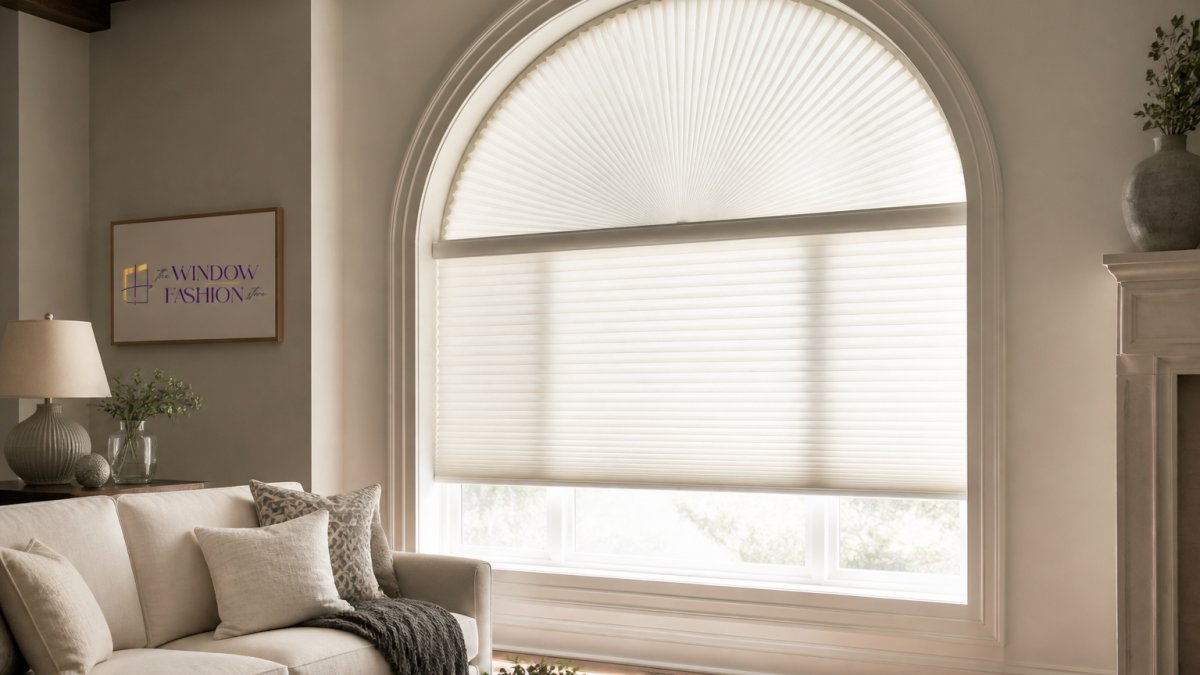
Cellular and Pleated Shades for Curved Openings
Cellular shades are the strongest choice for a true arch: the honeycomb structure compresses into a tight stack, so a custom-cut arch shade follows the curve without buckling.
Pleated shades work on the same principle with simpler single-pleat construction. Both come as stationary units fixed in the arch or operable shades that lift from the bottom.
Roman Shades and Fabric Treatments
Roman shades fold into horizontal panels, giving an arch a softer, more tailored look than a cellular shade. The trade-off is fit: on a tight curve, a Roman shade usually needs stationary mounting or pairing with a separate rectangular shade below the spring line.
Arched Window Shutters and Hard Treatments That Hold Their Shape
Shutters are the most rigid option for an arch, and rigidity is the point.
Louvers can be fixed or operable depending on the arch, and the frame is built as one piece so the curve reads as intentional. To browse actual products and louver sizes, explore our shutter options.
Hard treatments suit high-traffic rooms and humid spaces better than fabric.
How to Measure an Arched Window Before You Order
Measuring an arch takes four numbers, not two: width at the spring line, height to the top of the curve, radius, and rise. Order from a single measurement and the shade will not seat against the frame.
Measure width at the widest point, then height at the centerline from sill to the highest point of the arch. For radius and rise, a template beats a tape.
If you plan to handle the tape yourself first, our guide to measuring odd shaped windows walks through the full process.
Identifying Your Arch Shape
The shape determines which products are available. A half-round arch is a true semicircle and the easiest to fit. An eyebrow arch has a shallow rise, a quarter arch springs from one side, and an elliptical arch has two different radii.
Half-round and eyebrow arches accept the widest range of custom shades and shutters. Quarter and elliptical arches narrow your options and usually require a template-based order.
Window Treatments for High Arched Windows Above Eye Level
High arches need motorization or a fixed treatment, because nobody wants to fetch a ladder every morning. In a two-story foyer or great room, the harder question is usually whether to cover the arch and the rectangular window below it as one unit or two.
The Stacked Arch: One Treatment or Two?
Most arched windows in American homes are not arches standing alone.
Cover them separately. The arch gets a stationary or motorized shade, and the rectangle below gets its own operable shade, shutter, or drape.
Cover them as one unit. A single tall treatment spans the spring line and treats the arch and rectangle as one shape.
Frame the arch and cover only the rectangle. A third option leaves the arch uncovered as a design feature, with the covering stopping at the spring line.
The spring line is the decision point. Cover above and below it separately for flexibility, span it with one motorized treatment for a seamless look, or stop at it to keep the arch visible. There is no wrong answer, only a trade-off between access, light, and appearance.
Motorization and Fixed Treatments for the Arch Itself
For the arch section on its own, we recommend one of two approaches: a stationary shade that stays in place year-round, or a motorized shade on a remote or wall switch. Motorized shades remove the ladder entirely and let you set the arch to a fixed position for glare control. On a stacked window, a motorized arch shade paired with a manual or motorized lower shade gives the most control with the least reaching.
A valance or drapery panel mounted above the arch can also work, since the fabric covers the opening without needing to be reached. Both are decorative and functional and hide the hardware. On very tall walls, a valance is often the only treatment that reads at the right scale from the floor.
Access, Cleaning, and the Long View
High arches are hard to clean, and that should influence the product choice as much as the look.
Plan access before you buy. If the treatment is motorized, confirm where the remote lives and whether a wall switch is reachable from the floor.
Schedule an appointment and we will look at your stacked arch, measure the spring line, and walk you through the one-unit, two-unit, and frame-only options in the gallery before you commit.
Stationary Versus Operable: Which Arched Window Coverings Actually Open
Most arch coverings are stationary, and that is usually the right call. A stationary shade is fixed in the arch and never moves, which keeps the curve clean and costs less than a moving mechanism.
Operable treatments make sense in three situations: the arch is the room’s only light source, it sits at eye level where you actually want to open it, or it is large enough that blocking it permanently makes the room feel dark.
- Stationary: best for transom arches, decorative arches, and any arch above a door
- Operable: best for eye-level arches and arches that carry most of the room’s daylight
- Motorized: best for high arches and hard-to-reach openings
Comparing Arched Window Treatments by Light Control, Insulation, and Upkeep
Most arched window guides list benefits one product at a time. The table below puts the same criteria side by side so you can rule options in or out in a single pass. We use a version of this matrix in the design gallery when a client is deciding between two or three treatments for the same opening.
| Treatment | Light Control | Insulation | Privacy | Operation | Moisture Resistance | Arch Shapes That Fit | Upkeep |
|---|---|---|---|---|---|---|---|
| Cellular shade | High; blackout liners available | Strongest of the fabric options | High when closed | Stationary, bottom-up, or motorized | Low to moderate | Half-round, eyebrow, quarter, elliptical (template order) | Low; vacuum with a brush attachment |
| Pleated shade | Medium to high | Moderate | Medium to high | Stationary or operable | Low | Half-round, eyebrow, quarter | Low; dust lightly |
| Roman shade | Medium; depends on lining | Moderate | Medium | Usually stationary on a true arch | Low | Best on shallow eyebrow and elliptical arches | Medium; fabric holds dust |
| Plantation shutter | High; adjustable louvers | Good | High | Fixed louvers or operable | High | Half-round and eyebrow; quarter and elliptical by template | Low; wipe with a damp cloth |
| Drapery or valance | Medium; depends on lining and fullness | Good with heavy lining | Medium | Stationary or draw | Low to moderate | Any arch, since the fabric spans the opening | High; professional cleaning |
How to Read the Matrix
Start with the two columns that eliminate options fastest: arch shape and operation. If your arch is elliptical or quarter-round, the shutter and cellular rows survive a template-based order, and the Roman row usually drops out unless the rise is shallow. If the arch sits above eye level, the operation column pushes you toward stationary or motorized.
Then weigh light control against moisture. A bathroom or kitchen arch narrows the field to shutter or a moisture-rated fabric, regardless of how much you like a Roman shade. A bedroom arch flips the priority to a blackout cellular shade with a sealed perimeter.
Three Trade-Offs the Table Cannot Show
Perimeter seal beats fabric rating. A blackout cellular shade in an arch delivers the best light blocking available, but only if the edges seat against the frame.
Louver size changes the look of a shutter. Narrow louvers read as a finer, more furniture-like curve; wider louvers block more light per tilt.
Cordless is the default for a reason. Any operable treatment on an arch should be cordless or motorized.
Bring the arch dimensions and a photo to your consultation. Seeing the actual rise and spring line helps us determine which options are realistic for your opening.
If two treatments tie on the matrix, the tiebreaker is usually how the room is used. A media room rewards the cellular row; a sunroom rewards the shutter row; a formal room rewards the drapery row. Book a consultation and we will run your arch through the same comparison in person.
See the Options in Person at Our Design Gallery
Arched windows are the one category where seeing the product beats reading about it. Our design gallery holds full-sized displays of every Hunter Douglas, Alta Window Fashions, Norman, and Texton product we sell, so you can see the actual fabric, color, and function before you commit.
We also bring small sample books to your home for an in-home consultation if you would rather compare options in your own light. Either way, you get exact measurements, professional installation, and service on the products we sell. Schedule an appointment and we will walk you through the arch shapes and treatments that fit your windows.
Frequently Asked Questions
Can you put shades on an arched window?
Yes. Cellular and pleated shades are the most common choice because the fabric can be custom-cut to follow the curve, and Roman shades work when mounted below the arch or above it to cover the full opening. The key is custom sizing: a stock shade will leave light gaps along the curve. Bring your measurements or let a professional measure so the shade follows the arch shape exactly.
Are shutters a good choice for arched window shutters and other arched openings?
Plantation shutters suit arches when the frame is built to the curve, and they hold their shape well in humid rooms like bathrooms. They offer strong privacy and a finished, architectural look. Because each panel is custom-built, expect a longer lead time than shades. A design consultation helps confirm whether a fixed or operable shutter panel fits your arch.
How do you measure an arched window for a custom treatment?
Measure the width at the widest point, the height at the tallest point, and the radius of the curve. Note whether the arch is a half-round, a segmental (shallow) arch, or an eyebrow shape, since each needs a different template. Measure inside the frame for an inside mount and add overlap for an outside mount. Professional measuring removes the guesswork on curved openings.
Should window treatments for arched windows match the surrounding windows?
Matching fabric and finish across the room usually looks most cohesive, especially in open living areas. For a high arched window above rectangular ones, a shared fabric ties the wall together while a contrasting treatment makes the arch a focal point. Bring photos of the whole wall to your consultation so the choice works with the room, not just the single window.
Arched windows reward a measured decision more than any other window in the house. If you are weighing cellular against shutter, or stationary against motorized, our team can show you both in the gallery and measure your arch on the same visit. Get started with The Window Fashion Store and see the difference a custom-fit arch treatment makes in your room.
