


Table of Contents
- Comparing the Best Window Treatments for Odd Shaped Windows
- Hunter Douglas Custom Shutters: Best for Arches and Angles
- Alta Window Fashions Cellular Shades: Best for Energy Efficiency
- Norman Specialty Shape Shutters: Best for Complex Geometries
- Texton Custom Pleated Shades: Best Budget-Friendly Option
- Measuring for Custom Window Treatments: Getting It Right
- The Benefits of Professional Window Treatment Installation
- Design Consultation for Custom Blinds: What to Expect
- Frequently Asked Questions
Last Updated: September 16, 2026
Comparing the Best Window Treatments for Odd Shaped Windows
Odd shaped windows sell a home and then frustrate whoever has to cover them. Arches, trapezoids, triangles, and angled tops reject every standard-size product, so the best window treatments for odd shaped windows are always custom-built.
Custom-fit treatments solve odd shaped windows because they are built to the window’s exact geometry. A stock shade on an arched window leaves a crescent of exposed glass that no amount of adjusting will close.
Hunter Douglas Custom Shutters: Best for Arches and Angles
Hunter Douglas custom shutters are the strongest permanent solution for arched and angled windows: each panel is precision-engineered to the exact window dimensions, with operable louvers for adjustable light control.
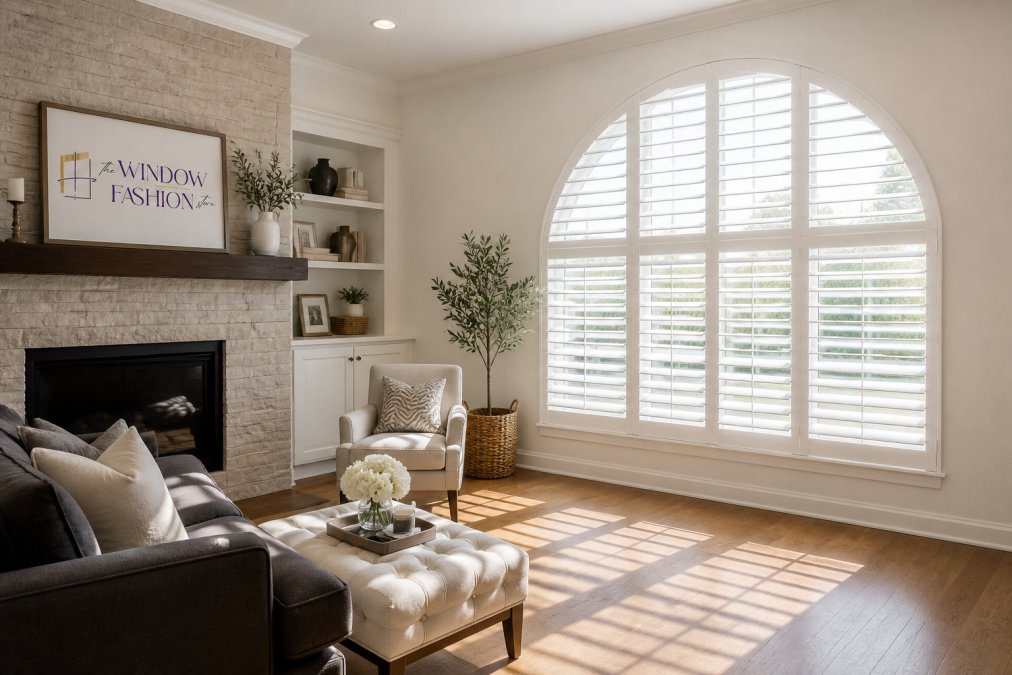
Pros and Cons of Custom Shutters
Pros:
- Highly durable and long-lasting
- Excellent light and privacy control
- Adds a permanent architectural feature
Cons:
- Higher initial investment compared to shades
- Requires professional measurement to fit curves correctly
The most common mistake with arched shutters is ordering from a rough sketch instead of a template. A curve that is off by a fraction at the template stage shows up as a visible gap at the frame, and the panel cannot be adjusted after fabrication.
Alta Window Fashions Cellular Shades: Best for Energy Efficiency
Alta Window Fashions cellular shades are the best pick when insulation matters most: the honeycomb construction traps air between the glass and the room, and the fabric can be manufactured to accommodate arched and angled tops.
Pros and Cons of Cellular Shades
Pros:
- Excellent insulation properties
- Softens the look of geometric window shapes
- Available in sheer through blackout fabric
Cons:
- Fabric can be more difficult to clean than hard shutters
On angled windows, ask for a cellular shade with a top-down option. It lets you drop the shade from the peak of the angle for privacy while keeping the lower glass open to the view.
Norman Specialty Shape Shutters: Best for Complex Geometries
Norman specialty shape shutters exist for windows that break the rules: true triangles, elongated arches, and openings where the angle changes partway up the frame.
Pros:
- Superior custom fit for complex shapes
- Increases home value through custom design
Cons:
- Requires professional measurement and installation
Texton Custom Pleated Shades: Best Budget-Friendly Option
Texton custom pleated shades are the most cost-effective route to a clean, uniform look on a specialty window: the lightweight fabric is custom-cut to match the frame geometry and retracts to a minimal profile.
Pros:
- Cost-effective custom solution
- Sleek, low-profile appearance
Cons:
- Less insulating than cellular shade alternatives
| Product | Best For | Key Strength | Main Trade-Off |
|---|---|---|---|
| Hunter Douglas Custom Shutters | Arches and angles | Permanent, durable fit | Higher investment |
| Alta Cellular Shades | Energy efficiency | Thermal insulation | Fabric cleaning |
| Norman Specialty Shape Shutters | Complex geometries | Precise multi-angle fit | Professional install required |
| Texton Custom Pleated Shades | Budget-conscious buyers | Low-profile custom fit | Less insulation |
Measuring for Custom Window Treatments: Getting It Right
Measuring for custom window treatments on an odd shaped window means capturing the width at multiple points, the height at the center and both edges, and a paper template of any curve or angle. On a rectangular window, a single width and height will do. On an arch, triangle, or angled top, that fails, because the frame is not square and the measurement has to describe the shape rather than its bounding box.
A practical sequence looks like this:
- Measure the width at the top, middle, and bottom of the opening, and record all three even if they match
- Measure the height at the left edge, center, and right edge
- Trace the curve or angle onto paper or cardstock to create a template, then test-fit the template against the glass before you order
- Note the mounting depth and whether the frame allows an inside mount or requires an outside mount
- Record the window framing material so the correct mounting hardware is specified
- Note the direction the window faces and how many hours of direct sun it receives, because that drives the fabric and opacity decision as much as the shape does
Why the Template Matters More Than the Tape
On a semicircular arch, the rise of the curve, the spring line where the curve begins, and the chord width all have to be captured. On a trapezoid or triangle, the two base angles and the apex angle matter as much as the lengths. A cardstock template trimmed to fit the opening transfers all of that in one step.
Skipping the template on a curved window is the single most expensive shortcut in this process. A replacement panel fabricated from a wrong measurement cannot be re-cut, only reordered.
Thermal Performance: The Number Most Buyers Never Ask For
Most shoppers compare treatments on looks and price and never ask about thermal performance, a mistake on a large arched or angled window where heat gain and loss are concentrated. A double-cell honeycomb construction with two layers of trapped air outperforms a single-cell shade of the same fabric. On a west-facing arch that takes direct afternoon sun, that difference shows up in the room’s temperature.
Cleaning and Maintaining Treatments on Hard-to-Reach Windows
Arched and angled windows sit above eye level, so dust settles for months before anyone notices. The routine differs by product:
- Cellular and pleated shades: vacuum monthly with a brush attachment on the lowest setting, and use a handheld vacuum with a crevice tool on the honeycomb cells. Never soak them; the cells collapse and will not recover their shape.
- Shutters: dust the louvers with a microfiber mitt or a static duster, and wipe with a damp cloth only when needed. On painted finishes, avoid abrasive cleaners that dull the surface.
- Hard-to-reach arches: a telescoping duster with a flexible head reaches the top of a tall arch without a ladder, which matters on stairwell windows where a ladder is genuinely unsafe to place.
If a window is above a stairwell or a two-story foyer, choose a treatment you can clean from the floor with a long-handled tool. The easiest treatment to maintain is the one you never have to climb to reach.
The Benefits of Professional Window Treatment Installation
Professional window treatment installation matters most on odd shaped windows because the mounting points, not the fabric, determine whether light gaps appear at the edges. A trained installer checks the frame for square, shims brackets where the wall is out of plumb, and confirms the treatment sits flush against an irregular opening. On a specialty shape, that adjustment work is the difference between built in and almost right.
Which Shapes Are Actually DIY-Friendly
Which of these windows can a careful homeowner handle, and which genuinely require a professional? The answer depends on the shape and the mounting method, not the product brand.
Shapes that are often workable as a do-it-yourself project:
- Standard rectangular windows with an outside mount, where the bracket screws into flat wall or trim and the headrail is level
- Angled-top windows where the treatment is an outside mount that simply overlaps the angle, so the headrail is still a straight horizontal line
- Any window where the mounting surface is flat, plumb, and solid enough to hold screws without anchors
Shapes that reliably require professional measurement and installation:
- True arches and semicircles, where the frame follows a curve and the mounting points are not on a single plane
- Triangles and trapezoids with an inside mount, where the treatment has to sit within a frame that has no parallel sides
- Multi-angle openings where the angle changes partway up the frame
- Windows above stairwells, two-story foyers, or any opening where placing a ladder safely is not possible
- Motorized units, where a headrail that is out of level causes the shade to bind, drift, or stall
What Professional Installation Actually Involves
A professional install on a specialty shape is a sequence, not a single step. The installer confirms the template against the finished opening, checks the frame for square, and identifies where the wall is out of plumb. Brackets get shimmed at those points so the headrail sits level even though the wall does not. On an inside mount, the installer verifies the mounting depth clears the headrail and that the panel does not bind against the frame.
On a specialty shape, the hardware and the mounting plane decide whether the treatment looks built in. The fabric is the easy part; the bracket placement is the job.
Why We Install Only What We Sell
We exclusively install and service products purchased directly through our store: Hunter Douglas, Alta Window Fashions, Norman, and Texton. That is deliberate, not a limitation. When we measure, order, and install the same product, one party owns the fit from template to final adjustment, and the installer already knows how that headrail, bracket system, and mounting hardware behave on an irregular opening before arriving.
Design Consultation for Custom Blinds: What to Expect
Design consultation for custom blinds is a working session, not a sales pitch. You will see the actual products, feel the fabrics, and compare how each option handles light control and privacy in your room.
Frequently Asked Questions
What are the best coverings for odd shaped windows?
The best covering depends on the shape and your goals. Custom shutters from brands like Hunter Douglas or Norman offer a permanent, architectural solution for arches and triangles. Cellular shades from Alta are excellent for energy efficiency and can be custom-cut for angled tops. For a budget-friendly option, custom pleated shades from Texton provide a clean look. A design consultation helps match the right product to your specific window geometry and light control needs.
How do you dress an arched window without losing its shape?
The key is a custom-fit treatment that follows the arch’s curve. Specialty shape shutters are built to trace the arch precisely, preserving its architectural lines while adding function. Cellular or pleated shades can also be custom-manufactured with an arched top rail. Avoid standard rectangular blinds, which will cover the arch and hide its shape. Professional measurement is essential to ensure the treatment complements the window rather than obscuring it.
Are cellular shades a good option for angled windows?
Yes, cellular shades are a strong choice for angled windows. Brands like Alta Window Fashions manufacture honeycomb shades with custom-angled top rails that fit sloped or triangular frames. Their cellular structure provides thermal insulation, which helps with energy efficiency. They are available in various opacities, from sheer to blackout, giving you control over light and privacy. The soft fabric also helps soften the look of sharp geometric angles.
What are the benefits of professional measurement for custom window treatments?
Professional measurement eliminates the risk of ordering a treatment that doesn’t fit. Odd-shaped windows have non-standard angles and curves that are difficult to measure accurately on your own. A professional ensures precise dimensions for inside or outside mount, accounts for window framing irregularities, and specifies the correct mounting hardware. This prevents light gaps, operation issues, and the costly mistake of a custom product that cannot be returned.
Can custom shutters be installed on triangular windows?
Yes, custom shutters can be crafted for triangular windows. Manufacturers like Norman Specialty Shape Shutters are designed for complex geometries, including triangles. Each panel is built to the exact angle of your window frame. Operable louvers allow you to control light and privacy just like a standard shutter. Because of the precision required, professional measurement and installation are strongly recommended to ensure smooth operation and a clean fit.