


Table of Contents
- Why Kansas City Homeowners Look for a Budget Blinds Alternative
- What a Budget Blinds Alternative Should Offer: A Comparison Framework
- Custom Window Treatments Near Me: What Local Really Means
- Your Window Treatment Design Consultation: What to Expect
- Why a Hunter Douglas Dealer Beats Off-the-Shelf Options
- DIY vs. Professional Installation: What You Actually Save
- How to Choose Your Budget Blinds Alternative: A Step-by-Step Framework
- Frequently Asked Questions
Last Updated: September 11, 2026
Why Kansas City Homeowners Look for a Budget Blinds Alternative
The search for a budget blinds alternative kansas city homeowners make usually starts with the same realization: the national franchise model is built for volume, not for your specific windows.
National chains sell a standardized package: a handful of product lines, a rotating cast of subcontractors, and pricing that flexes by zip code. That works for a rental, but less well for a new build with forty windows in three sizes, or a master bedroom with an arched window no stock size will fit.
A budget blinds alternative is any provider that departs from that franchise template, typically an independent, locally owned dealer who measures each opening, carries multiple manufacturer lines, and installs with its own crew. That distinction decides whether your shades fit the first time.
The real difference between a franchise and a local dealer isn’t price. It’s who measures, who installs, and who answers the phone when something needs adjusting two years later.
What a Budget Blinds Alternative Should Offer: A Comparison Framework
A strong alternative offers four things: multiple manufacturer lines, in-house measurement, in-house installation, and a physical showroom where you can see fabric and hardware before ordering.
The Criteria That Actually Matter
| Criteria | National Franchise Model | Local Independent Dealer |
|---|---|---|
| Product range | A handful of house-brand lines | Multiple manufacturers (Hunter Douglas, Alta, Norman, Texton, etc.) |
| Who measures | Often a sales rep, sometimes a subcontractor | The installing company’s own team |
| Who installs | Rotating subcontractor pool | In-house crew, same people every time |
| Showroom | Small sample board or van display | Full-size working displays you can operate |
| Pricing structure | Flexes by zip code and promotion cycle | Quoted per project, tied to actual window count and product |
| Service after install | Routed through a call center | Same dealer, same crew, direct line |
| Accountability | Split across franchise, subcontractor, and manufacturer | One company owns measurement, install, and warranty |
The showroom criterion is the one people skip, and it causes the most regret. A fabric that looks warm in a catalog photo can read flat and gray on your wall. Full-size displays let you see how a shade actually raises, lowers, tilts, and filters light.
Why Pricing Transparency Is the Real Test
Most national franchises quote by promotion cycle, so apples-to-apples comparison is nearly impossible. A local independent dealer typically quotes per project: window count, product line, fabric grade, lift system, and mounting method. Ask for a written line-item quote that breaks out:
- Number of windows and their dimensions
- Product line and fabric or material selected
- Lift and tilt mechanism (cord, cordless, motorized)
- Mounting type (inside, outside, ceiling)
- Installation labor
- Warranty terms
If a provider won’t put those line items in writing, that’s the answer.
The Local-vs-National Angle Competitors Skip
A local independent dealer competes on three things a franchise structurally can’t match:
- Continuity of crew. The person who measures is often on the install crew, so nobody can blame the other when a shade arrives a quarter inch narrow.
- Multi-line flexibility. A dealer carrying Hunter Douglas, Alta, Norman, and Texton can match fabric to room across price tiers; a single-line dealer can only match your room to their catalog.
- Direct accountability after install. Adjustments, warranty claims, and service calls route to the same local team.
The comparison framework isn’t about which brand is better. It’s about which business model puts measurement, installation, and service under one roof, and whether that roof is local.
Questions to Ask Before You Commit
Use these to filter providers quickly:
- Who will physically measure my windows, and are they employed by your company?
- Who will install, and is that crew in-house or subcontracted?
- Can I see and operate full-size displays of the products you’re recommending?
- Will you provide a written line-item quote before I commit?
- If something needs adjusting in year two, who do I call?
A provider who hesitates on any of them is telling you where the handoffs are.
Custom Window Treatments Near Me: What Local Really Means
“Custom window treatments near me” should mean a company whose installers live in your metro and whose reputation depends on your neighborhood. It usually doesn’t, many results resolve to a national call center that dispatches whichever contractor is available that week. Ask one question: who will physically install these? If the answer involves a scheduling department rather than a named crew, you’re looking at a franchise or a lead-generation service, not a local dealer. Local also means measurement and installation come from the same organization; when one company measures and another installs, nobody owns the gap.
Your Window Treatment Design Consultation: What to Expect
A design consultation is a working appointment, not a sales pitch. Expect it to run 60 to 90 minutes, cover every window you’re considering, and end with a written recommendation (hunterdouglas.com).
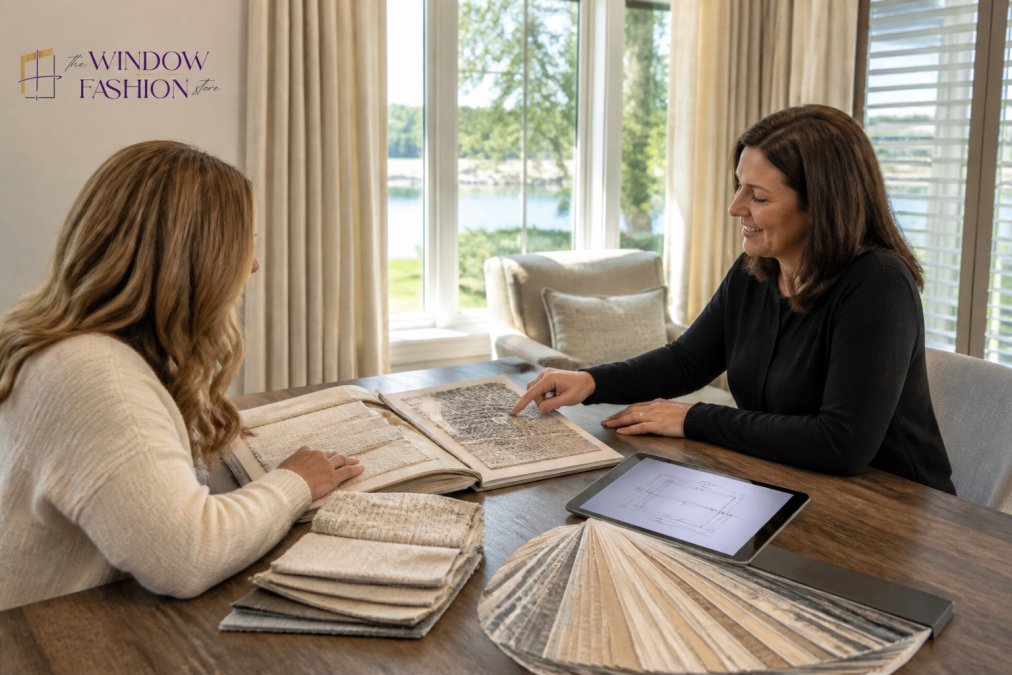
Bring three things: your room dimensions, photos of each window at different times of day, and a rough sense of how each room gets used. Morning glare in a home office and afternoon glare in a west-facing kitchen call for different light filtering choices, and a designer can only solve that if you say when the problem happens.
In-Home vs. Design Gallery Appointments
Both formats work and solve different problems. An in-home visit lets a designer see the light, trim, furniture, and sightlines in context. A gallery appointment lets you put your hands on the product.
If you’re deciding between the two, start at the gallery if you don’t yet know what you like, and start in-home if you already know the look and need the measurements confirmed. The Window Fashion Store offers both, and the gallery visit is where most people finally narrow down fabric and color.
Why a Hunter Douglas Dealer Beats Off-the-Shelf Options
An authorized Hunter Douglas dealer gives you access to engineered hardware, motorization platforms, and warranty support that off-the-shelf retail doesn’t carry. Off-the-shelf coverings are built to a small number of stock sizes and trimmed to fit; custom coverings are built to your opening. The difference shows up in light gaps at the edges, in how a wide span handles its own weight, and in whether the lift mechanism still feels smooth after a few thousand cycles.
Working with a dealer also means buying from someone authorized to service what they sell. The Window Fashion Store is an authorized dealer for Hunter Douglas, Alta Window Fashions, Norman, and Texton, and installs and services only products purchased directly through the store. That narrower scope is deliberate: the crew knows the hardware they’re installing.
For larger projects, motorization is worth pricing in from the start rather than retrofitting. Hunter Douglas PowerView motorization documentation explains how the platform handles scheduling, scenes, and app control, which matters more in a forty-window commercial space than in a single bedroom.
DIY vs. Professional Installation: What You Actually Save
DIY saves on labor and costs you on fit. What you save is the labor line, the smaller half of a custom treatment purchase. What you take on: measuring every opening to the fraction, confirming mounting depth against your trim, handling a product that arrives damaged, and owning the outcome if a shade is off by an eighth of an inch on a wide span.
The Cost-Benefit Breakdown
Most budget-conscious buyers focus on the labor line and miss the downstream costs:
| Factor | DIY | Professional Installation |
|---|---|---|
| Measurement accuracy | You own the risk | Measured by the installing company |
| Odd shapes and arches | Very difficult | Handled as standard |
| Wide spans and heavy shades | Hard to hang level | Crew has the hardware and lift |
| Motorized and hardwired setups | Complex | Configured and tested on site |
| Warranty on fit | Yours to resolve | Dealer handles it |
| Time | A full weekend per room | A single scheduled visit |
| Reorder risk | You pay for a replacement if you measured wrong | Dealer absorbs measurement errors |
| Resale value | Neutral | Cleaner install reads as a finished upgrade |
The reorder risk line is the one people underestimate. A custom shade measured wrong isn’t returnable, it’s built to your specification. On a wide span or an arched window, a single mismeasurement can mean reordering the entire unit.
Where DIY Genuinely Wins
DIY is the right call in a narrow set of situations:
- A single standard-width window in a low-traffic room
- A rental where you don’t want to invest in custom
- A temporary solution while you save for the real thing
- A room where light control isn’t the point
In those cases, the stakes of a small gap or a slightly off-level headrail are low, and the labor savings are real.
Where DIY Loses
DIY stops making sense when any of these are true:
- The window is arched, angled, or non-standard
- The shade is motorized or hardwired
- The span is wider than a standard headrail
- The room’s entire purpose depends on light control (nursery, home theater, home office)
- You’re covering more than two or three windows
Ordering motorized shades online and self-installing is where most DIY projects stall. The hardware usually arrives fine. The configuration, pairing, and scene setup is where people get stuck, and there’s no one to call who knows the product.
The Local Independent Alternative Angle
A local independent dealer often bundles measurement and installation into the project quote, so the labor line isn’t a separate decision, it’s part of the package. When measurement and installation come from the same local company, three things happen:
- Measurement errors are the dealer’s problem, not yours. If the shade doesn’t fit, they reorder it, risk transfer worth more than the labor line on any project with arched or oversized windows.
- The install crew knows the hardware. Hunter Douglas, Alta, Norman, and Texton each have their own mounting systems, bracket types, and motorization platforms, so a crew that installs these daily gets cleaner results than a first-time DIYer.
- Service after install is local. Adjustments, warranty claims, and motorization re-pairing route to the same team that installed the product.
How to Decide
Run this quick filter:
- One standard window, low stakes? DIY is reasonable.
- Two or more windows, or any non-standard shape? Professional installation usually wins once reorder risk is factored in.
- Motorized, hardwired, or wide span? Professional installation is the only realistic path.
- Whole-house or commercial project? Professional installation is the only path that scales.
DIY saves money on the simplest projects and costs money on everything else. The break-even point is lower than most people assume, usually around the second or third window, or the first non-standard opening.
If you’re on the fence, book a consultation and ask for a line-item quote that separates product from installation. Seeing the actual labor number, rather than guessing at it, is the fastest way to make the DIY-vs-professional call with real information instead of assumptions.
How to Choose Your Budget Blinds Alternative: A Step-by-Step Framework
Work through these in order. Each step filters out providers who won’t survive the next one.
- Confirm who installs. Ask directly whether the company uses its own crew or subcontractors, before you book.
- Visit a showroom. Look for full-size displays you can operate, not fabric swatches pinned to a board.
- Request an in-home or gallery consultation. Use it to walk every window, not just the one bothering you most.
- Ask about product lines. A dealer carrying several manufacturers can match fabric to room; a single-line dealer can only match your room to their catalog.
- Confirm the service scope. Ask what happens after installation if something needs adjusting, and who performs that work.
- Check the measurement process. On-site measurement by the installing company is the standard; anything else introduces a handoff.
- Review the timeline. Ask how long from consultation to installation, and get it in writing if you have a date you’re working toward.
Custom orders move at the speed of the manufacturer, and a provider who won’t commit to a timeline is telling you something.
A note on verification: the Better Business Bureau maintains accreditation and complaint records for window covering businesses, and it’s a fast way to check whether a provider resolves problems or accumulates them. The Window Fashion Store holds an A+ rating and is an accredited BBB member, which is the kind of record you should expect from any provider you’re considering.
For commercial spaces, the same framework applies with one addition: ask about capacity. A forty-window office build-out is a scheduling and logistics problem as much as a design one.
Choosing window coverings for a whole house, or a whole office, is a decision you live with for a decade. The providers worth your time measure their own work, install with their own crew, and stand behind the product afterward. The Window Fashion Store has served the area for over 20 years as a family-owned, authorized dealer for Hunter Douglas, Alta Window Fashions, Norman, and Texton, with a design gallery where you can see and operate full-size displays of every product line, plus in-home consultations with sample books for rooms where seeing the fabric in your own light matters most. Schedule a free consultation to walk your windows with a designer who installs what they sell.
Frequently Asked Questions
What are the benefits of choosing a local window treatment store over a national franchise?
A local store gives you one point of contact from measurement through installation, and the person who measures your windows is often the same team that installs them. Local shops also keep sample books and full-sized displays on hand, so you can see how a fabric or shade actually functions before ordering. The Window Fashion Store has served the area for over 20 years as a family-owned business and holds an A+ rating with the Better Business Bureau.
How do I ensure my custom blinds are measured and installed correctly?
Have the retailer measure after the window is finished, especially in a new build, because trim and drywall can shift the opening by half an inch or more. Ask whether the same company handles installation, since a single warranty covering both fit and labor removes finger-pointing. The Window Fashion Store provides exact measurements and professional installation on every custom window treatment it sells, and it only installs and services products purchased directly through the store.
Should I choose an in-home consultation or visit a design gallery?
Start at the design gallery if you want to see full-sized displays of every Hunter Douglas, Alta Window Fashions, Norman, and Texton product, including how fabrics and colors look in person. Choose an in-home consultation when you want small sample books brought to your windows, which helps with light direction, room darkening, and odd-sized openings. Many homeowners do both: browse the gallery first, then book a home visit to confirm the final selection.
How does professional installation impact the longevity of window coverings?
Most premature failures come from brackets set into drywall instead of studs or window framing, or from cords and motorized tracks installed out of level. Correct mounting keeps the headrail square, which reduces wear on cords, vanes, and motors, and it protects your warranty terms. The Window Fashion Store installs and services only the products it sells, so the hardware, fit, and labor are all covered by one accountable team.