


Table of Contents
- Why Window Blind Safety Matters for Children
- Cordless Blinds: The Safest Operating System
- Motorized Window Shades for Hands-Free Control
- Securing Cords, Chains, and Tapes on Existing Blinds
- How to Measure Windows for Custom Child-Safe Blinds
- Window Treatment Design Consultation for Your Home
- Creating a Safe Window Area: Placement and Supervision
- Conclusion
- Frequently Asked Questions
Last Updated: October 17, 2026
Why Window Blind Safety Matters for Children
Child safety features for window blinds are essential in any home with young children.
Children are naturally curious and pull, tug, and explore everything within reach. A cord that seems harmless to an adult can become a strangulation hazard in seconds (Window Covering Cords).
At The Window Fashion Store, we help families across the area select child-safe window coverings that work for their homes.
The safest window blinds are those without accessible cords or chains. If you have existing blinds with cords, securing them properly is your next best option. Both approaches eliminate the most common hazard.
Cordless Blinds: The Safest Operating System
Cordless blinds remove the hazard entirely. No cords means nothing for a child to pull, wrap, or tangle.
You grasp the bottom rail and lift or lower it to adjust the shade.
Parents love cordless blinds for this reason alone, but they offer other benefits too:
- Clean appearance: No visible cords cluttering your windows
- Durability: Fewer moving parts means less wear and tear
- Modern look: They fit contemporary interior design better than corded options
Roller shades, cellular shades, and vertical blinds all come in cordless versions. The Window Fashion Store carries cordless options from Hunter Douglas, Alta Window Fashions, Norman, and Texton.
Cordless blinds eliminate cord hazards completely. They’re the single safest operating system for homes with young children.
Motorized Window Shades for Hands-Free Control
Motorized window shades take convenience and safety even further. They open and close at the touch of a button or through a smartphone app, so no one, not even a child, can create a hazard by pulling on anything.
Beyond safety, motorized shades offer real lifestyle benefits:
- Scheduled operation: Set shades to open at sunrise and close at sunset automatically
- Remote control: Adjust shades from anywhere in your home or while away
- Integration: Connect with smart home systems for voice control
Motorized systems work with most window treatment styles, including roller shades, cellular shades, and panel track blinds. The Window Fashion Store offers motorized options that integrate seamlessly with your home, and our design consultants can help you choose the right style for each room.
Families who want maximum safety with minimal effort. Motorized shades work best in homes where multiple people need to adjust window coverings or where consistency matters.
Securing Cords, Chains, and Tapes on Existing Blinds
If you have existing window blinds with cords or chains, securing them properly is critical.
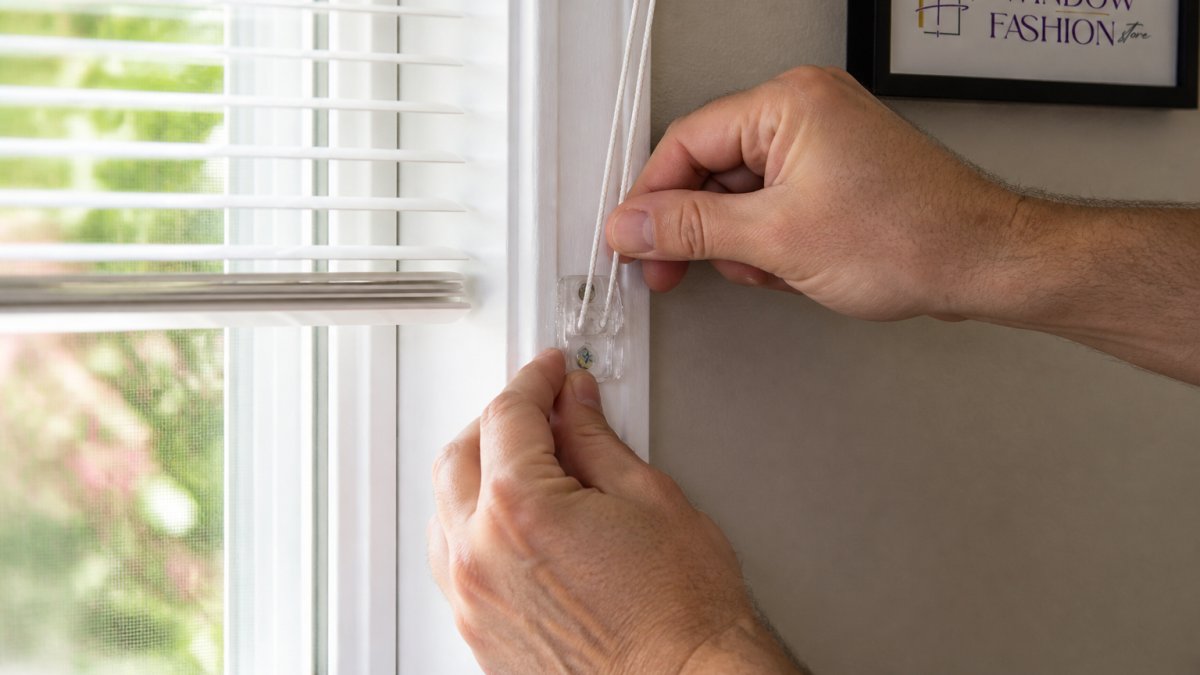
The goal is simple: keep all cords, chains, and tapes out of a child’s reach by securing them to the wall or window frame so they can’t dangle or form a loop.
Step 1: Identify Every Cord Type on the Treatment
Walk up to each window and count what is hanging. Most corded treatments use one or more of these:
- Pull cords (lift cords): single or paired cords ending in a tassel. The free end and the tassel are the hazard.
- Continuous-loop cords: a closed loop, often on a clutch or wand. The loop itself is the primary strangulation risk.
- Chains: a beaded metal or plastic chain loop, common on roller and vertical blinds. Same loop hazard as a continuous cord.
Step 2: Secure Pull Cords with a Cord Cleat
A cord cleat is a small device that holds cords tight against the wall, one of the most effective safety tools for pull cords.
- Trace the cord path: Follow where the cord runs from the headrail to its resting position.
- Choose cleat placement: Mount it high enough that a child cannot reach it, even standing on furniture.
- Secure the cleat: Use the provided screws to attach it firmly to the wall or window frame; screws hold better than adhesive on most surfaces.
- Route the cord: Wrap the cord around the cleat in a figure-eight so it stays pulled tight against the wall.
- Test the fit: Make sure the cord can’t slip out and still moves smoothly when you operate the blind.
Step 3: Anchor Continuous-Loop Cords and Chains
Continuous-loop cords and beaded chains are the highest-risk cord type because the loop is always present. Keep the loop short and under tension so it cannot be pulled away from the wall.
- Measure the loop: Pull it fully extended and note its length.
- Shorten if needed: A loose, long loop is the danger; shortening it so it stays close to the headrail reduces risk, but cutting and resealing cord is easy to get wrong.
- Seal the cut ends: If you do shorten a cord, melt the cut ends carefully so they don’t fray.
- Anchor the loop: Use a tensioner or cleat designed for loop cords so the loop stays tight against the wall at all times.
- Test operation: Confirm the blind still raises and lowers smoothly.
Never leave a continuous-loop cord or chain hanging loose and unanchored. A child can loop it around the neck in seconds. This is the most common hazard with older blinds, and it is the one to fix first.
Step 4: Deal with Tapes and Wands
Keep flat fabric tapes short and secured so they cannot form a loop. Rigid wands are generally safer for tilt and traverse because they don’t dangle. If a tape is long, loose, or frayed, secure it high on the wall.
Step 5: Run a Repeatable Safety Check
Securing a cord once is not the end of the job. Cords stretch, cleats loosen, and children grow. Use this checklist on a schedule:
- Monthly: Check that every cleat, tensioner, and anchor is firmly attached and cords are pulled tight.
- Quarterly: Look for frayed cords, cracked tassels, sagging loops, and exposed internal cords.
- After any adjustment: Re-test to confirm smooth operation and no new slack.
When a Blind Cannot Be Made Safe
Some treatments are beyond securing. Replace rather than patch if any of these are true:
- The cord is frayed, cracked, or has a broken tassel or connector.
- The loop cannot be shortened or anchored tight against the wall.
- Internal cords are exposed or the headrail is damaged.
In those cases, the safer path is a cordless or motorized replacement sized to the window. Our team measures the opening exactly and installs treatments from Hunter Douglas, Alta Window Fashions, Norman, and Texton so the new covering fits with no gaps and no accessible cords. We install and service only products purchased through our store.
The right fix depends on the cord type: cleats for pull cords, tensioners and anchors for loops and chains, and replacement when a treatment can’t be secured. A monthly and quarterly check keeps the fix working as children grow.
How to Measure Windows for Custom Child-Safe Blinds
Accurate measurements ensure your new window blinds fit perfectly and function safely; improper measurements lead to gaps, misalignment, and compromised safety features.
Measure width in three places, top, middle, and bottom of the window opening, and use the smallest measurement.
The Window Fashion Store provides professional measurement services. Our team visits your home, takes exact measurements, and ensures your custom blinds are sized perfectly for safety and function.
Always measure twice and use the smallest measurement. It’s better to have a blind that’s slightly too narrow than one with dangerous gaps.
Window Treatment Design Consultation for Your Home
Choosing child-safe window treatments is about more than safety, you want your home to look beautiful and feel right for your family. A professional design consultation helps you balance safety, style, and function. During a consultation, we can bring small sample books to your home to help you pick the right window coverings in the comfort of your own home.
We discuss your specific needs:
- Room function: Bedrooms need different solutions than living rooms
- Light control: Blackout shades or light-filtering options?
- Privacy: Some windows need more privacy than others
Our consultants recommend specific products from our partners: Hunter Douglas, Alta Window Fashions, Norman, and Texton. The consultation is free, with no obligation to purchase.
Consumer Product Safety Commission guidance on window covering hazards
Creating a Safe Window Area: Placement and Supervision
Safety isn’t just about the window coverings themselves. It’s also about how you arrange the space around your windows and how precautions change as children grow. Match the safeguard to the child’s age and stage, and treat supervision as a backup to physical safety, never a replacement for it.
Place Furniture and Sleep Spaces Away from Windows
Remove or move furniture children could climb on to reach windows. Cribs, beds, and play areas should be positioned away from windows, a child standing on a bed or crib can reach cords and chains that would otherwise be out of reach. Keep the window area clear of toys to reduce temptation.
Match Precautions to Your Child’s Age
Risk and the right safeguard change as a child develops:
- Infants and crawlers: Keep the crib away from windows, and choose cordless or motorized treatments in the nursery so there is nothing to reach even if a child stands in the crib.
- Toddlers: The highest-risk stage. Secure every cord high on the wall, anchor all loops, and re-check reach height often.
- Preschool and early school age: Children can climb deliberately and may treat cords as toys. Keep cords secured, teach simple rules about not pulling on window coverings, and keep climbable furniture away from windows.
Physical safeguards, cordless operation, anchored loops, and high-mounted cleats, protect a child in the moment you look away.
Verify Safety After Installation
A new treatment should be checked the day it goes in, not assumed safe. After installation:
- Confirm it operates smoothly through its full range with no snagging or slack.
- Check that there are no accessible cords or loops within a child’s reach.
- Confirm it fits the opening with no gaps at the sides or bottom that could expose hardware.
Keep a Simple Inspection Routine
- Monthly: Inspect cord cleats, tensioners, and anchors to make sure they’re still secure.
- Quarterly: Check that cords haven’t become loose or frayed and that loops still sit tight against the wall.
- After installation or service: Test all window coverings to confirm they operate smoothly and safely.
The safest window area combines age-appropriate physical safeguards, smart furniture placement, and regular supervision, with supervision treated as a backup to, not a replacement for, cordless operation and secured cords.
Conclusion
Child safety features for window blinds protect what matters most: your children.
The Window Fashion Store helps families across the area find window coverings that are both safe and beautiful.
Ready to upgrade your windows? Schedule a free consultation with our design team. We’ll visit your home, show you safe options in your actual space, and help you choose the perfect window treatments for your family.
Frequently Asked Questions
What are the most important child safety features for window blinds?
The most critical safety features are cordless operating systems, motorized controls, and devices that secure or shorten cords. Cordless blinds eliminate strangulation hazards entirely. If you have existing blinds with cords, cord cleats, tensioners, and anchors keep them taut and out of children’s reach. Custom window treatments designed with child safety in mind provide the best protection. Schedule a design consultation to explore options that match your home’s needs.
Are cordless blinds safer than blinds with cords?
Yes, cordless blinds eliminate the primary strangulation hazard associated with window coverings. There are no pull cords, chains, or tasseled cords to entangle a child. Cordless designs operate via a bottom rail lift system or motorized mechanism, making them ideal for homes with young children, cribs, playpens, or beds positioned near windows. They’re also easier to maintain and cleaner than corded alternatives.
Can motorized window shades improve child safety?
Motorized window shades are an excellent safety choice because they operate without any manual cords or chains. Children cannot access pull mechanisms, and the shades raise and lower at the push of a button or through automation. Motorized systems are especially valuable in bedrooms with cribs or play areas, and they offer the added benefit of convenience and modern functionality for the whole family.
How do I make my existing window blinds safer for children?
Install cord cleats or tensioners to keep cords taut and out of reach. Shorten continuous-loop cords so they cannot form a loop around a child’s neck. Use cord anchors to secure cords to the wall or window frame. Keep the area around windows clear of furniture that children could climb. Never hang cribs, beds, or playpens directly beneath or within reach of window coverings. If your existing blinds cannot be safely retrofitted, consider replacing them with cordless or motorized options.
Your family deserves windows that look great and keep everyone safe. The Window Fashion Store makes that possible with custom child-safe blinds, professional installation, and design expertise. Contact us today to book your free in-home consultation and see our beautiful Design Gallery of safe window treatment options.