


Table of Contents
- Understanding Curtain Hardware Types for Modern Spaces
- How to Measure for Curtain Rods
- Curtain Rod Length Guide for Every Window Size
- Matching Curtain Hardware Finishes to Your Design Style
- Curtain Rods for Heavy Curtains: Load Capacity and Support
- Selecting Hardware for Your Window Treatment Goals
- Getting Professional Help with Your Selection
- Frequently Asked Questions
Last Updated: October 10, 2026
Understanding Curtain Hardware Types for Modern Spaces
Choosing the right curtain hardware for modern interiors shapes how your windows look and function. At The Window Fashion Store, we help homeowners and businesses in the Kansas City area select hardware that complements their design while delivering reliable performance.
Rods vs. Tracks: Which Fits Your Design
A curtain rod is a decorative pole that holds curtains using rings, clips, or ties. A curtain track is a rail system where curtains glide on runners inside a channel.
Rods suit traditional, rustic, and eclectic interiors where the finial and bracket enhance decor. Modern spaces favor tracks because they disappear into the architecture. Curved rails bend around bay windows and corners.
Consider your window shape and interior style before deciding. A floor-to-ceiling window in a contemporary home calls for a track. A bedroom with classic furnishings benefits from a decorative rod.
Straight, Curved, and Bay Window Solutions
Straight rods and tracks mount flat against your wall. They work for most rectangular windows. Bay windows require curved rails that follow the window’s angle. These custom solutions ensure curtains hang properly across multiple planes.
Curved rails maintain smooth operation while adapting to your window’s geometry, preventing gaps and bunching that straight hardware cannot accommodate.
Measure your bay window’s angles before ordering curved hardware. A slight measurement error creates visible gaps where light leaks through.
Visit our Design Gallery to see how curved rails work in different bay window configurations. Our team can bring sample books to your home during an in-home design consultation.
How to Measure for Curtain Rods
Accurate measurements prevent costly mistakes and ensure curtains hang properly and close fully without interfering with trim.
Measuring Width and Determining Overhang
Measure the width of your window frame from left to right edge.
Add overhang on both sides, how far the rod extends beyond the window frame.
For a 36-inch window with 6-inch overhang on each side, your rod length is 48 inches. The formula is: window width + (overhang × 2) = rod length.
Measure three points across your window: top, middle, and bottom. If measurements differ by more than ½ inch, use the widest measurement to ensure full coverage.
Accounting for Window Depth, Projection, and Obstacles
Projection is how far your brackets extend from the wall. Measure the depth of your window frame from the wall surface to the front edge. If crown molding or trim sits above the window, measure to its outermost edge.
Standard projection ranges from 2 to 3.5 inches; heavy-duty brackets project 3 to 4 inches. Deep trim or crown molding requires 4 to 5 inches of projection.
Blackout curtains typically add 1 to 1.5 inches of depth when hung, requiring more projection than lightweight sheers.
Accounting for Wall Mounting Surfaces
Your wall type affects bracket placement. Drywall allows flexible placement; masonry and plaster may require special anchors.
Locate wall studs using a stud finder, they’re typically 16 inches apart and provide the strongest mounting surface. Position at least one bracket over a stud and mark locations with a pencil.
If studs don’t align with your ideal placement, use heavy-duty anchors rated for your curtain weight.
For windows near corners, if bracket placement falls within 6 inches of a corner, shift your measurement to avoid framing complications or use shorter overhang.
Recording and Double-Checking Measurements
Write down all measurements and sketch a simple diagram. Measure twice and have a second person verify if possible, a ½-inch error can cause visible problems.
The Window Fashion Store provides exact measurements during in-home design consultations. Our team uses professional tools, accounts for your wall type and obstacles, and confirms bracket placement before ordering. Schedule a free consultation to have our design team measure your windows and recommend the right rod length and projection.
Curtain Rod Length Guide for Every Window Size
Rod length determines how your curtains hang and function, too short leaves gaps, too long overwhelms the space.
Standard Windows and Floor-to-Ceiling Applications
Standard windows (24 to 48 inches wide) work well with a rod extending 4 to 8 inches beyond each side. Floor-to-ceiling curtains create drama and make rooms feel taller, mount your rod as close to the ceiling as possible to maximize visual height.
For a 60-inch-wide window with 6-inch overhang on each side, order a 72-inch rod. This gives balanced proportions and full coverage.
Longer rods make small rooms feel bigger. Mount hardware high and extend it wide for maximum impact.
Wide and Tall Windows: Support and Sizing
Wide windows (over 72 inches) need center support brackets to prevent sagging and keep curtains hanging evenly.
Tall windows benefit from floor-to-ceiling treatment with curtains that reach the floor or pool slightly.
For very wide windows, consider two separate rods instead of one long one to simplify installation and reduce hardware stress.
Matching Curtain Hardware Finishes to Your Design Style
Hardware finishes anchor your interior design. The right finish ties your curtains to other elements in the room.
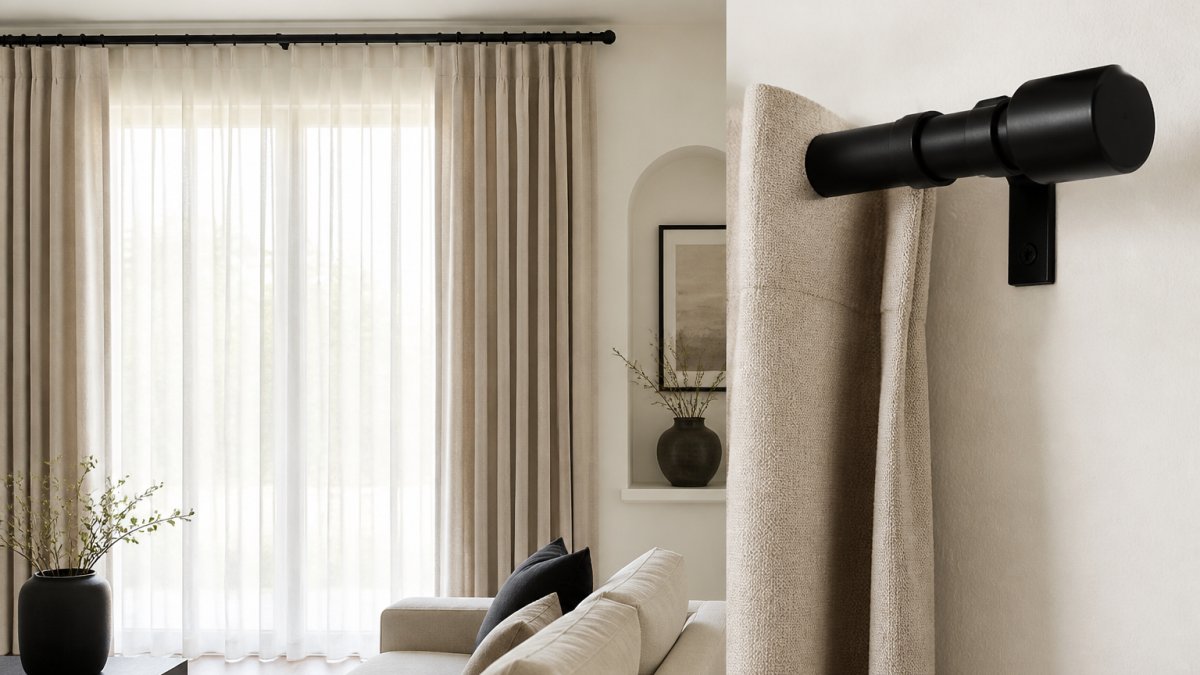
Metal Finishes and Decorative Options
Common finishes include black (modern/industrial), brushed nickel (contemporary/minimalist), oil-rubbed bronze (traditional), and polished brass (eclectic/mid-century). Finials are decorative end caps that range from simple spheres to ornate designs and reinforce your aesthetic.
Match your hardware finish to other metals in the room. If your door handles are brushed nickel, choose brushed nickel brackets and finials. Mixing finishes creates visual confusion. Consistency creates harmony.
Coordinating with Interior Elements
Match hardware to your wall color, furniture, and accent pieces. Consider whether you want the rod to blend (dark curtains on dark hardware) or create contrast (light curtains on dark hardware).
The Window Fashion Store carries hardware from Hunter Douglas, Alta Window Fashions, Norman, and Texton. Each brand offers finishes designed to coordinate with modern interiors. Our Design Gallery displays these options at full size so you can see how they look in your space.
Curtain Rods for Heavy Curtains: Load Capacity and Support
Heavy curtains demand strong hardware. Blackout curtains, velvet drapes, and lined fabrics weigh significantly more than sheers. Selecting the wrong rod or bracket placement leads to sagging, wall damage, and hardware failure.
Understanding Weight Ratings and Bracket Selection
Every rod has a weight capacity. Standard rods support 20 to 50 pounds; heavy-duty rods support 75 to 150 pounds or more. Decorative finials and bracket construction affect this rating.
Calculate your curtain weight before choosing hardware. Blackout curtains for a 48-inch window weigh 8 to 15 pounds; for 96 inches, expect 16 to 30 pounds. Lined velvet drapes can exceed 40 pounds.
Select brackets rated for at least 50% more than your curtain weight. If your curtains weigh 20 pounds, use brackets rated for 30 pounds or higher.
Bracket Spacing and Center Support Rules
Bracket spacing determines weight distribution. Standard spacing is 16 to 24 inches for lightweight curtains; heavy curtains require 12 to 16 inches to prevent bowing.
Rods over 72 inches must use a center support bracket to prevent sag. For a 96-inch rod, place brackets at left, center (48 inches), and right to distribute weight evenly.
For rods exceeding 120 inches, use two center support brackets at 40-inch intervals to maintain level hang.
Wall Type and Anchor Selection
Drywall walls use toggle bolts or heavy-duty anchors for rods up to 50 pounds per bracket.
Masonry and brick walls require masonry anchors or expansion bolts that expand behind the surface.
Plaster walls (common in older homes) are fragile. Use toggle bolts or specialized plaster anchors rather than standard drywall anchors.
Wood-framed walls (less common in modern interiors) can support the heaviest loads.
Finding studs is essential for heavy curtains. Use a stud finder to locate framing behind drywall. Mark stud locations with a pencil before drilling.
Quality Hardware and Long-Term Performance
Quality hardware lasts decades. Cheap brackets bend under weight, and low-grade rods develop permanent sag. Premium brackets from trusted manufacturers maintain their shape and function for years, even under continuous heavy-curtain use.
The Window Fashion Store provides professional installation with products purchased through our store. Our team locates studs, selects appropriate anchors for your wall type, spaces brackets correctly, and verifies that your hardware is rated for your curtains’ weight. We handle exact measurements during consultations. Schedule a free in-home design consultation to discuss your curtain weight and wall conditions.
Selecting Hardware for Your Window Treatment Goals
Your hardware choice affects how well your curtains perform their intended function.
Light Control and Blackout Considerations
Sheer curtains filter light while maintaining privacy. They require lightweight hardware because the fabric is thin and light. Standard rods with simple brackets work well.
Blackout curtains block light completely. They’re heavier and need sturdy hardware. Pair blackout fabric with heavy-duty rods and center support brackets.
The gap between your curtains and the wall lets light through. Wider overhang reduces this gap. Deeper projection keeps curtains away from the wall surface.
Thin rods bend under blackout curtain weight. Always verify your rod’s weight rating matches your fabric choice.
Accessibility and Ease of Operation
Consider who will operate your curtains. Heavy curtains are difficult for children or elderly people to move. Lightweight fabrics and smooth-gliding hardware make daily use easier.
Motorized hardware removes the physical effort entirely. Smart curtains open and close on schedule or voice command. They suit busy households and accessibility needs.
The Window Fashion Store offers motorized blinds and shades through our partnership with quality manufacturers. We can discuss motorized options during your free consultation.
Getting Professional Help with Your Selection
Choosing hardware involves multiple decisions. Width, length, finish, weight capacity, and style all matter. Professional guidance prevents costly mistakes.
Our team at The Window Fashion Store has over 20 years of experience helping Kansas City homeowners and businesses select window treatments. We offer in-home design consultations where we bring sample books and show you options in your actual space. This removes guesswork from the process.
We measure your windows precisely and recommend hardware that fits your style and budget. We handle professional installation of products purchased through our store.
Selecting the right curtain hardware transforms your windows from functional to fabulous. Schedule a free consultation today and bring your window vision to life with custom window treatments from Hunter Douglas, Alta Window Fashions, Norman, and Texton. Visit our website or call to book your appointment with our design team.
Frequently Asked Questions
How do I choose the right curtain hardware for my windows?
Start by identifying your window size, the weight of your curtains, and your interior design style. Measure your window width and height, then select a rod or track with appropriate load capacity for your curtain fabric. Consider whether you prefer visible decorative hardware or a minimal track system. Our Design Gallery displays every product option available, and a free in-home consultation lets you see samples in your actual space before deciding.
What’s the difference between curtain rods and tracks for modern interiors?
Curtain rods are decorative and visible, making them ideal when you want hardware to complement your design. Tracks are concealed above the window, offering a clean, minimalist look. For modern interiors, both work well depending on your preference. Rods come in various finishes and styles; tracks provide a streamlined appearance. Your choice depends on whether you want the hardware as a design feature or hidden from view.
How do I measure for curtain rods correctly?
Measure the window width and add 8 to 12 inches for overhang on each side to allow curtains to fully clear the glass when opened. Measure the desired height from where you’ll mount the rod to the floor or sill. Account for the rod’s diameter and bracket depth to ensure curtains hang properly. Professional measurement ensures exact fit and optimal light control. Schedule a free consultation to have our team measure your windows and confirm all dimensions.
What curtain rod finish works best with modern decor?
Modern interiors typically feature black, brushed nickel, or matte finishes that complement contemporary design. Choose finishes that coordinate with other metal elements in your room, such as door hardware or light fixtures. Neutral metallic finishes work with most color schemes. Consider your wall color and furniture style when selecting. Our in-home design consultations help you coordinate finishes with your existing décor and see samples in your space.