


Table of Contents
- Why Commercial Window Blinds Matter for Office Buildings
- Types of Commercial Window Blinds and Their Applications
- Energy Efficient Office Window Treatments and Heat Reduction
- Commercial Roller Shades for Offices: Light Filtration and Glare Control
- Motorized Commercial Blinds Benefits and Smart Building Integration
- Durability, Safety Standards, and Maintenance Requirements
- Custom Sizing and Mounting Options for Odd-Shaped Windows
- Design Gallery and Professional Consultation Process
- Frequently Asked Questions
Last Updated: September 23, 2026
Why Commercial Window Blinds Matter for Office Buildings
Commercial window blinds are essential infrastructure for modern workplaces. They control light, manage heat, protect privacy, and create environments where employees can actually focus on their work instead of squinting at glare or feeling exposed to the street.
Proper light control, thermal management, and privacy increase productivity, reduce energy costs, and create intentional spaces where employees stay comfortable.
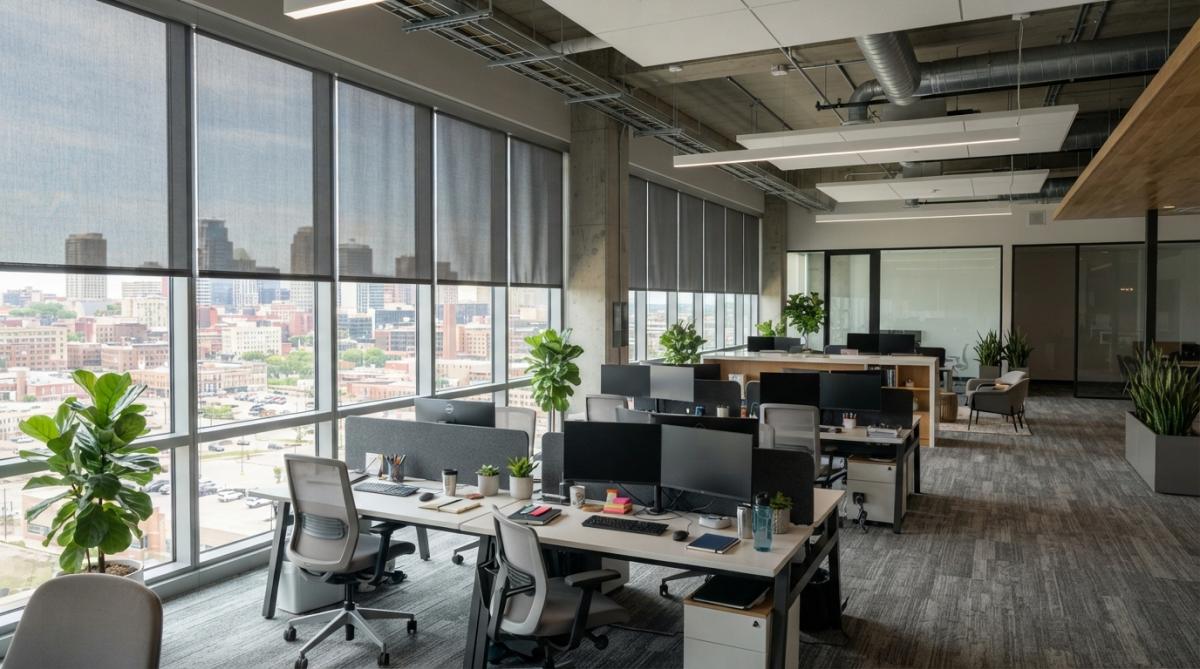
Commercial window blinds are engineered for durability, safety compliance, and the demands of shared spaces.
Types of Commercial Window Blinds and Their Applications
Roller Shades for Modern Offices
Roller shades dominate commercial installations: they’re clean, reliable, and disappear when raised. Light-filtering fabrics block glare while maintaining views; room-darkening cuts 90% of light; blackout is essential for conference rooms. Commercial-grade hardware resists fading and operates thousands of times without degradation. They’re cost-effective across multiple floors because components are standardized.
Venetian Blinds for Light Control
Venetian blinds offer granular light control by adjusting slats to any angle. They require more frequent cleaning than roller shades but deliver unmatched directional light control. Aluminum slats are durable, fire-resistant, fade-proof, and easy to wipe clean, ideal for spaces where occupants adjust light throughout the day.
Vertical Blinds for Large Windows
Vertical blinds work on very large windows and glass walls where horizontal slats are impractical. Panels draw open and closed like curtains with blind-like light control. Dust settles less aggressively on vertical surfaces, and they’re easier to operate on extremely wide windows. They’re ideal for specific applications like conference rooms with glass walls.
Cellular Shades for Thermal Performance
Cellular shades trap air in honeycomb structures to insulate windows, reducing heat loss in winter and heat gain in summer. Available in single-cell, double-cell, or triple-cell configurations with room-darkening or semi-sheer fabrics. They require periodic vacuuming but deliver measurable energy savings, especially in buildings pursuing LEED or sustainability certifications.
Energy Efficient Office Window Treatments and Heat Reduction
Windows account for 25-30% of summer cooling costs and significant winter heat loss. Commercial roller shades with reflective backing reduce solar heat gain; cellular shades insulate; motorized blinds can be programmed to close during peak solar hours or respond to temperature and occupancy sensors.
Connection to LEED and WELL Building Certifications
Facility managers pursuing Leadership in Energy and Environmental Design (LEED) certification or WELL Building Standard certification should understand how window treatments contribute to these credentials.
For LEED v4.1, automated or manually operable shades support the Daylighting and Views credit by allowing occupants to control daylight and glare while maintaining views. High-performance window treatments reduce solar heat gain, supporting the Energy and Atmosphere credit by lowering cooling loads.
For WELL Building Standard, window treatments support Light Quality and Circadian Rhythm credits. Light-filtering shades maintain views while reducing glare; motorized systems programmed to follow circadian-aligned schedules (opening in the morning, adjusting during peak sun, dimming in the afternoon) support healthy light exposure and occupant health.
Thermal Performance by Blind Type
Different blind types deliver different thermal performance levels:
Cellular Shades: Most thermally efficient; single-cell provides basic insulation, double-cell better performance, triple-cell maximum resistance.
Roller Shades with Reflective Backing: Reduce solar heat gain by reflecting sunlight; most effective on south- and west-facing windows.
Venetian Blinds: Moderate thermal performance; slats allow air circulation. Ability to tilt slats lets occupants optimize light and heat throughout the day.
Vertical Blinds: Similar to venetian blinds; most effective when fully closed.
Integration with Building Management Systems
Motorized blinds integrated with Building Management Systems can respond to outdoor temperature sensors, solar radiation sensors, occupancy sensors, and time-of-use schedules to optimize thermal performance automatically. This ensures consistent performance across the building without relying on manual adjustment and provides facility managers with operational data to optimize energy performance over time.
Commercial Roller Shades for Offices: Light Filtration and Glare Control
Direct sunlight on computer screens causes eye strain and reduced contrast. Commercial roller shades with light-filtering fabric diffuse incoming light to soften glare while maintaining visibility and natural light benefits. Light filtration is the middle ground between glare control and blackout darkness. Commercial-grade fabrics maintain color consistency for years, directly affecting occupant experience.
Motorized Commercial Blinds Benefits and Smart Building Integration
Motorized blinds respond to schedules, sensors, or building management systems. They close during peak sun hours automatically, adjust based on occupancy, and integrate with smart controls. For facility managers, motorization ensures uniform positioning across floors. For occupants, blinds optimize automatically without manual adjustment. Higher initial cost can be offset by operational savings, reduced energy consumption, fewer maintenance requests, and improved comfort.
Durability, Safety Standards, and Maintenance Requirements
Commercial window blinds must meet rigorous fire safety codes and structural standards that residential products do not. The fabrics and materials need to pass NFPA 701 (Standard Methods of Fire Tests for Flame Propagation of Textiles and Films) or equivalent flame-spread ratings. The hardware must support repeated daily operation, often 10+ cycles per day in high-traffic areas, without mechanical failure. Installation must be secure enough to withstand seismic events, high wind loads, and the constant adjustment cycles of a busy office environment.
Compliance and Safety Standards
Fire safety is non-negotiable in commercial buildings. Most jurisdictions require window treatments to meet NFPA 701 standards, which measure how quickly flames spread across fabric. Cellular shades, roller shade fabrics, and vertical blind materials all carry flame-spread ratings. When specifying blinds for your building, verify that the fabric meets your local fire code, this is especially critical in healthcare facilities, schools, and high-occupancy buildings where fire safety codes are stricter.
Maintenance Protocols and Cleaning Schedules
Monthly: Visual inspection for visible dust, damage, or mechanical issues. Spot-check motorized systems for smooth operation.
Durability Advantages of Commercial-Grade Products
When you work with a professional installer who measures precisely and installs according to manufacturer specifications, you also eliminate common failure points: blinds that bind on trim, hardware that’s undersized for the window, or fabric that’s stretched incorrectly during installation. Proper installation extends the life of the blinds and ensures they perform as designed.
Custom Sizing and Mounting Options for Odd-Shaped Windows
Not every office window is a standard rectangle. Some buildings have angled windows, curved glass, or irregular shapes. Some have deep frames or shallow frames. Some need to fit between existing trim without modifications.
Design Gallery and Professional Consultation Process
Choosing the right commercial window blinds requires understanding your specific needs: light control requirements, thermal performance goals, aesthetic preferences, maintenance capacity, and budget constraints.
Frequently Asked Questions
What type of blinds are best for an office space?
The best choice depends on your office layout and needs. Roller shades work well for modern offices needing clean aesthetics and light filtration. Venetian blinds offer precise glare reduction for computer screens. Cellular shades provide superior energy efficiency and thermal performance. Vertical blinds suit large windows and open-plan offices. Custom commercial window blinds tailored to your specific windows and workspace requirements deliver the best long-term value and professional appearance.
How do commercial roller shades for offices improve productivity?
Commercial roller shades reduce glare on computer screens, a major source of eye strain and headaches. They provide consistent light filtration throughout the day, maintaining comfortable brightness levels without harsh shadows. By controlling daylighting and thermal heat gain, they create an ergonomic workspace where employees stay focused. Blackout options allow for presentations and video calls without external distractions, while solar screens protect against UV damage to furnishings and equipment.
What energy efficiency benefits do window treatments provide in office buildings?
Energy efficient office window treatments reduce heat gain in summer and heat loss in winter, lowering HVAC costs significantly. Cellular shades with honeycomb construction trap air, improving thermal performance. Motorized blinds can be programmed to close during peak sun hours, minimizing solar heat gain. This reduces your building’s overall energy consumption, supports LEED certification goals, and creates a more comfortable occupant environment year-round, directly impacting facility management budgets.
Are motorized commercial blinds benefits worth the investment?
Motorized commercial blinds integrate with building management systems for automated light and temperature control throughout the day. They eliminate manual adjustments, reduce maintenance wear on hardware, and provide consistent performance across large installations. Smart integration allows scheduling based on occupancy and sun position, maximizing energy savings. For office buildings with 40+ windows or facilities prioritizing occupant comfort and operational efficiency, motorization delivers measurable returns through reduced energy costs and improved workplace productivity.
What safety standards apply to commercial window coverings?
Commercial window coverings must meet fire retardant standards and cordless safety requirements per commercial building codes. All commercial-grade materials used in office buildings should be tested for flame spread and smoke development. Cordless designs prevent entanglement hazards in high-traffic areas. Professional installation ensures proper mounting and compliance with local building codes. When you work with authorized dealers of quality manufacturers, you receive products that meet all applicable safety regulations and come with proper documentation.
How do custom window treatments improve office aesthetics?
Custom window treatments create a cohesive, professional appearance that reflects your company’s brand and culture. They eliminate light gaps and uneven coverage that cheap off-the-shelf options create, presenting a polished facade both inside and out. Customization allows you to select colors, fabrics, and styles that complement your office design and architectural features. Professional installation ensures precise fit and function, while durable commercial-grade materials maintain their appearance for years, enhancing the overall value and professionalism of your workspace.
What factors should I consider when selecting blinds for large office windows?
For large windows, consider the window size, mounting options (inside or outside mount), and whether motorization is practical. Vertical blinds and roller shades handle large expanses better than venetian blinds. Evaluate light filtration needs, how much privacy and glare control do you need? Assess thermal performance requirements and whether energy efficiency is a priority. Think about maintenance access and cleaning protocols for hard-to-reach windows. Professional measurement and consultation ensure your custom selections actually fit your space and solve your specific challenges.