


Last Updated: October 22, 2026
Quick Summary
Custom drapery lining options for energy efficiency reduce heat loss in winter and block unwanted heat gain in summer through reflective coatings, trapped air layers, and dense materials. Thermal linings work year-round by bouncing warm air back into rooms and reflecting solar radiation outward, while blackout linings provide superior insulation and total light control for bedrooms and media rooms.
- Thermal lining with reflective backing performs best in climates with significant seasonal temperature swings and works year-round through different mechanisms.
- Blackout drapery lining delivers total darkness and superior insulation but is heavier and requires sturdy hardware and professional installation.
- Floor-to-ceiling coverage, side returns, center overlap, and pelmets are installation details that determine whether a lining measurably reduces heat transfer.
- West-facing windows benefit most from blackout or heavily coated thermal lining due to intense afternoon sun; north-facing windows need minimal thermal treatment.
- Proper measurement and professional installation ensure your custom drapery performs as intended, book a consultation to assess your specific windows and climate.
Table of Contents
- How Custom Drapery Lining Improves Energy Efficiency
- Drapery Lining Types and Their Performance
- Thermal Drapery Lining for Winter and Summer
- Blackout Drapery Lining: Light Control and Insulation
- How to Measure for Custom Drapes with Proper Lining
- Choosing the Right Lining for Your Climate and Windows
- Installation and Long-Term Care
- Frequently Asked Questions
How Custom Drapery Lining Improves Energy Efficiency
Custom drapery lining options for energy efficiency transform how your home manages temperature year-round.
At The Window Fashion Store, we’ve helped homeowners across the region understand that drapery lining is one of the most overlooked tools for energy management.
The science is straightforward: air moves from warm to cold.
This matters most in bedrooms and media rooms, where precise light and temperature control improves sleep and picture quality.
Drapery Lining Types and Their Performance
Each lining type performs differently based on material, thickness, and coating.
Standard Uncoated Lining
Standard uncoated lining is a plain cotton or cotton-blend fabric sewn to the back of your drapery. It protects fabric from sun fading, adds slight weight for clean draping, and provides basic daytime privacy, but it offers minimal thermal performance, so it suits mild climates and rooms where energy efficiency is secondary to aesthetics.
Coated and Thermal Lining
Coated thermal lining features a reflective backing that creates a thermal barrier, bounces heat back into your room during winter, and blocks incoming summer heat through a dense weave. It measurably reduces drafts, improves temperature consistency, and protects fabric from UV damage, performing best in climates with significant seasonal temperature swings.
Blackout and Specialty Linings
Blackout drapery lining uses dense, opaque, multi-layer material for total darkness, superior insulation, maximum privacy, and significant reduction in summer heat gain. Specialty fire-retardant options meet safety codes for commercial and some residential spaces. Trade-offs: blackout is heavier and needs sturdy hardware, the dark lining is visible when drapery is open, and cost is higher than standard or thermal options.
Thermal Drapery Lining for Winter and Summer
In winter, thermal lining creates dead air space between lining and glass, and the reflective coating bounces warm air back into the room instead of letting it escape.
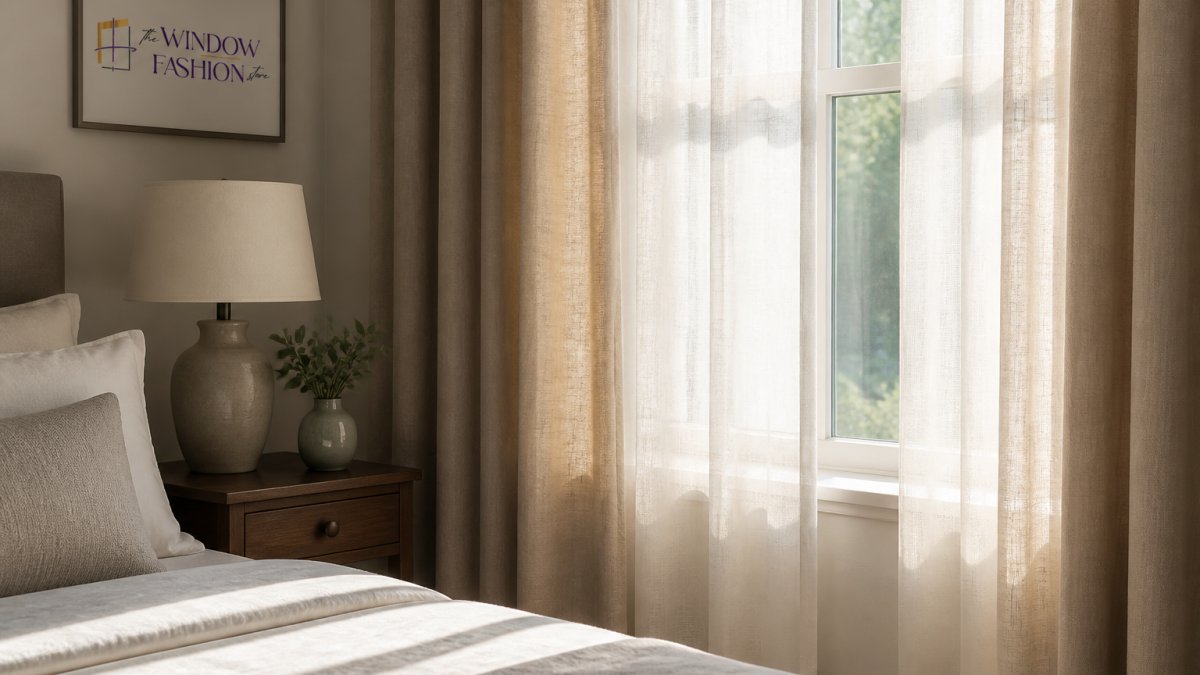
In summer, sunlight hits the coating before reaching the glass and much of that energy reflects away, so your air conditioning works less, especially valuable in south- and west-facing rooms with intense afternoon sun.
The key insight: thermal lining works year-round, but the mechanism changes, winter performance depends on reflection, summer performance on blocking.
Blackout Drapery Lining: Light Control and Insulation
Blackout drapery lining delivers total light control and superior insulation together.
Light control is the primary reason most people choose it: blackout blocks virtually all incoming light, which matters for bedrooms disrupted by early sun, media rooms needing darkness, shift workers sleeping in daylight, and spaces where privacy is essential.
Insulation comes from the lining’s density and thickness, the material that blocks light also blocks heat transfer, so blackout typically outperforms thermal lining in both winter and summer.
How to Measure for Custom Drapes with Proper Lining
Accurate measurements are essential, incorrect ones lead to gaps, poor light blocking, and reduced energy efficiency.
Measure your window opening:
- Measure width at the top, middle, and bottom of the frame
- Use the smallest measurement to account for uneven frames
- Measure height from frame top to the sill (or floor for floor-length drapery)
- Record measurements in inches
Determine coverage: wall-to-wall and floor-to-ceiling drapery provide maximum thermal benefit, and extending beyond the frame on both sides reduces light leakage.
Account for lining thickness: thermal and blackout linings add bulk, so confirm your drapery width accommodates it.
Mounting: outside mounting provides better light blocking and insulation; inside mounting works for shallow windows or tight spaces.
| Measurement Type | What to Record | Why It Matters |
|---|---|---|
| Window width | Smallest of top, middle, bottom | Ensures proper fit without gaps |
| Window height | Frame top to desired hem point | Determines fabric yardage needed |
| Rod placement | Inside or outside frame | Affects light blocking and thermal performance |
| Lining choice | Thermal, blackout, or standard | Impacts fabric weight and hardware requirements |
Choosing the Right Lining for Your Climate and Windows
Most lining guides stop at “thermal for cold, blackout for hot.” The right lining depends on three variables working together: your climate zone, each window’s orientation, and how you use the room.
Start with the mechanism, not the label
Every lining option manages heat in one of three ways:
- Reflective barrier, a coated backing bounces radiant heat back toward its source, keeping interior warmth in during winter and reflecting solar radiation out during summer.
- Trapped air layer, the gap between lining and glass, plus fabric loft, slows conductive heat transfer. This is why a properly sealed, floor-to-ceiling drape outperforms a short curtain even with identical fabric.
- Opaque mass, dense blackout construction blocks solar radiation that would otherwise heat the glass and radiate inward.
A lining combining all three (a coated, densely woven blackout with an interlining layer) outperforms single-mechanism linings in almost every climate. The trade-off is weight, cost, and visual bulk when open.
Match lining to window orientation
Orientation determines when and how much solar energy hits each window, which changes what the lining needs to do.
| Orientation | Dominant load | Best-performing lining | Why |
|---|---|---|---|
| North | Diffuse light, minimal direct sun | Standard uncoated or light thermal | Direct solar gain is low; prioritize fabric protection and privacy over heavy insulation |
| South | High winter sun, moderate summer sun | Thermal with reflective coating | Captures passive solar heat in winter when open; reflects summer gain when closed |
| East | Moderate morning sun | Thermal | Morning heat is real but short-lived; thermal balances control and daylight |
| West | Intense afternoon sun | Blackout or coated thermal | Afternoon sun drives the largest cooling load; maximum blocking pays off |
A common pattern in mixed-orientation homes is to specify different linings per room rather than one lining throughout. A west-facing living room and a north-facing guest room rarely need the same treatment.
Climate-zone decision guide
Cold-dominant climates: prioritize heat retention with coated thermal or blackout lining on north- and west-facing windows.
Hot-dominant climates: prioritize solar rejection with blackout or heavily coated thermal lining on west- and south-facing windows. East-facing windows benefit from thermal lining to blunt morning heat without going fully dark.
Mixed climates: a coated thermal lining is the most versatile single choice because it reflects heat in both directions. Blackout works if the room’s use (bedroom, media room) justifies the darkness trade-off.
Factor in room use
- Bedrooms: blackout for sleep quality; thermal if morning light is acceptable.
- Media rooms: blackout for screen contrast and light control.
- Living and dining rooms: thermal with a light-colored lining preserves daytime ambiance while managing heat.
- Home offices: thermal balances daylight for video calls with glare and heat control.
A note on expectations
Lined drapery is one layer of a window’s performance. It reduces heat transfer and solar gain but does not replace glazing upgrades, air sealing, or insulation, which is why installation details matter as much as the lining choice itself.
Bring your window orientations and a rough sense of your seasonal utility patterns to a consultation. Seeing lining samples against your actual light conditions is the fastest way to confirm a choice that looks right on paper.
The Window Fashion Store team can assess your specific windows and climate to recommend the best lining for each room. We bring sample books to your home so you can see how different linings look and perform in your actual spaces.
Installation and Long-Term Care
A premium lining only performs as well as its installation. The details that separate a drape that measurably reduces heat transfer from one that merely looks finished are coverage, side returns, overlap, and gap control.
Installation details that determine efficiency
The lining’s thermal performance depends on how completely it separates the interior from the window. Air moves through gaps, so every gap is a leak in the barrier.
Floor-to-ceiling coverage. A drape that stops at the sill leaves glass and the wall above it exposed to convective air movement.
Side returns. The portion of the drape that wraps back toward the wall at each edge closes the gap that would otherwise let air slip around the sides.
Hardware rated for weight. Lined, interlined, and blackout drapery is heavy.
Gaps at the top, sides, and center are the most common reason a thermal lining underperforms. If you can feel air moving at the edge of a closed drape, the barrier is compromised regardless of the lining’s rating.
Care that preserves performance
- Vacuum gently with an upholstery brush attachment to remove dust without abrading the coating.
- Avoid machine washing unless the manufacturer explicitly permits it; coatings and interlinings can degrade in water and heat.
- Dry clean when needed to preserve both face fabric and lining integrity.
- Operate gently, pull cords and wands smoothly to avoid straining seams where lining meets face fabric.
- Address small issues early, a loose seam or a sagging ring is easier to correct before it distorts the drape’s hang.
Lifespan and environmental considerations
Quality custom drapery with a properly specified lining commonly lasts a decade or more, and the lining holds its performance because the face fabric shields it from direct UV exposure. Worth planning for:
- Replaceable linings. Some constructions allow the lining to be replaced separately, extending the assembly’s useful life and reducing waste.
- Material durability. Natural-fiber linings breathe and drape well but are more moisture-sensitive; synthetic and coated linings resist moisture and hold reflective properties longer in humid rooms.
- End-of-life. Natural-fiber and some synthetic linings can be recycled in some markets; coated and blackout linings are harder to recycle. Matching the lining to the room’s real needs avoids over-specifying.
Why professional installation matters here
Returns, overlap, pelmet fit, and rod projection are measured and fitted details requiring exact window measurements and hardware selected for the finished weight of the lined drape. At The Window Fashion Store, we measure precisely, specify hardware for the assembly, and install so the lining seals as intended. We install and service only products purchased directly through our store, Hunter Douglas, Alta Window Fashions, Norman, and Texton, so fit and performance stay consistent from measurement through installation.
The lining does the insulating; the installation does the sealing. Floor-to-ceiling coverage, side returns, center overlap, and a pelmet are the details that turn a good lining into a measurable barrier.
Frequently Asked Questions
Which drapery lining is best for energy efficiency?
Custom window treatments can add an insulating layer that reduces heat transfer through windows. Options with a reflective backing also help by bouncing heat back into the room during winter and reflecting it away in summer. The best choice depends on your climate, window orientation, and whether you prioritize light control or insulation. A design consultation can help match the right custom window treatment to your specific needs.
How do thermal drapery linings help insulate a room?
Custom window treatments can create a dead air space between the window treatment fabric and your window, which slows heat transfer. This barrier reduces drafts and minimizes the temperature difference between your interior and the glass surface. In cold climates, custom window treatments keep warm air inside; in warm climates, they can reflect solar heat away from living spaces. The thickness and material density of the custom window treatment determine how effective this insulation becomes.
Can lined drapes help keep a room cooler in summer?
Yes. Custom window treatments can reflect solar radiation away from windows, reducing the heat that enters your home during warm months. When paired with properly fitted custom window treatments that cover the entire window frame without gaps, they can noticeably lower cooling costs. The effect is strongest on south and west-facing windows that receive direct afternoon sun.
What is the difference between thermal and standard drapery lining?
Custom window treatments can protect fabric from fading and dust. Some custom window treatments are thicker, often with a reflective coating, and actively reduce heat transfer through windows. Custom window treatments can offer insulation and light-blocking properties with thermal benefits, making them ideal for bedrooms and media rooms where both privacy and temperature control matter.
