


Table of Contents
- Why Drafty Old Windows Lose Heat and What Custom Treatments Fix
- Energy Efficient Shades for Homes: Cellular, Thermal, and Insulating Liners Compared
- How to Measure Windows for Custom Shades So the Fit Actually Seals
- Benefits of Motorized Window Treatments for Hard-to-Reach Old Windows
- Custom Fit vs. Ready-Made: What Drafty Old Windows Actually Need
- Durability, Moisture, and Maintenance in Older Homes
- Conclusion: Book a Design Consultation Before You Buy
- Frequently Asked Questions
Last Updated: September 21, 2026
Why Drafty Old Windows Lose Heat and What Custom Treatments Fix
Custom window treatments for drafty old windows solve a problem caulk can’t touch: the gap between what a frame actually is and what a standard-size covering assumes. At The Window Fashion Store, we’ve spent over 20 years measuring frames that are out of square and out of plumb.
How Air Infiltration and Thermal Resistance Work in an Old Sash Window
Air infiltration is outside air moving through gaps in a window assembly. Thermal resistance, measured as R-value, describes how well a material slows heat transfer. On a single-pane sash window, both work against you at once.
What to Fix Before You Buy: Weatherstripping, Sealing, and an Energy Audit
Weatherstripping and sealing come first. A covering over an unsealed frame is a curtain over an open door.
- Check the meeting rail where the upper and lower sashes meet, a common leak point
- Inspect the sash channels and the perimeter where frame meets wall
- Test for air movement on a windy day with a lit incense stick or your hand
- Address gaps with weatherstripping rated for the gap size before ordering anything
Energy Efficient Shades for Homes: Cellular, Thermal, and Insulating Liners Compared
Energy efficient shades for homes fall into three practical categories, and the right one depends on your window’s construction, not a spec sheet. Cellular shades lead on thermal performance; thermal curtains add a fabric layer with an insulating liner; window quilts offer the heaviest barrier for extreme cases.
| Option | How It Insulates | Best For | Trade-off |
|---|---|---|---|
| Cellular (honeycomb) shades | Trapped air in cells | Most drafty windows | Cells can collect dust |
| Thermal curtains with liners | Fabric plus insulating liner | Large or arched windows | Bulkier stack-back |
| Window quilts | Multi-layer quilted barrier | Severe drafts, historic homes | Heaviest look |
| Insulating liners (add-on) | Extra layer behind existing | Retrofits | Adds weight to hardware |
The cell size matters less than the mounting. A 3/4-inch single-cell shade mounted outside the frame with side channels will outperform a 1.5-inch double-cell shade floating inside a loose mount. Ask about side tracks and mounting hardware before you compare cell counts.
How to Measure Windows for Custom Shades So the Fit Actually Seals
Knowing how to measure windows for custom shades is the difference between a covering that seals and one that merely hangs. On an old frame, measurement is only half the job, the other half is choosing a mount that compensates for the frame’s irregularities.
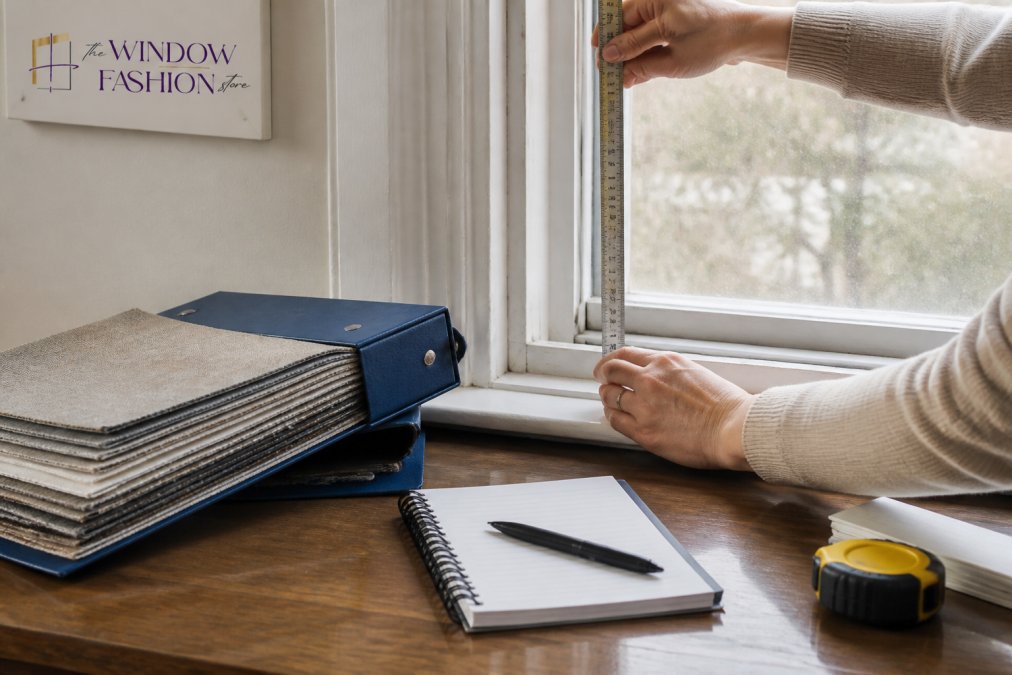
The Three-Point Measurement, and What the Numbers Tell You
Measure width at top, middle, and bottom, and use the narrowest number. Measure height at left, center, and right, and use the longest. Old frames are rarely square, and a single measurement will betray you.
- Under 1/8 inch variance: the frame is effectively square. Inside mount is viable if depth allows.
- 1/8 to 1/4 inch variance: borderline. Outside mount with overlap is the safer call.
- Over 1/4 inch variance: the frame is visibly out of square. Inside mount will leave a light gap no matter how the shade is sized. Outside mount is the only path to a seal.
Inside Mount vs. Outside Mount on Non-Standard and Historic Frames
Inside mount tucks the shade into the frame recess. It looks cleaner and preserves the window’s lines, but it demands a square, deep frame and seals only at the recess perimeter, not a continuous line on a warped frame.
How Side Channels and Fascias Actually Block the Draft
A shade mounted with a plain bracket seals only at the top and bottom. The left and right edges stay open, and on a drafty window those vertical edges are where cold air moves most.
Measuring to the nearest eighth of an inch “just to be safe” on an outside mount leaves a visible light gap and a draft path. Measure to the sixteenth, and let the fabricator add the overlap. Guessing wide does not fix an out-of-square frame, it just moves the gap.
What to Bring to the Measurement
A few things make the measurement usable:
- Note the mount type (inside or outside) before measuring, the two require different numbers
- Record frame depth at the shallowest point, not the deepest
- Note the wall material at the mounting points (plaster, drywall, historic casing) so the right hardware is selected
- Photograph the frame corners, fabricators can often spot an out-of-square condition from a photo
If your frame is out of square and you want the cleanest possible seal, ask about outside mount with side channels before you compare any other option. It solves the geometry problem and the infiltration problem in one installation.
Measuring determines whether everything downstream works. If you’d rather not reconcile three-point measurements against mount types yourself, Schedule Free Consultation, we measure every window, note frame conditions, and recommend the mount and hardware that will seal it.
Benefits of Motorized Window Treatments for Hard-to-Reach Old Windows
The benefits of motorized window treatments show up fastest on windows you can’t easily reach: tall parlor windows, transoms above doors, and stacked sashes in older two-story homes. Motorized Blinds & Shades let you lower a thermal shade at dusk without a step stool.
Custom Fit vs. Ready-Made: What Drafty Old Windows Actually Need
Custom fit wins on drafty old windows almost every time, and it’s not close. The reason isn’t fabric or brand, it’s geometry. Ready-made coverings are built to nominal widths that assume a plumb, square, standard-depth frame. Old homes rarely deliver one, so the covering ends up with light gaps at the edges, and light gaps are air gaps.
Where Ready-Made Actually Fails on an Old Frame
A ready-made shade is sized to the nearest standard width, then mounted with generic brackets. On a frame out of square by a quarter inch or more, common in pre-war housing, the shade sits proud on one side and recessed on the other, creating a continuous leak path down the entire edge, exactly where infiltration concentrates. It looks installed. It isn’t sealing.
Three failure modes show up repeatedly:
- Width mismatch: the nearest standard width is either too narrow (edge gaps) or too wide (won’t fit the recess at all)
- Depth mismatch: old frames are often too shallow for an inside mount, forcing a surface mount the bracket wasn’t designed for
- Hardware mismatch: generic brackets assume modern wall construction, not plaster-and-lath or a deep historic casing
The Real Cost-Benefit: Why the Second Purchase Is the Expensive One
Most guides frame this as a simple upfront-price comparison, which misses the actual math. A ready-made covering that doesn’t seal gets replaced, sometimes twice, before the homeowner accepts that the frame, not the product, was the problem.
| Factor | Ready-Made | Custom Fit |
|---|---|---|
| Fit on out-of-square frame | Edge gaps, leak path | Measured to the frame |
| Mounting hardware | Generic, assumes modern wall | Selected for wall type and depth |
| Reorder risk | High on non-standard frames | Low, fabricated to measurement |
| Lead time | Immediate | Order-to-install window |
| Seals the perimeter | Rarely | Yes, by design |
The Professional Measurement Advantage
If you’re weighing ready-made against custom, measure your frame in three places on each axis first. If the numbers vary by more than an eighth of an inch, ready-made is already the wrong answer for that window.
The cheapest covering is the one you only buy once. On a non-standard frame, custom fit isn’t a premium, it’s the only option that closes the gap the draft travels through.
If your windows are square and standard, ready-made can work. If they’re historic, non-standard, or visibly warped, custom is the only option that solves the draft. The fastest way to know which you have is to have the frame measured properly, book a consultation and we’ll measure every window in three places before you commit.
Durability, Moisture, and Maintenance in Older Homes
Material durability matters most in high-moisture rooms: kitchens, bathrooms, and older homes with single-pane glass that condenses in winter.
The covering that lasts is the one matched to its room. Pick moisture-resistant materials for wet rooms and you avoid the replacement cycle that cheap, wrong-material coverings create.
Conclusion: Book a Design Consultation Before You Buy
The hardest part of treating drafty old windows isn’t choosing a fabric. It’s getting the measurements, mount, and material right for a frame that was never square to begin with.
Frequently Asked Questions
Do cellular shades help with drafty old windows?
Yes. Cellular shades trap air inside their honeycomb pockets, which adds thermal resistance at the glass and reduces heat loss. On drafty old windows, the biggest gain comes from a tight custom fit: an outside mount that overlaps the frame by 2 to 3 inches blocks more air infiltration than a loose ready-made shade. Pair them with weatherstripping on the sash and you address both the gap around the window and the glass itself.
How do I stop cold air from coming through old windows without replacing them?
Start with the frame, then the covering. Seal gaps with weatherstripping and caulk, and have an energy audit confirm where air is actually entering. After that, add a custom treatment sized to your opening: cellular shades, an insulating liner behind drapery, or thermal curtains with a blackout layer. Together these cut draft reduction and HVAC load without the cost of new windows, which matters on historic homes where original frames are worth preserving.
Why choose custom window treatments over off-the-shelf options for old homes?
Old homes rarely have square, uniform openings. Ready-made shades come in fixed widths, so you end up with light gaps and air gaps at the edges. Custom fit means the shade is built to your exact measurements and mounting hardware, whether that is an inside mount in a deep plaster reveal or an outside mount over an uneven frame. That precision is what turns a decorative shade into an insulation layer.
How long does the process take from consultation to installation?
Timeline depends on the product line, fabric availability, and whether your windows need any prep work first. Measure and order happen at the consultation, then fabrication and installation follow once materials arrive. If you have a date in mind, mention it during the consultation so the schedule can be built around it. Your design consultant will confirm the sequence for your specific rooms.
U.S. Department of Energy energy-efficient window guidance
ENERGY STAR guidance on window treatments and efficiency