


Table of Contents
- Why Custom Window Treatments for Offices Beat Off-the-Shelf Options
- Commercial Window Blinds and Shades: Quick Comparison
- Hunter Douglas Custom Shutters: Best for Executive Offices
- Alta Window Fashions Roller Shades: Best for Glare Reduction
- Norman USA Custom Shades: Best for Sustainable Materials
- Texton Custom Window Treatments: Best for Large Commercial Spaces
- Motorized Office Shades: Smart Control for Modern Workspaces
- Energy Efficiency, Compliance, and Maintenance for Office Window Coverings
- Frequently Asked Questions
Last Updated: September 13, 2026
Why Custom Window Treatments for Offices Beat Off-the-Shelf Options
Custom window treatments for offices are measured and built to the exact dimensions of each window, rather than bought in fixed sizes. The difference matters most in workplaces, where a half-inch gap at the edge of a shade throws a stripe of glare across a monitor all afternoon. This guide walks through the four product lines we install, plus what to weigh on motorization, energy, and upkeep.
Off-the-shelf coverings are built to a handful of stock widths. Office windows rarely match them. That mismatch is why so many workplaces end up with light leaks, uneven shade heights, and cords dangling at different lengths across a row of glass.
The gap compounds at scale: a single misaligned shade is an annoyance, but forty across an open floor plan read as unfinished space to every client who walks through the door.
Commercial Window Blinds and Shades: Quick Comparison
The right commercial window blinds depend on the room, not the catalog. Executive suites, open-plan floors, and conference rooms all have different needs for light control, privacy, and durability. Here is how the four lines we carry compare:
| Product Line | Best For | Key Strength | Watch Out For |
|---|---|---|---|
| Hunter Douglas Shutters | Executive offices | Light blocking, durability | Higher cost |
| Alta Roller Shades | Glare reduction | Fabric opacity range | Less decorative texture |
| Norman Custom Shades | Sustainable specs | Precise alignment | Needs pro measurement |
| Texton Treatments | Large commercial spaces | Commercial-grade fabric | Pro install recommended |
How We Evaluated These Options
We judged each line on four things: light and glare control, durability under daily commercial use, fit on non-standard windows, and ease of maintenance. Every product below is one we measure, order, and install ourselves, so the assessment reflects what we see on job sites rather than a spec sheet.
Ask for a fabric sample under your actual office lighting before you commit. A shade that looks neutral in a showroom can read warm or gray against the specific daylight and overhead fixtures in your space.
Hunter Douglas Custom Shutters: Best for Executive Offices
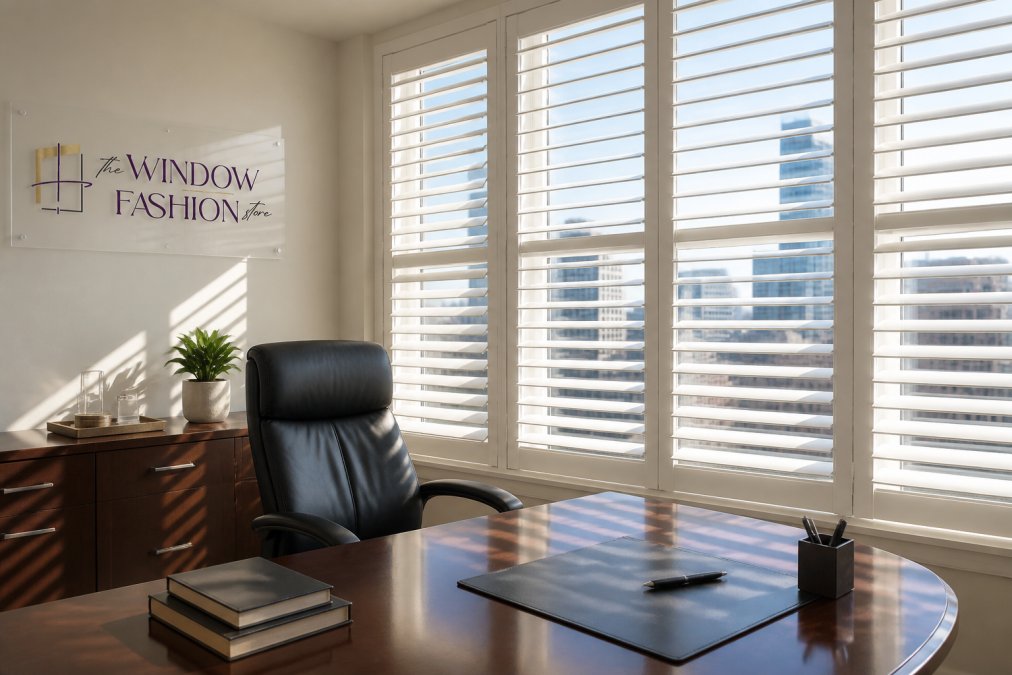
Hunter Douglas custom shutters are the strongest option for executive offices that need serious light control and a finished, high-end look. Tiltable louvers let you angle daylight precisely, cutting glare on one side of a corner office without blacking out the whole room.
SoftClose technology is the detail people notice first: louvers close quietly instead of snapping shut, which matters in a room where you take calls. Custom engineering means each panel aligns to its window rather than sitting a quarter-inch off like a stock unit.
The honest trade-off is cost. Shutters sit at a higher price point than roller shades, and pricing depends on window count, panel size, and material. For a single executive suite, that premium buys a fixture you will not replace; across forty windows, it adds up fast.
Alta Window Fashions Roller Shades: Best for Glare Reduction
Alta Window Fashions roller shades are the cleanest answer to screen glare in a modern office. The fabric range spans sheer to room-darkening, so you can dial in the exact opacity that kills monitor glare without turning the room into a cave.
For open-plan floors, that range is the whole point: a light-filtering weave softens harsh afternoon sun while keeping the space bright, and a darker fabric handles a west-facing conference room where screen washout is severe.
Alta offers manual and motorized lift systems, and the tailored fit keeps shade heights consistent across a wall of windows. The limitation is decorative: roller shades give you a sleek, uniform look, not the texture and layering drapery adds.
Norman USA Custom Shades: Best for Sustainable Materials
Norman USA custom shades are built for offices that care about material sourcing without giving up fit precision. The line includes eco-friendly and sustainable material options, and each shade is engineered to align cleanly across a window run.
Precision is Norman’s real strength: coverings that line up exactly look intentional, while ones that drift look cheap no matter what they cost. Norman builds to consistent proportions, which is why we recommend it for offices where visual order matters.
Motorization is available if you want to add it later. The catch is measurement: these shades need professional measuring to hit the fit they are capable of, and a self-measured order often lands slightly off.
Do not measure your own windows to save a step. A small error in width or mounting depth shows up as a light gap or a shade that rubs the frame, and custom orders are not returnable once cut.
Texton Custom Window Treatments: Best for Large Commercial Spaces
Texton custom window treatments are designed for offices that break the standard mold: wide spans, odd angles, and windows no stock size will ever fit. The commercial-grade fabric holds up under daily use in a way residential fabric does not.
That durability is why facility managers tend to land here: a treatment that frays or fades in two years costs more in replacement labor than it saved up front. Texton’s fabric selection is broad, and integrated light-filtering options let you manage heat gain and glare across a large footprint.
Professional installation is strongly recommended for this line. Large-format shades are heavy, and mounting them wrong risks both the hardware and the window frame.
Motorized Office Shades: Smart Control for Modern Workspaces
Motorized office shades solve a problem manual coverings create: nobody walks the floor lowering forty shades at 4 p.m. Motorization puts the whole building’s light control on a schedule or a single tap, an operational decision, not a luxury.
This matters for more than convenience. When shades raise and lower automatically with the sun’s angle, you cut heat gain during peak hours and reduce the load on your HVAC system. Conference rooms, patient-facing spaces, and any window wall with a harsh exposure benefit most.
Power Strategy: Decide This Before Installation
The biggest planning decision in a motorized project is how the shades get power, and it has to be made before the drywall goes up or the order is placed:
- Hardwired: the most reliable option for new construction or a renovation where an electrician is already on site. Power runs to each headrail, so there are no batteries to change and no downtime.
- Battery-powered: the practical choice for retrofits where running conduit is disruptive or expensive. Modern lithium-ion battery tubes can run for months between charges depending on daily cycles, but someone has to own the charging schedule.
- Low-voltage bus or centralized power: common in larger commercial installations where dozens of shades are grouped into zones and controlled from a single panel.
Grouping is the other early decision. Shades are typically zoned by exposure, all the west-facing glass on a floor moves together, which keeps operation simple and wiring runs shorter.
Scheduling, Sensors, and Building Integration
A motorized system earns its keep when it runs itself. The most common setup ties shade position to a time-of-day schedule, then layers in a daylight or solar sensor that overrides the schedule when the sun is actually hitting the glass. That combination delivers the energy benefit: shades close when the load is real, not on a fixed clock that ignores cloud cover.
Most commercial motorized systems can tie into a building management system or lighting control platform so shades, lights, and HVAC respond to the same signals. If your building already runs a BMS, confirm compatibility before you specify the shade system, the protocol matters, and mismatches are expensive to fix after installation.
Why Motorization Is Also a Compliance and Safety Decision
Cordless and motorized operation removes the dangling-cord hazard that safety codes flag in commercial and child-occupied settings. In offices with tall or hard-to-reach windows, motorization is often the only practical way to give occupants control at all, a manual shade on a 14-foot window simply stays where it was installed.
There is an ergonomic payoff too: when occupants can adjust light without climbing or tugging, they actually do it, keeping glare and brightness comfortable through the day.
Offices with tall or hard-to-reach windows, west-facing conference rooms, multi-tenant floors where a facility manager controls the whole building, and any space where staff cannot adjust coverings by hand throughout the day.
Bring your floor plan and window exposures to your consultation. Zoning and power strategy are far easier to get right when we can see which windows face which direction and where power is already available.
Energy Efficiency, Compliance, and Maintenance for Office Window Coverings
Window coverings do quiet work on energy efficiency, and in a commercial space that work is measurable. Solar heat gain through unprotected glass is one of the largest drivers of afternoon cooling load on a west- or south-facing floor. Cellular (honeycomb) shades trap air in their cells, slowing heat transfer at the glass; roller shades with a reflective or light-colored backing bounce solar radiation back out before it becomes interior heat. Layering a sheer with a room-darkening shade lets you hold daylight and views in the morning and cut radiant gain at peak sun without touching the thermostat.
There is a second, less obvious benefit: UV control. Unfiltered daylight fades carpet, upholstery, artwork, and laminate finishes, and degrades the plastics in monitors and printers over years of exposure. A shade that stays partly drawn during peak hours protects that investment across the whole floor, not just the desk nearest the window.
Fire Safety and Building Code Considerations
Commercial interiors are held to standards that homes are not, and window treatments are part of that review. The most commonly cited specification for textile window coverings is NFPA 701, the National Fire Protection Association’s standard test method for flame propagation of textiles and films (nfpa.org). Many commercial projects, especially offices in multi-tenant buildings, healthcare suites, schools, and any space subject to a fire marshal’s review, require documentation that the fabric passes NFPA 701. Ask for the manufacturer’s certificate of compliance before the order is placed, not after the inspector visits.
Cord safety is the other code-adjacent issue. Corded coverings have been progressively restricted in commercial and child-occupied settings, and the practical answer is cordless, continuous-loop-with-tensioner, or motorized operation, which removes the dangling-cord hazard entirely and simplifies the inspection conversation (cpsc.gov).
Requirements vary by occupancy type, sprinkler coverage, and local amendment, so confirm what applies to your space with your building’s code official or fire marshal before ordering. A supplier who works in commercial settings regularly will already know which fabrics carry the ratings your project needs and can supply the paperwork alongside the quote.
Cleaning and Long-Term Care
High-traffic offices accumulate dust faster than homes, and the cleaning method depends on the product:
- Cellular and roller shades: dust with a soft microfiber cloth or a vacuum brush attachment on low suction, working top to bottom. Spot-clean with a mild detergent and water on a clean cloth; do not soak the fabric or scrub the weave, which distorts the cells and leaves water rings.
- Shutters: wipe louvers and frames with a damp cloth and a mild cleaner. Shutters tolerate more frequent cleaning than fabric shades and are the easiest product to keep looking new in a lobby or reception area.
- Motorized systems: keep the headrail and any exposed track free of dust so the mechanism runs smoothly, and have the system serviced if operation becomes sluggish or noisy.
A simple quarterly dusting schedule prevents the buildup that dulls a shade’s appearance and shortens its life.
If your project will go through a fire marshal or building inspector, request the NFPA 701 documentation at the time of order. Getting it later can delay your certificate of occupancy.
The Ergonomic Case for Light Control
Most office lighting conversations stop at glare, but the effect on people runs deeper. Daylight is the primary cue that sets the body’s circadian rhythm, and uncontrolled brightness swings, a wall of glass at 3 p.m., then a dark room at 5, work against that rhythm, showing up as afternoon fatigue, headaches, and eye strain that employees rarely connect to the windows (PubMed).
A layered approach solves it: a light-filtering shade that holds a steady, diffuse daylight level through the day, paired with task lighting that fills in when the sun drops. That keeps screen contrast comfortable and reduces the squinting and monitor repositioning that follow a harsh exposure, one of the few office upgrades that improves both the look of the space and how people feel working in it.
Before you settle on a product line, it helps to see the fabrics and operating systems in person. Our Design Gallery has full-sized displays of every Hunter Douglas, Alta Window Fashions, Norman, and Texton product we sell, so you can compare function, fabric, and color side by side, and if it is easier to review samples at your office, we offer in-home design consultations with small sample books. Either way, the next step is to Schedule Free Consultation so we can measure your windows and talk through the right fit for your space.
Frequently Asked Questions
What are the best window treatments for a professional office?
The right choice depends on your space. Executive offices often suit Hunter Douglas custom shutters for a polished look and strong light control. Open-plan areas benefit from Alta roller shades in solar or light-filtering fabrics to cut screen glare. Large commercial buildings with unusual window sizes work well with Texton commercial-grade treatments. A design consultation can help match fabric opacity, mounting style, and motorization to each room’s needs.
Are motorized office shades a good investment for commercial offices?
Motorized office shades simplify light control across many windows, especially in conference rooms and open-plan spaces where manual adjustment is impractical. They can be scheduled to adjust with the sun, which helps reduce glare and heat gain during peak hours. For offices with hard-to-reach windows or a large window count, motorization often pays back through consistent daylighting and lower cooling demand.
How do custom window treatments improve office productivity?
Screen glare and harsh overhead light contribute to eye strain and fatigue, which pull focus from work. Custom shades with the right fabric opacity filter daylight without darkening the room, keeping visual comfort steady through the day. Adjustable louvers on shutters and motorized shades let employees tune light to their task. The result is a workplace environment that supports concentration rather than fighting it.
Do custom window treatments help with office energy efficiency?
Yes. Cellular and roller shades with reflective or insulating fabrics reduce heat gain in summer and heat loss in winter, which lowers HVAC load. Solar shades block UV rays that fade furniture and flooring while still letting in daylight. Pairing shades with a motorization schedule that tracks the sun’s position throughout the day keeps thermal control consistent without staff intervention.
What should I know about fire safety and building codes for commercial window blinds?
Commercial spaces often fall under local fire codes that require fire retardant fabrics and cordless systems in certain occupancies. Cordless and motorized options also address child and employee safety requirements in many jurisdictions. Before ordering, confirm the specific code requirements for your building type with your local authority. A professional consultation can help you select compliant fabrics and mounting hardware without guesswork.