


Last Updated: October 25, 2026
Quick Summary
Design floor-to-ceiling windows with layered treatments combining sheer and opaque fabrics, mounted outside the window frame for full coverage. Choose between curtains for elegance, roller shades for clean lines, or Roman shades for a tailored look, then add motorization for smooth operation on tall windows.
- Layer sheer and opaque fabrics to control light independently throughout the day
- Mount treatments outside the window frame, extending 4-6 inches beyond each side
- Roman shades create horizontal visual interest while stacking neatly when fully raised
- Semi-opaque fabrics provide privacy during the day while still filtering natural light
- Professional installation ensures smooth operation and prevents gaps on large windows
Table of Contents
- Why Floor-to-Ceiling Windows Need Thoughtful Treatment
- Window Treatments for Large Windows: Layering and Coverage
- Curtains for Floor-to-Ceiling Windows: Soft Elegance and Function
- Shades for Tall Windows: Precision and Clean Lines
- Privacy Solutions for Large Windows Without Sacrificing Light
- Measuring and Mounting Large Window Treatments
- Energy Efficiency and Durability for Your Investment
- Schedule Your Design Consultation Today
- Frequently Asked Questions
Why Floor-to-Ceiling Windows Need Thoughtful Treatment
Floor-to-ceiling windows flood your home with natural light and create a stunning visual connection to the outdoors. But that same beauty presents a design challenge.
The solution isn’t complicated, it’s about choosing the right combination of window coverings and mounting them correctly.
The American Society of Interior Designers emphasizes that large windows require thoughtful treatment to balance aesthetics with practical needs like privacy, light control, and energy efficiency.
Window Treatments for Large Windows: Layering and Coverage
Layering is the secret to handling large windows effectively. A single treatment often falls short. Combining sheer and opaque layers gives you flexibility you can’t get any other way.
Think of layering like building a wardrobe. You need basics (sheer fabrics), mid-tones (semi-sheer options), and statement pieces (blackout shades). This approach lets you control light throughout the day without sacrificing style.
Combining Sheer and Opaque Layers
Sheer curtains soften natural light and maintain your outdoor view during the day. Opaque layers, like roller shades or blackout panels, give you privacy and complete light control when you need it.
The best part? You don’t have to choose one or the other. Pair a sheer fabric in front with a roller shade or Roman shade behind it.
For example:
- Morning: sheer curtains only for soft, filtered light
- Afternoon: add the opaque shade to reduce glare
- Evening: close everything for complete privacy
This flexibility is exactly what makes layered treatments worth the investment for large windows.
Choosing Inside Mount vs. Outside Mount
Inside mount means the shade or curtain rod sits inside the window frame. Outside mount means it extends beyond the frame to the wall.
For floor-to-ceiling windows, outside mount is usually the better choice. Here’s why:
- Covers more glass: Outside mount shades extend fully across the entire window, eliminating light gaps at the edges
- Creates visual impact: The treatment becomes part of the room’s design, not hidden inside the frame
- Easier to operate: Motorized shades work more smoothly with outside mount on tall windows
Inside mount works if your window frame is deep and sturdy, but most floor-to-ceiling installations benefit from the coverage and flexibility of outside mount.
Curtains for Floor-to-Ceiling Windows: Soft Elegance and Function
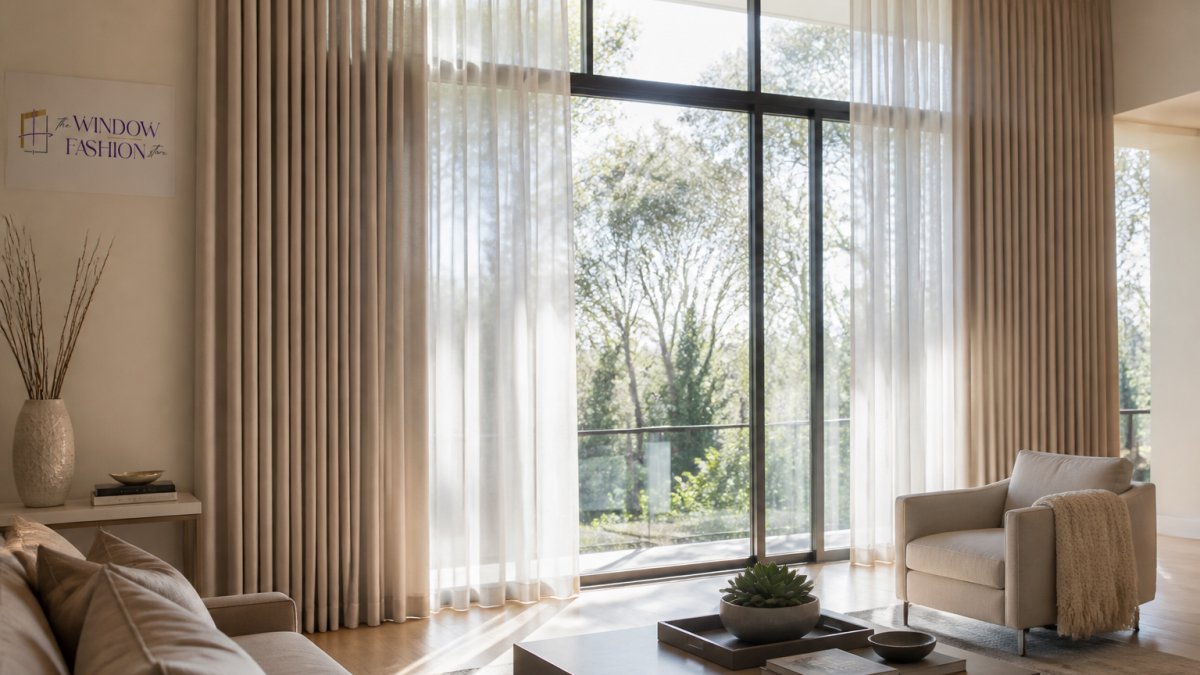
Curtains and drapery panels are the go-to choice for large windows because they combine elegance with practical light control. Unlike shades, curtains add texture and warmth to a room while managing light beautifully.
The key is choosing the right fabric and hanging them correctly to maximize coverage and minimize gaps.
Drapery Panels That Preserve Your View
Custom drapery panels let you maintain your outdoor view while controlling light on your terms.
Start by thinking about your priorities:
- Do you want to see outside during the day?
- How much privacy do you need?
- What’s the room’s primary use (bedroom, living room, office)?
For rooms where you want to preserve the view, semi-sheer fabrics work best. They filter light softly while keeping the landscape visible.
Drapery panels also work well because you can stack them to the sides when open. This means they don’t block your window view during the day, they simply frame it beautifully.
Fabric Opacity and Light Control
Opacity refers to how much light a fabric lets through. Understanding this helps you pick the right material for each room.
- Sheer (5-15% opacity): Maximum light, outdoor view visible, minimal privacy
- Semi-sheer (30-50% opacity): Filtered light, view partially visible, some privacy
- Semi-opaque (60-80% opacity): Reduced light, minimal view, good privacy
For floor-to-ceiling windows in living areas, semi-sheer works well because it softens light without making the space feel dark.
The fabric color also matters. Light colors reflect light and make rooms feel brighter.
Fabric opacity determines how much light passes through and how much privacy you get.
| Opacity Level | Light Transmission | View Visibility | Privacy Level |
|---|---|---|---|
| Sheer | 5-15% | Outdoor view visible | Minimal |
| Semi-sheer | 30-50% | View partially visible | Some |
| Semi-opaque | 60-80% | Minimal view | Good |
| Blackout | 95%+ | No view | Total |
Shades for Tall Windows: Precision and Clean Lines
Shades offer a cleaner, more modern look than curtains. They’re also easier to operate on tall windows, especially if you go with motorized options.
Shades work by rolling, folding, or stacking as you raise and lower them. This design means they take up less visual space and give your room a simplified appearance.
Roller Shades and Solar Shades
Roller shades are a simple option. They roll up inside a tube at the top of the window and unroll to cover the glass. They are durable and available in many fabrics.
Solar shades are a specialized type of roller shade designed to reduce heat and glare while preserving your outdoor view. The fabric has tiny perforations that let light through while blocking UV rays. This makes them ideal for:
- Rooms with intense afternoon sun
- Home offices where glare on screens is a problem
- Large windows where heat gain is a concern Selecting the right opacity and texture for these shades ensures they integrate seamlessly into a cohesive interior design while maintaining the functional balance of your living space.
Both work beautifully on floor-to-ceiling windows because they mount cleanly outside the frame and operate smoothly from top to bottom.
Roman Shades for a Tailored Look
Roman shades fold into neat horizontal pleats as they raise. They create a more formal, tailored appearance than roller shades, think of them as the dress-up option for window treatments.
Roman shades work especially well on floor-to-ceiling windows because:
- The horizontal pleats draw the eye across the width of the window
- They add visual interest without clutter
- Custom fabrics let you match your room’s design perfectly
For a modern aesthetic, flat Roman shades (no pleats) offer clean lines. For traditional rooms, relaxed Roman shades with soft folds add elegance and texture.
Privacy Solutions for Large Windows Without Sacrificing Light
Privacy and light control don’t have to be mutually exclusive. The right treatment strategy lets you have both.
Many homeowners worry that privacy means darkness. That’s not true. Semi-opaque fabrics, strategic layering, and smart mounting positions give you privacy while keeping your space bright and welcoming.
Consider these approaches:
- Layered sheers and opaque shades: Keep sheers closed during the day for privacy while light filters through. Add opaque shades only when you need complete darkness or extra privacy at night.
- Solar shades positioned strategically: Mount them on the lower half of floor-to-ceiling windows if you mainly need privacy from street level. The upper portion stays open for light and views.
- Motorized shades on a timer: Close them automatically at dusk for privacy. Open them at dawn for light. No manual operation needed.
The key is thinking about when you need privacy most. Morning? Evening? All day? Your answer should guide your fabric and mounting choices.
Measuring and Mounting Large Window Treatments
Proper measurement and installation are critical for floor-to-ceiling windows. A small mistake gets magnified across a large surface.
Getting exact measurements right prevents gaps, ensures smooth operation, and makes your treatments look professionally finished.
Getting Exact Measurements Right
Measure three times. Seriously. Floor-to-ceiling windows often have slight variations in width from top to bottom, and walls aren’t always perfectly square.
For width:
- Measure at the top, middle, and bottom of the window
- Measure from inside the frame (if inside mount) or from wall to wall (if outside mount)
- Use the smallest measurement for inside mount, the largest for outside mount
For height:
- Measure on the left, center, and right side
- For floor-to-ceiling windows, measure from the top of the frame to the floor
- Add a few inches if you want the treatment to puddle slightly on the floor (a designer touch)
Write everything down. Take photos of the window from different angles. This information becomes essential when you work with a professional installer or order custom treatments.
Avoiding Common Installation Mistakes
The most common mistake is mounting shades or curtain rods too low or too narrow. This creates the illusion that your windows are smaller than they actually are.
To avoid this:
- Mount outside the window frame whenever possible
- Extend the rod or shade at least 4-6 inches beyond the window on each side
- Hang curtain rods as close to the ceiling as possible, even if it’s above the actual window frame
Professional installation matters here. We handle measuring and installation for custom window treatments in our local service area. Visit our Design Gallery to see full-sized displays of Hunter Douglas, Alta Window Fashions, Norman, and Texton products, or schedule a free consultation where we bring sample books to your home so you can see fabrics and colors in your actual space before ordering.
The National Association of Certified Home Inspectors notes that proper window treatment installation protects your investment and ensures long-term performance. This is especially true for floor-to-ceiling windows where weight and operation matter more.
Energy Efficiency and Durability for Your Investment
Floor-to-ceiling windows are a significant investment.
Energy-efficient window treatments reduce heat loss in winter and heat gain in summer.
Look for these features:
- Thermal-lined fabrics: They insulate your windows and reduce energy transfer
- UV-protective materials: They block harmful rays that fade furniture and artwork
- Quality hardware: Motorized systems from established manufacturers last longer than budget alternatives
Custom window treatments from manufacturers like Hunter Douglas, Alta Window Fashions, Norman, and Texton are built to last.
Maintenance is simple. Dust regularly with a soft brush or vacuum attachment.
The U.S. Department of Energy recommends window treatments as part of a home’s overall energy strategy.
Schedule Your Design Consultation Today
Choosing the right treatment for floor-to-ceiling windows feels overwhelming until you talk to someone who’s done it hundreds of times. The decisions, fabric, opacity, mounting style, motorization, come together quickly once you understand your priorities.
The Window Fashion Store offers in-home design consultations where we bring fabric samples and show you exactly how different options look in your space. We handle measuring, ordering, and professional installation of custom window treatments. Schedule a free consultation to visit our Design Gallery and discuss which treatments work best for your windows, your budget, and your lifestyle.
Frequently Asked Questions
What’s the best way to cover floor-to-ceiling windows without blocking the view?
Layering treatments works best for floor-to-ceiling windows. Pair sheer curtains or semi-sheer fabric with motorized roller shades or Roman shades that you can adjust independently. This approach lets you control light and privacy while keeping your outdoor view visible when the sheers are closed. Drapery panels mounted at the top of the window frame and stacked to the sides also preserve the view while softening the room.
Are curtains or shades better for tall windows?
Both work well, but they serve different purposes. Curtains and drapery panels add softness and elegance while allowing you to preserve views when pulled aside. Roller shades and solar shades provide clean lines, precise light control, and glare reduction with minimal stack. For large windows, many homeowners choose a combination: shades for functional light control and curtains for design impact and privacy.
How do I prevent light gaps in large window treatments?
Light gaps happen when treatments don’t extend far enough beyond the window frame or mount inside instead of outside. Outside mounting pulls the treatment wider than the glass, eliminating gaps at the sides. For floor-to-ceiling windows, extending the mounting rod higher and lower than the glass itself prevents gaps at the top and bottom. Custom measurements and professional installation ensure proper coverage.
Can motorized shades help with large windows?
Motorized shades are ideal for large windows, especially floor-to-ceiling installations. They make it convenient to adjust multiple shades at once, and you can program them to open and close on a schedule. This is particularly useful for glare control throughout the day and for privacy without manual effort. Motorized options work with roller shades, solar shades, and Roman shades.
