


Table of Contents
- Do Energy Efficient Shades Reduce Cooling Costs? What the Data Shows
- How Shades Cut Heat Gain and Cooling Demand
- How Energy-Efficient Cellular Shades Trap Air and Block Heat
- Solar Shades for Heat Reduction: When Reflective Fabrics Win
- How to Use Window Coverings for Energy Efficiency Room by Room
- Smart Shades and Energy Savings: Automating Your Schedule
- Measuring, Fitting, and Verifying Your Cooling Savings
- Frequently Asked Questions
Last Updated: October 12, 2026
Do Energy Efficient Shades Reduce Cooling Costs? What the Data Shows
Yes, energy efficient shades reduce cooling costs, and the effect is bigger than most homeowners expect. Department of Energy reports that window coverings can cut heat gain through windows by up to 77 percent, and cellular shades alone can reduce heat gain by roughly 45 percent when fitted correctly.
Here is what that means in plain terms. A loose shade with gaps around the edges lets hot air slide past it. A tight shade traps a layer of air against the glass and stops that heat before it reaches your rooms.
Below, we break down how each shade type performs, which rooms benefit most, and how to check whether your own cooling bill actually drops.
The shade is only half the system. A cellular shade with a tight, measured fit blocks far more heat than a loose one of the same fabric.
How Shades Cut Heat Gain and Cooling Demand
Sunlight passing through window glass turns into heat once it hits your floors, furniture, and walls. That trapped heat is called heat gain, and your air conditioner has to work harder to remove it.
Window coverings interrupt that process in two ways:
- They reflect sunlight back outside before it enters.
- They trap air between the fabric and the glass, which slows heat transfer.
Less heat gain means less cooling demand. Your system runs shorter cycles, and your indoor temperature stays steadier through the hottest part of the day.
U.S. Department of Energy guidance on window coverings and heat gain
How Energy-Efficient Cellular Shades Trap Air and Block Heat
Energy-efficient cellular shades are window treatments built with hollow honeycomb pockets that trap air between the fabric and the glass. That trapped air acts as insulation, slowing the movement of heat into your home during summer and out of it during winter.
The pockets are the whole point. Still air is a poor conductor of heat, so the more air you trap, the better the barrier.
Single, Double, and Triple Cell Construction Compared
More cells mean more trapped air and a better barrier. They also mean a thicker stack and a higher cost. Here is how the three builds compare:
| Cell Construction | Insulating Air Pockets | Best For | Trade-Off |
|---|---|---|---|
| Single cell | One layer of trapped air | Bedrooms, lighter use | Least insulation |
| Double cell | Two layers of trapped air | Most living spaces | Slightly bulkier stack |
| Triple cell | Three layers of trapped air | Hot, sun-facing rooms | Thickest, heaviest stack |
For most homes, double cell is the sweet spot. Triple cell earns its keep on west- and south-facing windows that take direct sunlight all afternoon.
Ask about side tracks or a tight perimeter fit. The gap at the edge of a shade is where most heat sneaks past, and closing it does more for performance than upgrading the fabric.
Solar Shades for Heat Reduction: When Reflective Fabrics Win
Solar shades for heat reduction work best when the goal is blocking sunlight without darkening the room.
Light-colored and reflective materials outperform dark fabrics in direct sun. A pale, reflective backing bounces solar heat away instead of absorbing it.
Where solar shades fall short is total insulation. They reduce heat gain from sunlight, but they do not trap air the way a honeycomb pocket does.
- Best for: Living rooms, offices, and sunrooms with a view worth keeping
- Weaker at: Blocking conducted heat on very cold windows
- Pair with: Cellular shades in bedrooms for full light control
How to Use Window Coverings for Energy Efficiency Room by Room
How you operate your coverings matters as much as what you buy. The right schedule, matched to each room, is how you turn a good shade into real savings.
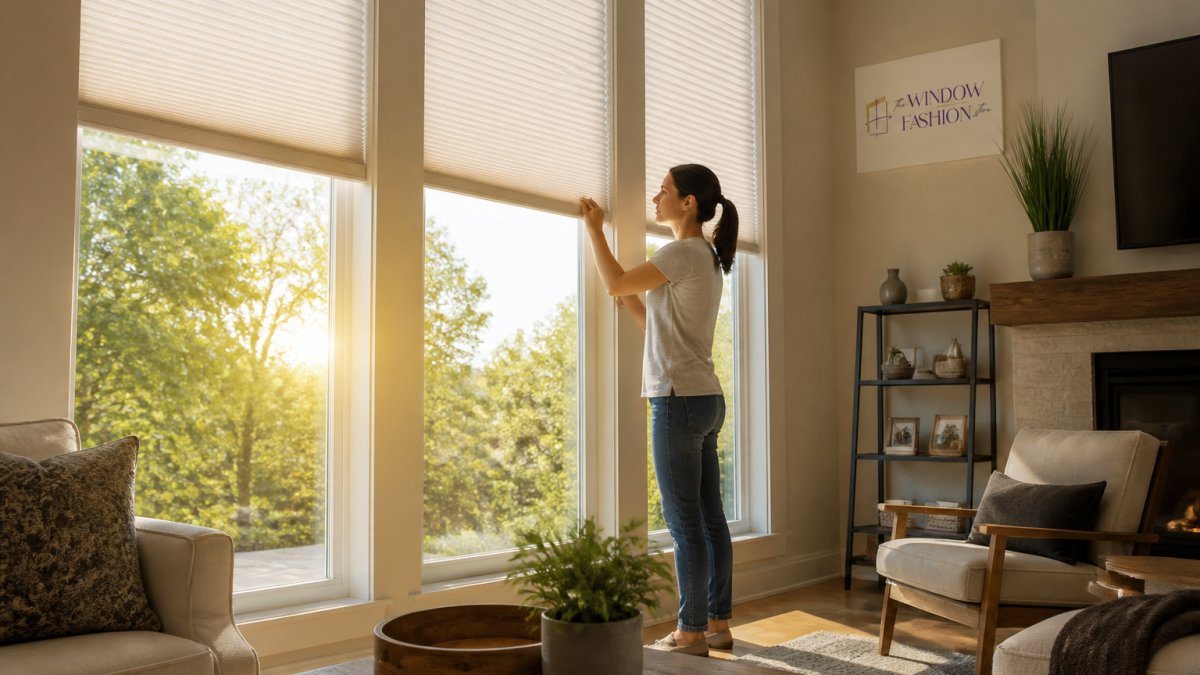
Managing solar gain through strategic window treatments is a vital first step in optimizing home energy efficiency, a principle that extends to the thermal performance of your roof as well.
Start with the rooms that take the most sun. Then work outward.
- West-facing rooms: These are the hardest-working windows in summer. Afternoon sun arrives when outdoor temperatures are already at their peak, so close shades by early afternoon and keep them down through sunset.
- South-facing rooms: Close during midday hours in summer; open in winter to let warmth in. South glass is a seasonal swing window, it overheats in July and helps in January.
- East-facing rooms: Close in the morning, then open once the sun moves past. Morning sun is milder, so the penalty for leaving these open is smaller.
Window Orientation and Daily Shade Schedule
Window orientation decides your schedule more than any other factor. Track which windows get direct sunlight and when, then set your coverings to close an hour before that sun arrives. The hour of lead time matters because glass and furnishings keep releasing stored heat after the sun has moved off.
A practical way to build the schedule:
- On a clear day, walk the house every two hours and note which windows are in direct sun.
- Write down the first and last hour of direct sun for each exposure.
- Set your close time one hour before the first hour and your open time one hour after the last.
- Adjust by season, summer schedules run longer on west glass, winter schedules flip to favor south glass.
Large Glass Doors and Sliding Doors
Big glass doors are the single largest heat-gain surface in many homes, and they are also the hardest to cover well.
For large glass doors, look for a covering that spans the full opening, seals at the sides, and can be drawn during the hottest hours without blocking the door’s use. Vertical cellular and panel-track styles are common choices because they cover a wide span and stack tightly to the side.
Leaving shades fully open on a west-facing window during a July afternoon is the single biggest mistake we see. The glass heats up, the room overheats, and the air conditioner runs nonstop until evening.
If you cannot be home to run the schedule, that is the strongest argument for motorization. A schedule that runs itself does not forget the 2 p.m. close.
Smart Shades and Energy Savings: Automating Your Schedule
Smart shades and energy savings go together because automation removes the human error.
Motorized Blinds & Shades let you set daily open-and-close times per room. Many systems also adjust automatically based on sunlight, so the shades react to real conditions rather than a fixed clock.
Consumer guidance on motorized window covering technology
That consistency is where the savings live. A schedule followed every day beats a perfect schedule followed half the time.
Measuring, Fitting, and Verifying Your Cooling Savings
Proper installation and a tight fit decide how much of the shade’s potential you actually capture. Air gaps around the edges let heat bypass the fabric entirely, which is why an exact measurement matters more than a fancy fabric. A shade with a perfect honeycomb and a half-inch gap at each side is a shade with a built-in leak.
Measuring for a Tight Fit
Here is how we approach a fit:
- Measure the window opening at the top, middle, and bottom. Openings are rarely perfectly square, and the smallest of the three numbers is the one that governs an inside mount.
- Note the depth so the shade sits flush, not proud of the frame. A shallow mount can leave the shade sitting in the sun path rather than against the glass.
- Choose inside or outside mount based on the gap you need to cover. An inside mount looks cleaner and sits closer to the glass, but it only works if the opening is deep enough and square enough. An outside mount overlaps the frame, which lets you cover a wider area and close edge gaps more easily.
- Check for side gaps and add a track or overlap where needed. Side tracks hold the shade against the frame and stop air from sliding around the edge.
- Confirm the shade closes fully with no light leaking at the edges. A quick test: stand in the room with the shade down on a bright day and look for a bright rim of light around the perimeter.
Inside Mount vs. Outside Mount: The Trade-Off
Inside mount gives you a clean look and puts the fabric close to the glass, which is good for trapping air. Outside mount gives you more coverage and more room to seal the edges, which is good for blocking heat. The right answer depends on your window depth, your frame, and how much of the glass you need to cover.
Payback Period and Total Cost of Ownership
Payback period is the time it takes for your cooling savings to cover what you spent on the shades. It depends on three things: your shade cost, how much heat your windows let in, and your local electric rates.
Total cost of ownership looks past the purchase price. Custom shades from a quality maker typically last many years, while cheap alternatives often need replacing far sooner.
How to Verify Your Real-World Results
This is the part most articles skip. You can check whether your shades are actually working without any special equipment.
- Pick the same billing month across two summers, for example, July of last year and July of this year.
- Pull both electric bills and note the total usage, not just the dollar amount. Rates change, so usage is the cleaner comparison.
- Note the cooling degree days for each period. Your utility or a public weather record will show these. More cooling degree days means a hotter month, which would raise usage on its own.
- Confirm your thermostat settings were the same both months. A lower setpoint will raise usage regardless of your shades.
- Compare usage against cooling degree days. If usage fell while cooling degree days held steady or rose, the shades are likely contributing.
One month is noise; a full season is a trend. If you want a stronger signal, compare the whole cooling season rather than a single month, and keep a simple log of when you ran the shades.
When Shades Are Not the Whole Answer
Shades are one layer of a system. If your windows are single-pane, if the frame itself leaks air, or if your air conditioner is undersized, shades will help but will not carry the whole load.
If you would rather not guess at cell counts and mount types, our team sells Custom Window Treatments – Shades, takes exact measurements, and handles professional installation in our local service area.
Federal Trade Commission guidance on window covering safety and claims
Frequently Asked Questions
Do energy-efficient shades make a noticeable difference in cooling costs?
Yes, when they fit tightly and are used correctly. Cellular shades with insulating air pockets and reflective solar shades can reduce heat gain through windows, which lowers how hard your air conditioner works. The exact savings depend on your window orientation, climate, and how consistently you deploy the shades. Homes with large west- or south-facing glass tend to see the biggest impact because those windows collect the most solar heat during peak cooling hours.
Which window shades block the most heat?
Cellular shades with multiple air pockets and reflective light-colored fabrics block the most heat, especially when mounted close to the glass with minimal air gaps. Solar shades with low openness factors also cut heat gain while preserving some view. Blackout shades help in bedrooms but are less effective at reflecting solar heat than reflective cellular or solar fabrics. For the hottest exposures, a tight-fitting cellular shade paired with a light-colored backing performs best.
When should you close shades to keep a room cooler?
Close shades on sun-facing windows before direct sunlight hits the glass, typically mid-morning for east windows and early afternoon for west and south windows. Keep them closed through the hottest part of the day, then reopen in the evening to release trapped heat. Motorized smart shades can run this schedule automatically, so you are not relying on memory. Rooms with large glass doors benefit most from a consistent close-and-open routine.
How do cellular shades help improve home energy performance?
Cellular shades trap air inside their honeycomb pockets, creating an insulating layer between the window glass and the room. That layer slows heat transfer, so less solar heat enters during summer and less warmth escapes in winter. A tight fit matters as much as the fabric: gaps around the edges let air and heat bypass the shade. Custom-measured shades installed inside or outside the window frame reduce those gaps and improve performance.