


Last Updated: October 23, 2026
Quick Summary
Select commercial window coverings by requiring documented cycle-life ratings, material thickness, reinforced hardware, and a warranty that covers commercial use. Match fabric openness to each space, specify motorization for hard-to-reach windows, and compare total cost of ownership rather than sticker price.
- Builder-grade blinds fail from frayed cords, warped slats, loose brackets, fading fabric, and jammed lift mechanisms.
- Ask manufacturers for cycle-life ratings, material thickness, hardware ratings, commercial warranty terms, and parts availability.
- Match fabric openness to the room: lower for private offices and conference rooms, higher for lobbies.
- Motorized shades pay off fastest on tall windows, glass walls, and multi-window floors where manual adjustment is impractical.
- Keep a log of install dates, part numbers, and warranty expiration per room to turn service requests into parts orders.
Table of Contents
- Why Commercial Window Coverings Fail in High-Traffic Spaces
- Commercial-Grade Blinds: What Separates Them From Builder-Grade Options
- Commercial Roller Shades and Solar Shades for Light Control
- Window Coverings for Large Commercial Windows and Glass Walls
- Motorized Shades for Commercial Buildings: Hard-to-Reach Windows and Operating Consistency
- Matching Window Treatments to Each Space: Offices, Lobbies, and Patient Rooms
- Maintenance, Replacement Parts, and Lifecycle Planning
- Frequently Asked Questions
Why Commercial Window Coverings Fail in High-Traffic Spaces
Most commercial window coverings don’t fail because of bad design. They fail because they were never built for the workload.
At The Window Fashion Store, we’ve spent over 20 years specifying window treatments for offices, clinics, and retail spaces, and the pattern is always the same.
Here’s what actually breaks first:
- Cords fray from constant tugging
- Slats warp in direct sun and heat
- Cheap brackets pull loose from drywall
The fix isn’t more careful handling. It’s picking products rated for commercial duty from the start.
The Real Cost of Replacing Cheap Blinds Every Few Years
Cheap blinds are a subscription, not a purchase. You buy them, they fail, you buy them again. Each replacement cycle eats staff time, disrupts tenants, and lands another line item in the maintenance budget.
Durability is the cheaper path. A commercial-grade product that lasts a decade costs less per year than three rounds of builder-grade replacements. That math holds even before you count the labor to take old blinds down and hang new ones.
The hidden cost of cheap blinds isn’t the product. It’s the repeated removal, disposal, and reinstallation, plus the downtime in occupied spaces. Budget for lifespan, not sticker price.
Commercial-Grade Blinds: What Separates Them From Builder-Grade Options
The difference comes down to materials, hardware, and testing. Commercial-grade blinds use thicker aluminum, stronger cords, and heavier brackets. Builder-grade versions cut all three to hit a low price point. But “commercial-grade” is a marketing label, not a standard, so the only way to compare products is to ask for documented specs and test data.
Here’s how the two compare on the specs that matter:
| Feature | Builder-Grade | Commercial-Grade |
|---|---|---|
| Slat thickness | Thin aluminum | Reinforced aluminum |
| Lift hardware | Light-duty cord | Heavy-duty clutch |
| Brackets | Standard | Reinforced, rated for daily use |
| Warranty | Short | Extended commercial coverage |
| Best for | Low-traffic rooms | High-traffic spaces |
For a deeper look at how these products are built for offices, see our guide to commercial window blinds for office buildings.
Durability Criteria to Check Before You Specify
Broad claims like “durable” and “commercial-grade” are not comparable across brands. Ask for the underlying data and compare it line by line:
- Cycle-life rating. Manufacturers test lift systems for a stated number of raise/lower cycles. Ask for the rating and confirm it reflects the daily use your space will see, not a residential assumption.
- Material thickness and composition. Request slat or fabric thickness in mils or ounces per square yard, plus the alloy or weave. Thicker is not automatically better, but undocumented thickness is a red flag.
- Hardware strength. Brackets, clutches, and cord locks should be rated for the window size and mounting surface. Drywall, masonry, and steel studs each need different anchors.
Manufacturers publish cycle ratings and material specs. Ask for them. A product that can’t document its durability is a product you’ll replace early.
Fire Safety, Accessibility, and Code Considerations
Durability is only part of the specification. Facility teams also need to confirm that coverings meet applicable fire-performance and accessibility requirements, and that is where generic product pages usually go quiet.
- Fire performance. Commercial buildings often require window coverings to meet a fire-performance standard for flame spread and smoke development. Ask the manufacturer for test documentation and confirm it matches what your local authority having jurisdiction requires for your occupancy type.
- Accessible controls. Where occupants or staff need to operate coverings, controls should be reachable and operable without excessive force (Chapter 3: Operable Parts). Motorization and wand or cord-loop controls can help meet accessibility goals, and corded products should be evaluated against current cord-safety requirements.
- Egress and life safety. Coverings should not obstruct egress paths or interfere with emergency egress windows. Confirm mounting and operation do not conflict with life-safety requirements.
These checks belong in the specification stage, not after installation. Bringing them up early with your installer keeps the project moving and avoids substitutions later.
Total Cost of Ownership, Not Sticker Price
A commercial-grade product that lasts a decade usually costs less per year than repeated rounds of builder-grade replacements, even before labor. Build a simple total-cost comparison across the expected service life:
- Purchase price per unit, multiplied by the number of windows
- Installation labor, including any reinforcement of mounting surfaces
- Cleaning supplies and staff time over the service life
When you compare products this way, the cheapest sticker price rarely wins. The product with documented cycle ratings, available parts, and a commercial warranty usually has the lower cost per year of service.
The hidden cost of cheap blinds isn’t the product. It’s the repeated removal, disposal, and reinstallation, plus the downtime in occupied spaces. Budget for lifespan, not sticker price.
Ready to compare specs side by side? Schedule an appointment to see full-sized displays of every Hunter Douglas, Alta, Norman, and Texton product we carry in our Design Gallery, or book an in-home consultation and we’ll bring sample books to your space.
Commercial Roller Shades and Solar Shades for Light Control
Commercial roller shades and solar shades are the workhorses of light control. Roller shades block light fully. Solar shades filter it while keeping your view, which is why they show up on so many glass-heavy office facades.
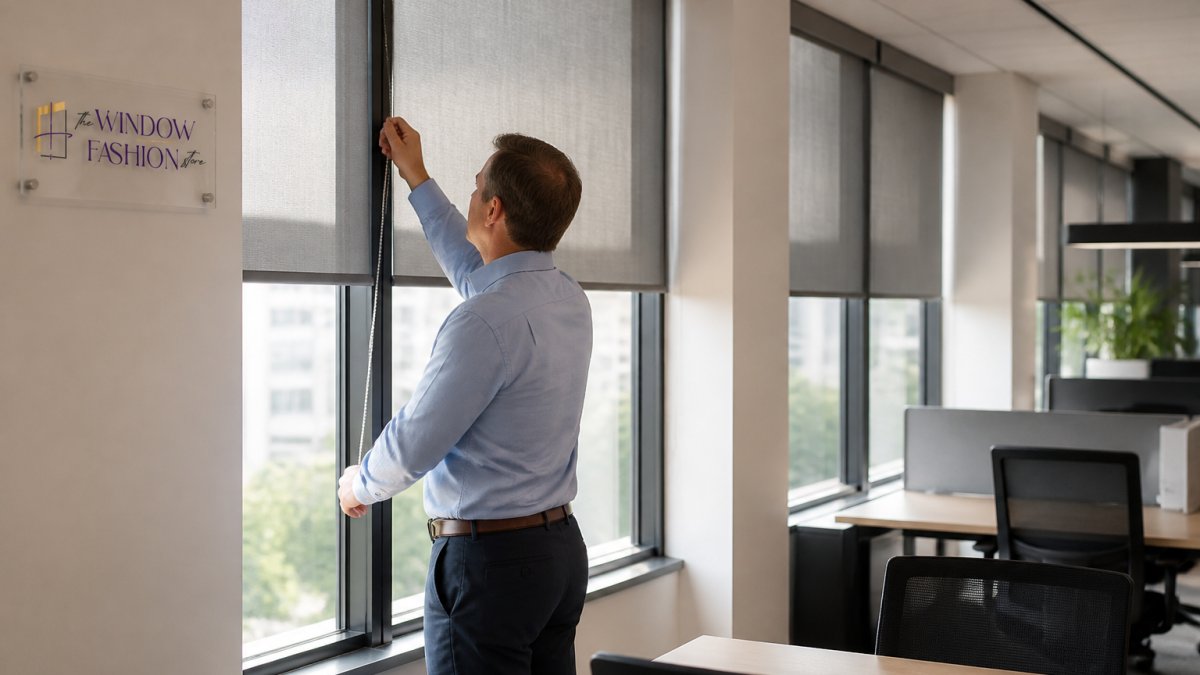
The key spec is fabric openness. It’s the measure of how much light and view pass through the weave. Lower openness means more privacy and less glare.
You can browse our Custom Window Treatments – Shades to compare fabric options in person.
Fabric Openness and Glare Reduction by Room Type
Match the fabric to the room, not the other way around:
- Private offices: Lower openness for glare control on screens
- Open-plan floors: Mid-range openness to balance daylight and view
- Conference rooms: Lower openness for presentation visibility
Glare reduction is the goal in most workspaces. Screen fatigue and hot spots near windows both trace back to uncontrolled daylight. Solar screen shades cut that without turning the room into a cave.
Ask for fabric samples against your actual windows. Openness looks different in a showroom than it does on a west-facing glass wall at 4 p.m.
Window Coverings for Large Commercial Windows and Glass Walls
Large commercial windows and glass walls need custom sizing and stronger hardware. Off-the-shelf products can’t span wide openings, and thin fabric sags on tall drops.
Specify these for big glass:
- Roller shades in wide-width fabrics
- Solar shades with reinforced hems
- Motorized systems for tall or wide spans
Custom sizing matters here. A shade cut to the exact opening closes the light gaps that stock sizes leave behind, and it fits the window instead of fighting it.
Motorized Shades for Commercial Buildings: Hard-to-Reach Windows and Operating Consistency
Motorized shades for commercial buildings solve two problems at once: hard-to-reach windows and inconsistent operation. Staff can’t reach a 20-foot window, and they won’t adjust a manual shade the same way every day.
Motorization fixes both. For a full breakdown, read whether motorized shades are worth it for commercial offices, or explore our Motorized Blinds & Shades to see how the systems work.
Motorized shades pay off fastest on tall windows, glass walls, and multi-window floors where manual adjustment is impractical or inconsistent.
Matching Window Treatments to Each Space: Offices, Lobbies, and Patient Rooms
Different spaces have different jobs, and the covering should match. Get this right and the whole building performs better.
- Offices: Glare control and privacy, often solar shades
- Lobbies: A polished look with daylight and view, higher openness
- Patient rooms: Privacy and easy cleaning, roller shades or wipeable fabrics
Privacy requirements vary by space. A patient room needs more than a lobby. Match the fabric and coverage to who uses the room and what they need to see, or not see.
Ready to specify coverings for your own spaces? Schedule an appointment to see fabrics and options in person.
Maintenance, Replacement Parts, and Lifecycle Planning
Plan for upkeep from day one. Commercial coverings need occasional cleaning, and parts wear over time. The products that last are the ones with replacement parts still available years later, and the facilities that stay ahead of failures are the ones that treat maintenance as a specification requirement rather than an afterthought.
A simple upkeep routine:
- Dust or vacuum fabrics on a set schedule
- Wipe high-touch controls and wands
- Check brackets and cords each year
Repairability and Replacement Parts
Repairability is a durability feature, and it belongs in the specification. Before you commit to a product line, ask:
- Are individual components, such as brackets, clutches, cord locks, and slats, orderable separately?
- How long will replacement parts be stocked after the product line changes?
- Are parts standardized across sizes and product families, so one spare kit covers multiple windows?
Products with standardized parts and long parts support reduce downtime across multi-window projects. When one shade fails, you replace a component instead of a whole unit, and you avoid mismatched replacements that look different from the rest of the floor.
Lifecycle Planning Across a Multi-Window Project
Lifecycle planning means choosing products with long-term parts support, then tracking when each unit was installed. A simple log per room or floor should capture:
- Install date and product line
- Window dimensions and mounting type
- Fabric or slat specification and color
With that record, a service request becomes a parts order instead of a site visit and a guess. It also supports budget planning, because you can forecast replacement cycles by floor rather than reacting to failures one at a time.
When you buy through us, our professional installation team handles the setup for the Hunter Douglas, Alta, Norman, and Texton products we sell, so the system starts out right and the spec record is accurate from day one.
A Procurement and Specification Checklist
Use this checklist to document requirements before you request bids. It gives installers and facility teams a shared basis for comparison and reduces substitutions later.
- Dimensions and mounting. Measure every opening, note the mounting surface (drywall, masonry, steel stud), and record whether coverings mount inside or outside the frame.
- Exposure and orientation. Note which windows face direct sun, which see temperature swings, and whether any area is humid, dusty, or coastal. Exposure drives fabric and hardware choices.
- Performance requirements. State the light-control goal (blackout, glare reduction, view retention), privacy level, and any thermal or energy goals.
Keep a simple log of install dates and part numbers per room. When a shade needs service, you’ll know its age and spec without a site visit.
Ready to build your specification? Schedule an appointment to see full-sized displays of every Hunter Douglas, Alta, Norman, and Texton product we carry in our Design Gallery, or book an in-home consultation and we’ll bring sample books to your space.
Frequently Asked Questions
What should you look for when choosing window coverings for a commercial building?
Start with how the space is used. Check the fabric or slat construction for wear resistance, confirm the lift system is rated for frequent daily use, and verify moisture resistance in humid areas. For large glass walls, look at solar fabric openness to control glare without blocking daylight. Also plan for replacement parts and confirm the installer services the products they sell, so operating consistency holds up over the full lifespan.
Which window coverings are most durable for high-traffic commercial spaces?
Commercial roller shades and solar shades hold up well because there are fewer moving parts and the fabric resists wear from frequent daily use. Aluminum blinds suit utility areas where moisture resistance matters. Faux wood blinds work in spaces that need a warmer look without real wood’s sensitivity to humidity. In every case, the hardware and lift mechanism matter as much as the material, so specify commercial-grade components rather than builder-grade.
Are motorized shades for commercial buildings worth the investment?
They solve two common problems: hard-to-reach windows above atriums or tall glass walls, and operating consistency across many windows. A facility manager can schedule shades to lower together at peak sun, which helps with glare reduction and heat gain without staff walking the floor. Motorized shades also reduce wear from manual tugging. Pricing depends on window count and control setup, so request a quote for your space.
How should commercial window coverings be maintained?
Dust roller and solar shades monthly with a soft brush or vacuum attachment, and spot clean fabric per the manufacturer’s instructions. Wipe aluminum and faux wood blinds with a damp cloth; avoid harsh cleaners that dull the finish. Check cords, brackets, and motorized components twice a year for wear. Keeping a small stock of replacement parts on hand keeps operating consistency high and extends lifespan.
