


Table of Contents
- Why Energy Efficient Shades for Homes Actually Move the Needle
- Cellular Shades Energy Efficiency: How the Honeycomb Design Works
- Comparing Energy Efficient Shade Types: Cellular, Roller, Roman, and Insulating Panels
- Smart Motorized Shades for Home Insulation: Automation Meets Thermal Comfort
- ROI and Energy Savings: What to Realistically Expect
- How to Measure Windows for Custom Shades (and Why Precision Matters)
- Professional Window Treatment Installation: What the Process Looks Like
Last Updated: August 25, 2026
Most homeowners think of window treatments as a design decision. The reality is they’re also one of the most accessible home performance upgrades available. At The Window Fashion Store, we’ve spent over 20 years helping homeowners select energy efficient shades, and the difference the right product makes is consistently underestimated.
This guide covers everything from the physics of how cellular shades trap air to smart motorization strategies that automate your home’s thermal management.
Why Energy Efficient Shades for Homes Actually Move the Needle
The window is the weakest link in your home’s insulation envelope. Glass conducts heat far more readily than an insulated wall, meaning untreated windows constantly work against your HVAC system. Energy efficient shades address this by reducing heat transfer through the glass and blocking or managing incoming solar radiation, resulting in less demand on heating and cooling equipment and noticeably lower energy consumption.
According to the U.S. Department of Energy’s guidance on window treatments, heat gain and heat loss through windows account for 25 to 30 percent of residential heating and cooling energy use.
The key performance metrics to understand are:
- R-value: Measures thermal resistance. Higher R-value means better insulation against heat transfer.
- Solar heat gain coefficient (SHGC): Measures how much solar radiation passes through. Lower SHGC means less heat entering on hot days.
- Light transmittance: Controls how much visible light enters, affecting both comfort and passive heating potential.
Cellular Shades Energy Efficiency: How the Honeycomb Design Works
Cellular shades are the gold standard for window insulation. The honeycomb structure creates sealed air pockets between the window glass and the room interior. Air is a poor conductor of heat, so trapping it in those cells creates a genuine thermal barrier, the same principle behind insulated wall cavities.
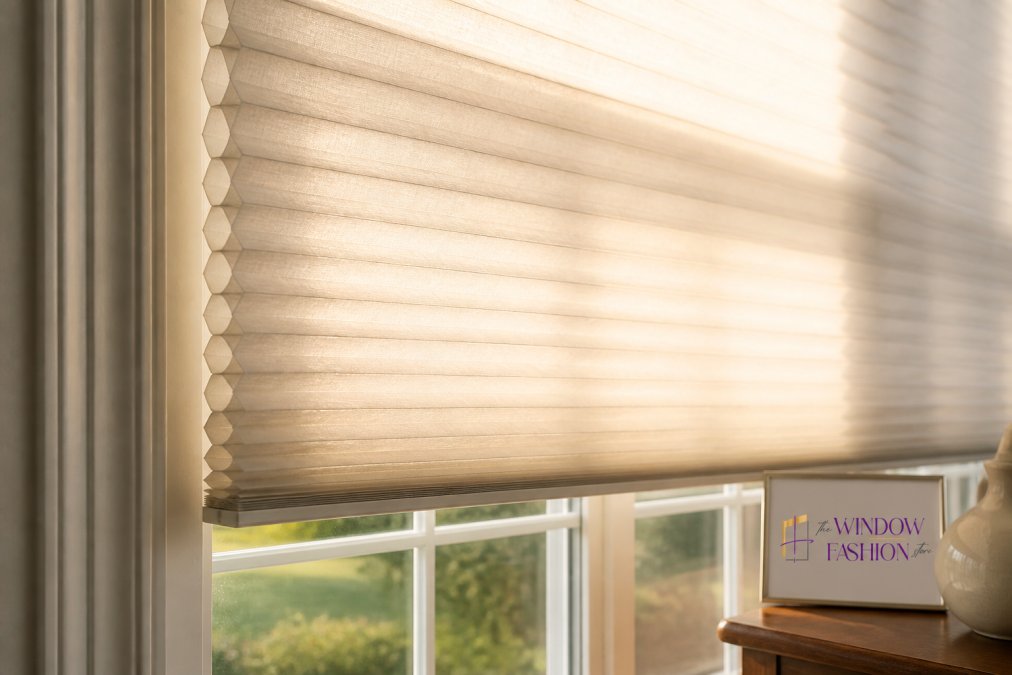
The fabric itself matters too. Many cellular shades use fiber batting or quilted construction within each cell wall, adding another layer of thermal resistance. Cellular shades energy efficiency is also enhanced by fit. A shade that leaves gaps at the sides or doesn’t reach the sill allows convective air currents to bypass the insulating cells entirely (peer-reviewed research). This is why custom-fit shades consistently outperform off-the-shelf options: the thermal performance only works when coverage is complete.
Single-Cell vs. Double-Cell vs. Triple-Cell: Which R-Value Do You Need?
The number of honeycomb layers directly determines insulating performance:
| Configuration | Air Pockets | Typical R-Value Range | Best For |
|---|---|---|---|
| Single-cell | 1 per cell | R-3 to R-4 | Mild climates, interior rooms |
| Double-cell | 2 per cell | R-4 to R-5.5 | Mixed climates, living areas |
| Triple-cell | 3 per cell | R-5.5 to R-8+ | Extreme climates, large windows |
Single-cell shades offer solid improvement over bare glass. Double-cell is the most popular choice for main living areas and bedrooms, balancing thermal performance with a wider range of fabric and opacity options. Triple-cell is worth the additional investment in rooms with large, sun-exposed windows or in homes where heating and cooling costs are a persistent concern.
If you have a room with floor-to-ceiling windows or a western exposure that bakes in afternoon sun, triple-cell honeycomb shades are the single highest-impact product change you can make.
Light Filtering, Room Darkening, and Blackout Lining Options
Cellular shades come in three main opacity levels:
- Light filtering: Diffuses sunlight without blocking it. Maintains passive heating benefits in winter while softening glare.
- Room darkening: Blocks most light but allows some to pass around edges. Reduces solar heat gain significantly.
- Blackout lining: Eliminates virtually all light transmission. Maximizes solar heat gain control in summer.
In climates with harsh summers, lean toward room darkening or blackout lining on south and west exposures. In climates with cold winters, light filtering on south-facing windows lets you capture free passive heating on sunny days.
Comparing Energy Efficient Shade Types: Cellular, Roller, Roman, and Insulating Panels
Cellular shades lead on pure insulation performance, but other options serve different needs:
| Shade Type | Insulation Level | Solar Heat Gain Control | Best Climate Use |
|---|---|---|---|
| Cellular (honeycomb) | High (R-3 to R-8+) | Moderate to high | All climates |
| Quilted roller shades | Moderate | High with blackout layer | Hot, sunny climates |
| Roman shades with thermal lining | Moderate | Moderate | Mixed climates |
| Insulating panels / cellular panels | High | High | Cold climates, large windows |
Roller shades with reflective or blackout backing are effective at reducing solar heat gain in summer but offer minimal insulating value against conductive heat loss in winter. Roman shades can be lined with thermal or blackout fabric to improve energy performance, but the flat fold design doesn’t create the air-pocket barrier that cellular construction does.
Climate-Specific Recommendations: Hot Summers vs. Cold Winters
Climate is the single variable most guides ignore, and it changes the right answer significantly.
Hot-summer climates: Prioritize low SHGC. Quilted roller shades with reflective backing or double-cell cellular shades in room darkening fabric are effective. Focus on south and west exposures where afternoon sun drives the most heat gain.
Cold-winter climates: Prioritize R-value. Triple-cell cellular shades on all exterior windows make a measurable difference. Light-filtering options on south-facing windows allow passive heating on clear days.
Mixed climates: Double-cell cellular shades in light-filtering fabric give you flexibility to manage both scenarios. Pair with motorization so you can adjust positioning automatically based on time of day and season.
Buying shades based on appearance alone in a climate with extreme seasonal swings is a common and costly mistake. A shade that looks perfect but has a single-cell construction and no blackout lining will underperform a well-chosen double-cell alternative by a wide margin.
Smart Motorized Shades for Home Insulation: Automation Meets Thermal Comfort
Smart motorized shades for home insulation represent the most significant evolution in window treatment performance over the past decade. The energy efficiency of any shade depends not just on its construction, but on whether it’s actually deployed at the right time. Manually adjusting shades across a whole house is a habit most people don’t sustain.
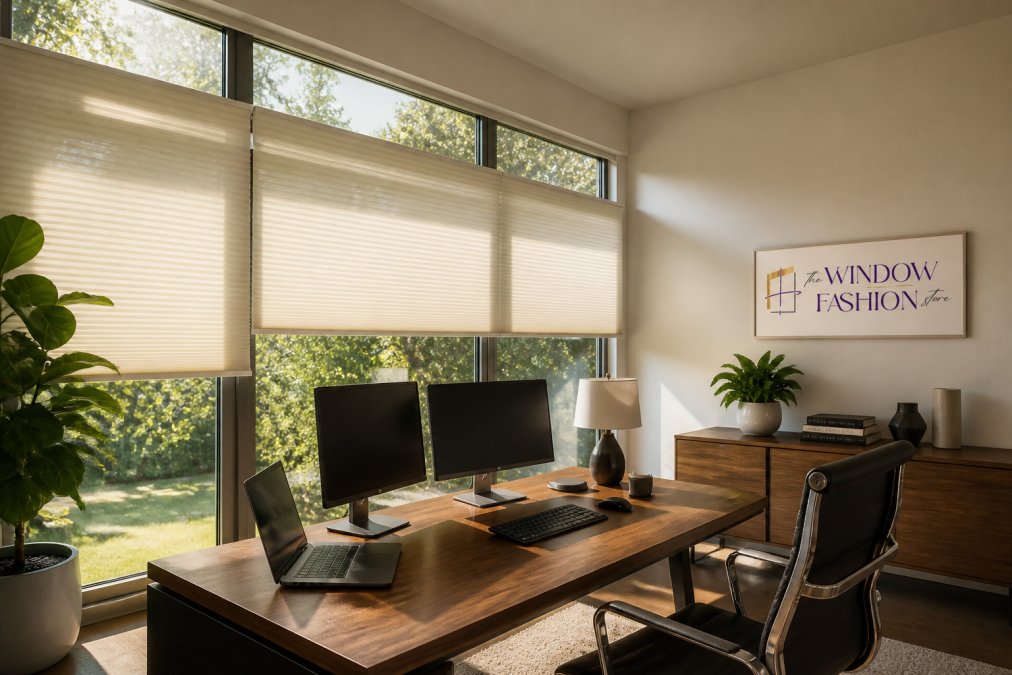
Motorized systems from manufacturers like Hunter Douglas, Alta Window Fashions, Norman, and Texton allow shades to respond to schedules, sun position, and smart home commands. A shade that lowers automatically at 2 PM on west-facing windows during summer, before the peak heat gain period, does more thermal work than a manually operated shade that gets adjusted inconsistently. Integration with smart home platforms means energy efficient shades can work in coordination with your thermostat, lowering automatically when the HVAC system detects a temperature rise and closing at night to retain indoor warmth.
For homes with many windows or difficult-to-reach skylights, motorization removes the practical barrier to actually using the shades as intended.
You can explore the full range of motorized options at The Window Fashion Store’s Motorized Blinds & Shades page.
ROI and Energy Savings: What to Realistically Expect
The payback calculation for energy efficient shades depends on your current window situation, climate, energy rates, and how consistently the shades are used. Homes with older single-pane windows in extreme climates see the largest gains.
- Cellular shades on older single-pane windows can meaningfully reduce heat loss in winter and solar heat gain in summer.
- The payback period for quality cellular shades is typically measured in years, not decades, especially when you factor in the extended lifespan of custom-fit products.
- Motorized shades that operate on a schedule tend to deliver better real-world energy performance than manual shades, because they’re actually used consistently.
According to Lawrence Berkeley National Laboratory’s window energy efficiency research, window treatments that improve thermal resistance can reduce heating and cooling loads in residential buildings, with the magnitude depending heavily on existing window quality and climate zone.
Energy efficient shades are not a replacement for window upgrades in severely deteriorated frames or single-pane glass. They’re a complement to good windows, not a substitute for them.
The ROI on cellular shades is real, but it’s not dramatic in year one. The value compounds over the product’s lifespan, typically 10 to 20 years for quality custom shades, and is highest in homes with high energy costs, extreme climates, or large window areas.
How to Measure Windows for Custom Shades (and Why Precision Matters)
Getting the measurement right is where the thermal performance of energy efficient shades either succeeds or fails. A shade that’s a quarter-inch too narrow on each side creates a gap that allows convective air movement around the cellular structure, defeating most of the insulating benefit.
Custom shades require two distinct measurement approaches depending on mount type:
Inside mount: Measure the exact width of the window opening at the top, middle, and bottom. Use the narrowest measurement. Measure height on the left, center, and right. Use the tallest measurement.
Outside mount: Measure the width of the area you want covered, adding overlap on each side to prevent light gaps. Measure the height from the mounting point to where you want the shade to fall, adding coverage above the frame.
The most common mistake is measuring only once, at one point. Professional measurement eliminates this risk entirely. Our Design Gallery features full-sized displays of every Hunter Douglas, Alta Window Fashions, Norman, and Texton product we sell, so you can see exactly how products look and function before committing. You can see products, function, choices, fabric and colors for any product in the store. For personalized guidance, schedule an in-home design consultation where we can bring small sample books to help you pick the right window coverings in the comfort of your own home.
Professional Window Treatment Installation: What the Process Looks Like
Professional installation matters more for energy efficient shades than for almost any other window covering type. The thermal performance depends on a tight, precise fit, and that requires accurate mounting, level brackets, and proper adjustment.
A typical professional installation process looks like this:
- Pre-installation measurement confirmation: The installer verifies all measurements against the fabricated shade dimensions before mounting anything.
- Bracket placement and leveling: Brackets are positioned to ensure the shade hangs plumb and covers the window opening completely.
- Shade mounting and travel adjustment: The shade is hung, tested through its full range of motion, and adjusted for smooth, consistent operation.
- Fit verification: The installer checks for light gaps at the sides, top, and bottom, and makes any necessary adjustments.
- Operation walkthrough: For motorized shades, the installer programs schedules, connects to smart home systems, and walks through operation with the homeowner.
The difference between a professionally installed cellular shade and a self-installed one is often visible in the gaps.
Maintenance and Cleaning to Preserve Thermal Efficiency
The thermal efficiency of cellular shades depends on the integrity of the cells themselves. Compressed, dusty, or damaged cells lose their air-pocket insulating capacity over time.
Dusting: Use a soft brush attachment on a vacuum at low suction, working from top to bottom. Quarterly is a reasonable baseline.
Spot cleaning: Most cellular shade fabrics can be spot-cleaned with a damp cloth and mild soap. Avoid saturating the fabric, as excessive moisture can distort the cell structure. Always blot rather than rub.
What to avoid: Dry cleaning solvents, abrasive cleaners, and high-pressure steam can all damage the fiber batting or cell structure. Once cells are compressed or the fabric is distorted, the thermal resistance of that section is compromised.
For motorized shades, periodic lubrication of the drive mechanism (per manufacturer guidelines) keeps operation smooth and prevents the motor from working against stiff fabric.
A well-maintained cellular shade installed in 2026 should still be performing at close to its original thermal efficiency a decade later.
Windows are responsible for a disproportionate share of home energy loss, and the right window treatments are one of the most practical ways to address that without a construction project. The Window Fashion Store carries the full range of Hunter Douglas, Alta Window Fashions, Norman, and Texton products, including the complete cellular shade lineup in every cell configuration, opacity level, and motorization option. Our Design Gallery has full-sized working displays of every product we sell, so you can see exactly how double-cell versus triple-cell construction looks and feels in real light before you commit. We sell custom window treatments, provide exact measurements and professional installation in our local service area. We exclusively install and service products purchased directly through our store (Hunter Douglas, Alta, Norman, and Texton). We do not offer repair or installation services for outside brands, big-box store products, or customer-provided drapery. Schedule a free consultation and we’ll help you identify the right energy efficient shades for every window in your home, measure precisely, and handle installation so the thermal performance is everything it should be.
Frequently Asked Questions
What are the most energy-efficient shades for residential use?
Cellular (honeycomb) shades are widely regarded as the top choice for thermal resistance. Their air-filled pockets trap heat in winter and block solar heat gain in summer, giving them the highest R-value among common window coverings. Double-cell and triple-cell configurations perform better than single-cell versions. For rooms with intense sun exposure, quilted roller shades with a blackout lining or insulating panels are strong alternatives. The best option depends on your window orientation, local climate, and how much natural light you want to preserve.
How do cellular shades help with home insulation?
Cellular shades trap air inside their honeycomb-shaped cells, creating a thermal barrier between the glass and your living space. This reduces heat transfer in both directions: warmth stays inside during cold months, and solar heat gain is blocked during summer. The more cell layers a shade has, the higher its thermal resistance, or R-value. A properly fitted cellular shade that covers the full window opening with minimal side gaps delivers the most consistent insulation. Custom sizing ensures there are no light or air gaps that would undermine that performance.
Can energy-efficient window treatments really lower utility bills?
Yes, though the actual savings depend on your home’s existing insulation, window quality, climate, and how consistently you operate the shades. The U.S. Department of Energy notes that window treatments can reduce heat loss through windows significantly during winter and cut solar heat gain in summer. Homes with older single-pane windows tend to see the most noticeable impact. Pairing cellular shades or insulating panels with a smart motorized system that adjusts automatically by time of day or temperature maximizes those energy savings year-round.
What is the difference between thermal shades and standard window blinds?
Standard blinds, like aluminum or faux-wood slats, primarily control light and privacy. They offer minimal insulation because the slats leave gaps and the material itself has very low thermal resistance. Thermal shades, by contrast, use materials specifically chosen for their insulating properties: fiber batting, honeycomb cells, or quilted fabrics with reflective or blackout lining. They create a more complete seal against the window surface. The result is measurably better temperature regulation and lower energy consumption compared to standard blinds used in the same window opening.
Are motorized shades more energy efficient than manual options?
The shade material determines insulation performance, not the operating mechanism. However, smart motorized shades for home insulation consistently outperform manual shades in practice because they actually get used correctly. Automated schedules raise shades for passive heating on winter mornings and lower them to block solar heat gain on summer afternoons, without relying on anyone remembering to do it. That consistency is where the real energy savings come from. Motorized systems can also integrate with smart home platforms and thermostats for fully coordinated climate control.
How do I measure windows for custom shades accurately?
Measure the width and height of the window opening at three points each (top, middle, and bottom for width; left, center, and right for height) and record the smallest measurement. For an inside mount, use those smallest dimensions exactly. For an outside mount, add at least 3 inches on each side to maximize coverage and minimize light gaps. Always measure in inches and double-check before ordering. Even small errors create gaps that undermine both the appearance and the thermal efficiency of the shade, which is why professional measurement before a custom order is strongly recommended.