


Table of Contents
- Why Motorized Window Treatments Belong in a Smart Home
- Types of Motorized Shades and Blinds: Roller, Roman, and Beyond
- Smart Home Integration for Window Treatments
- Hardwired vs. Battery Motorized Shades: Which Is Right for You?
- Energy Efficiency, Privacy, and Cybersecurity of Motorized Window Treatments
- Accessibility, Long-Term Maintenance, and Battery Lifecycle
- Custom Window Treatment Design Consultation: See It Before You Buy
- Conclusion
Last Updated: August 27, 2026
Motorized window treatments are one of the most impactful upgrades you can make to a smart home. Home automation with motorized window treatments means more than just remote control convenience; it means precision light management, energy savings, and seamless integration with the smart home systems you already use. The most important thing most guides skip? Seeing the product in person before you commit. Fabric, opacity, and motor behavior look completely different on a full-sized display than in a catalog photo.
Why Motorized Window Treatments Belong in a Smart Home
Motorized window treatments are not a luxury add-on. For homes with high windows, large glass panels, or complex light management needs, they’re the practical choice.
Manual cords on high windows are a daily frustration. Cordless safety requirements from the Window Covering Safety Council guidelines have made corded treatments increasingly obsolete in homes with children, and motorized systems eliminate that risk entirely. The ability to schedule shades to open at sunrise and close before afternoon heat builds is a genuine quality-of-life improvement. Automated scheduling means your window coverings do their job consistently, protecting floors, furniture, and artwork from UV damage.
The real argument for motorization is integration. A shade that responds to your thermostat, your alarm clock, and your voice assistant is a fundamentally different product than a standalone remote-controlled shade.
If you’re building out a smart home from scratch, plan your window covering automation alongside your lighting and HVAC systems. Coordinating these three systems in a single scene setup produces results that none of them can achieve independently.
Types of Motorized Shades and Blinds: Roller, Roman, and Beyond
Motorized window treatments cover a wide product range, and the right type depends on your room’s function, architecture, and aesthetic goals.
Roller shades are the most common motorized option. They’re clean, minimal, and available in everything from sheer light-filtering fabrics to full blackout materials. The motorized lift system integrates naturally into the roller mechanism, making them one of the easiest products to automate without visible hardware.
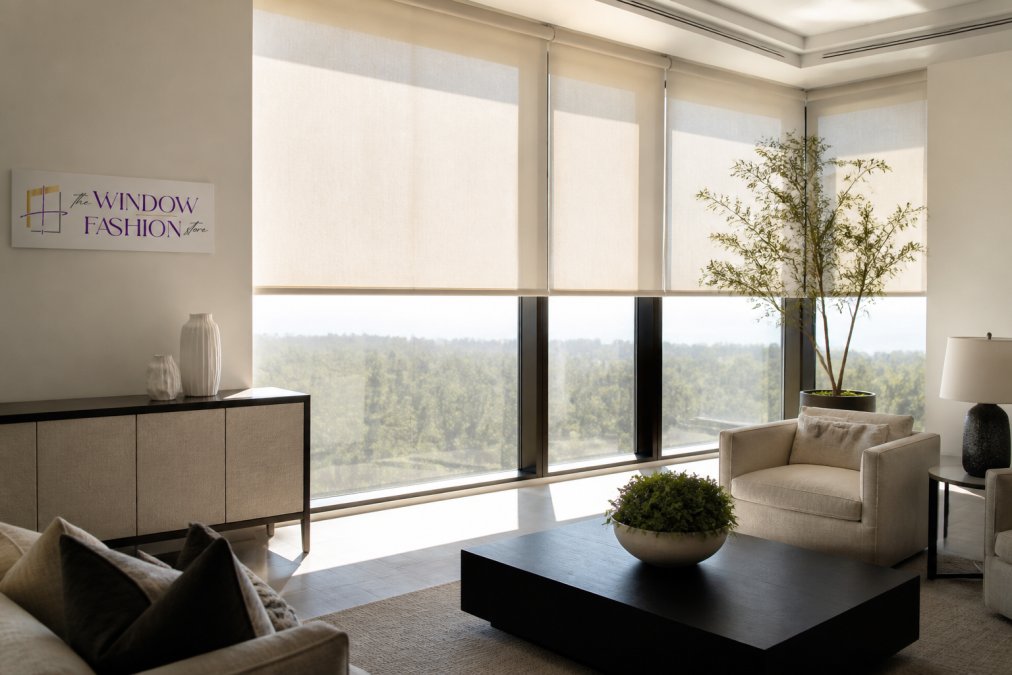
Roman shades bring a softer, more tailored look and work particularly well in dining rooms and bedrooms where the fabric stack and fold pattern is part of the design. Cellular shades are the energy-efficiency standout, with their honeycomb structure trapping air and providing thermal insulation at the glass. Motorized options extend to woven wood shades, drapery systems, and exterior solar shades. The best way to understand your options is to see them at full scale.
Light Filtering vs. Blackout Options
Light filtering fabrics diffuse sunlight while maintaining daytime privacy, ideal for living rooms and offices. Blackout fabrics block light completely, making them the right choice for bedrooms and media rooms. In a motorized system, blackout shades benefit more from precise scheduling because even a few minutes of morning light can disrupt sleep. Light filtering shades work well in scene-based automation where the goal is ambiance rather than total darkness.
Motorized window treatments are inherently cordless, satisfying safety standards for child and pet safety. UV protection varies by fabric opacity; a light filtering fabric blocks a meaningful portion of UV radiation, while a blackout fabric blocks it entirely.
Smart Home Integration for Window Treatments
Smart home integration for window treatments works across several connectivity protocols: Wi-Fi, Z-Wave, Zigbee, and proprietary RF systems. Hub-based automation platforms including Amazon Alexa, Google Home, Apple HomeKit, and Control4 each support different subsets of these protocols. Before selecting a motorized product, confirm its compatibility with your existing smart home bridge or hub.
According to the Z-Wave Alliance’s smart home adoption data, Z-Wave remains one of the most reliable protocols for home automation devices because it operates on a dedicated frequency that avoids Wi-Fi congestion. For window covering automation in larger homes with many devices, this matters more than most buyers realize.
Voice Command Integration and App Control
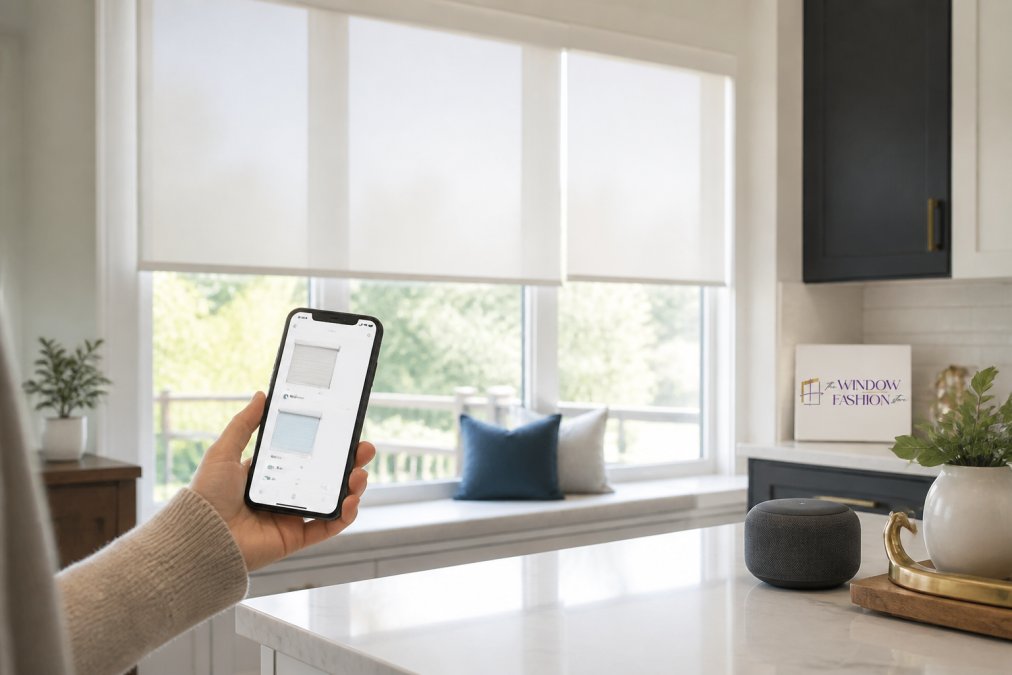
Voice command integration is one of the most-requested features in motorized window treatments. Most current systems support Alexa, Google Assistant, and Siri through either native integration or a smart home bridge. Voice commands work best for simple open/close/set-to-50% instructions. For complex multi-room scenes, app control or scheduled automation is more reliable.
App control gives you precise adjustment from anywhere, useful for managing light and heat while you’re away. The app experience varies by manufacturer, so testing the interface before committing to a system is worth doing.
Automated Scheduling and Scene Setting
Automated scheduling is where motorized window treatments move from convenient to genuinely smart. A morning scene might raise bedroom shades at 7:00 a.m., lower living room shades to 50% at 2:00 p.m. to block peak heat, and close everything at sunset. Scene setting allows multiple shades across different rooms to respond to a single trigger, a "movie mode" scene, for example, could lower blackout shades in the media room while leaving the kitchen shades open.
Daylight harvesting takes this further: some systems integrate with light sensors to adjust shade position automatically based on actual sunlight intensity rather than a fixed schedule. This is particularly effective for offices where consistent lighting levels matter throughout the day.
Hardwired vs. Battery Motorized Shades: Which Is Right for You?
The choice between hardwired motors and battery-operated shades is one of the most practical decisions in any motorized window treatment project.
| Factor | Hardwired Motors | Battery-Operated Shades |
|---|---|---|
| Power reliability | Continuous, no interruption | Depends on battery lifecycle |
| Installation complexity | Requires electrical work | No wiring needed |
| Best for | New construction, major renovation | Retrofit, rental, existing homes |
| Long-term maintenance | Minimal once installed | Battery replacement every 1-3 years |
| Ideal window count | Large installations, many windows | Smaller installations or single rooms |
Hardwired motors are the cleaner long-term solution. Once installed, they require essentially no ongoing maintenance and deliver consistent performance. The tradeoff is installation complexity: running power to window locations requires planning, and in an existing home, that often means opening walls. Hardwired systems are the right choice for new construction or full renovations where electrical rough-in is already part of the project.
Battery-operated shades are the retrofit solution. They install without any electrical work, making them practical for existing homes, rental properties, or anyone who wants to add motorization without a construction project. Most battery-powered motors run for one to three years on a charge, depending on usage frequency and motor type. Rechargeable battery wands have improved this significantly, but it remains an ongoing maintenance task.
Don’t underestimate battery lifecycle in a large installation. A home with 20 battery-operated shades requires a real maintenance schedule. For installations over 10 windows, hardwired motors are worth the upfront investment.
Energy Efficiency, Privacy, and Cybersecurity of Motorized Window Treatments
Motorized window treatments deliver real energy performance, but only when they’re actually being used consistently.
Thermal Regulation and Daylight Harvesting
Thermal regulation through window coverings works by reducing solar heat gain in summer and limiting heat loss through glass in winter. Cellular shades with motorized automation are particularly effective because their insulating honeycomb structure works best when the shade is fully deployed, something automated scheduling makes reliable.
Daylight harvesting, documented in commercial building energy standards from the U.S. Department of Energy’s Building Technologies Office, uses automated shade positioning to optimize natural light while reducing HVAC load. In residential applications, keeping shades at the right position throughout the day reduces both cooling costs in summer and heating demand in winter.
IoT Device Security and Privacy Control
Motorized window treatments connected to your home network are IoT devices. Like any IoT device, they introduce potential security considerations. An unsecured smart home device can serve as an entry point to your network, and shade position data (when you’re home, when you’re asleep, when you’re away) is behavioral information worth protecting.
The Cybersecurity and Infrastructure Security Agency’s smart home security guidance recommends keeping IoT devices on a dedicated network segment separate from computers and phones. Setting up a guest Wi-Fi network specifically for smart home devices is a five-minute configuration change that meaningfully reduces exposure.
Motorized shades that close automatically at sunset mean your home’s interior isn’t visible from outside during evening hours, without relying on anyone remembering to close them manually.
Accessibility, Long-Term Maintenance, and Battery Lifecycle
Motorized window treatments are one of the clearest examples of universal design in home furnishings. For homeowners with mobility limitations, arthritis, or other physical constraints, the ability to operate every window covering in a home from a single app or voice command is transformative.
The U.S. Access Board’s accessibility guidelines address reach range requirements, but the residential application is equally compelling. A motorized system means window coverings on high windows, in awkward corners, or behind furniture are just as accessible as any other window in the home.
Long-term maintenance for motorized systems is genuinely low. The motors in quality products are built for tens of thousands of cycles and rarely require service. Main maintenance tasks include battery replacement or recharging (every one to three years for battery systems), fabric cleaning per manufacturer guidelines, motor firmware updates, and annual inspection of mounting hardware.
Motorized window treatments require less maintenance than most homeowners expect. For battery systems, set a calendar reminder annually for battery replacement and you’ll rarely be caught off guard.
Custom Window Treatment Design Consultation: See It Before You Buy
The single most important step in any motorized window treatment project is seeing the product at full scale before you commit. Fabric swatches and online photos do not tell you how a shade will look when it’s eight feet tall and deployed across a large window. Light filtering behavior, fabric texture, and color in your specific room’s light are things you need to see in person.
The Window Fashion Store’s Design Gallery is built specifically for this. We carry full-sized displays of every Hunter Douglas, Alta Window Fashions, Norman, and Texton product we sell, so you can see exactly how each product looks and operates before making a decision. You can evaluate fabric opacity, motor operation, and color choices at the scale they’ll actually appear in your home.
For homeowners who prefer to start at home, we also offer in-home design consultations where we bring sample books to you. Seeing fabrics in your actual room light, against your existing finishes and furniture, often changes the decision in ways that a showroom visit alone can’t replicate.
Custom window treatments also mean exact measurements. Off-the-shelf products leave light gaps at the edges and top; custom sizing eliminates that entirely. Professional installation ensures the motorization operates correctly from day one.
We exclusively install and service Hunter Douglas, Alta, Norman, and Texton products purchased through our store. That focus means our installation team knows these products thoroughly, and our service relationship extends beyond the initial install.
Choosing motorized window treatments involves more decisions than most homeowners anticipate: motor type, connectivity protocol, fabric opacity, integration compatibility, and installation approach all need to align. The Window Fashion Store has guided this process for over 20 years, and our Design Gallery exists specifically to make those decisions easier. Visit us to see every product at full scale, or schedule a free in-home consultation to explore your options in the comfort of your own home. Book your free consultation at The Window Fashion Store’s scheduling page and get the right answer the first time.
Frequently Asked Questions
Can I automate my existing window blinds?
Some retrofit motor kits can add automation to certain existing blinds, but results vary widely by product age, mounting style, and compatibility with your smart home ecosystem. For reliable performance and full smart home integration, most homeowners get better results starting with purpose-built motorized window treatments. A design consultation can help you assess whether retrofitting makes sense or whether new custom motorized shades are the better long-term investment.
What should I consider when choosing between battery-powered and hardwired motorized shades?
Battery-operated shades install without an electrician and work well in most rooms, though batteries typically need recharging or replacing every one to three years depending on usage. Hardwired motors never need battery maintenance and suit high-use windows or new construction where wiring is accessible. Your choice often comes down to how many windows you're covering, how frequently the shades will move, and whether your home is under renovation or already finished.
What are the primary benefits of integrating window treatments with home automation?
Automated motorized window treatments let you control light, privacy, and temperature across your entire home from a single app, voice command, or pre-set schedule. Practical benefits include UV protection for furniture, improved thermal regulation that reduces HVAC load, cordless safety for households with children, and the convenience of scene setting, where shades across multiple rooms adjust simultaneously at sunrise, sunset, or a movie-night trigger.
Are there energy-saving advantages to automated window treatments?
Yes. Motorized shades programmed for daylight harvesting can lower on south- and west-facing windows during peak afternoon heat, reducing cooling demand. In winter, closing insulating shades at dusk retains heat. The U.S. Department of Energy notes that window treatments are among the most accessible ways to reduce residential heating and cooling costs, and automation ensures those adjustments happen consistently rather than relying on manual habits.