


Table of Contents
- Start With How You Sleep, Not the Shade Catalog
- Motorized Shades for Privacy and Light Control
- Motorized Blackout Shades for Bedrooms: Fabric Density and Light Gaps
- Battery-Powered Motorized Shades vs. Hardwired and Plug-In
- Smart Shades for Bedroom Windows: Controls, Routines, and Noise
- Measurements, Mounting, and Light-Leak Prevention
- Safety, Maintenance, and Total Cost of Ownership
- Conclusion: Book a Design Consultation
- Frequently Asked Questions
Last Updated: October 19, 2026
Start With How You Sleep, Not the Shade Catalog
Choosing motorized shades for bedrooms starts with one question: what wakes you up? If morning sun hits your pillow at 5:40 a.m. in June, no fabric swatch matters until you solve that. At The Window Fashion Store, we’ve spent over 20 years helping homeowners match window coverings to how they actually sleep, not to what looks good in a catalog.
Most guides jump straight to motors and apps. That’s backwards.
Light control comes first, privacy second, convenience third. Get those in order and the technology decisions become simple.
Below, we’ll walk through the whole process: fabric density, power options, controls, measurements, and the small installation details that decide whether a bedroom shade actually delivers darkness. Here’s what most guides get wrong: they treat the bedroom like any other room. It isn’t. You sleep there, you change clothes there, and you notice every sliver of light at 6 a.m.
Motorized Shades for Privacy and Light Control
Motorized shades for privacy and light control solve two problems at once: they block sightlines from outside and they manage how much sun enters the room. The right combination depends on your window orientation and what’s across the street.
North-facing bedroom windows rarely need full blackout. A light-filtering fabric keeps the room bright but private.
South and west windows are different. Afternoon sun through west glass heats a bedroom fast, and motorized shades let you schedule them to close before the room overheats.
For street-level bedrooms, privacy matters more than view. Sheer or light-filtering shades let you see out during the day while blocking the view in.
Set your privacy shades to close at dusk automatically. You’ll never again walk into a lit bedroom with the shades up and realize the whole street can see in.
Motorized Blackout Shades for Bedrooms: Fabric Density and Light Gaps
Motorized blackout shades for bedrooms only work if the fabric and the edges both block light. A blackout fabric with a visible gap at the sides still lets in a bright line at sunrise.
Fabric density is the first check. Hold a swatch up to a lamp. If you can see the glow through it, it’s not blackout.
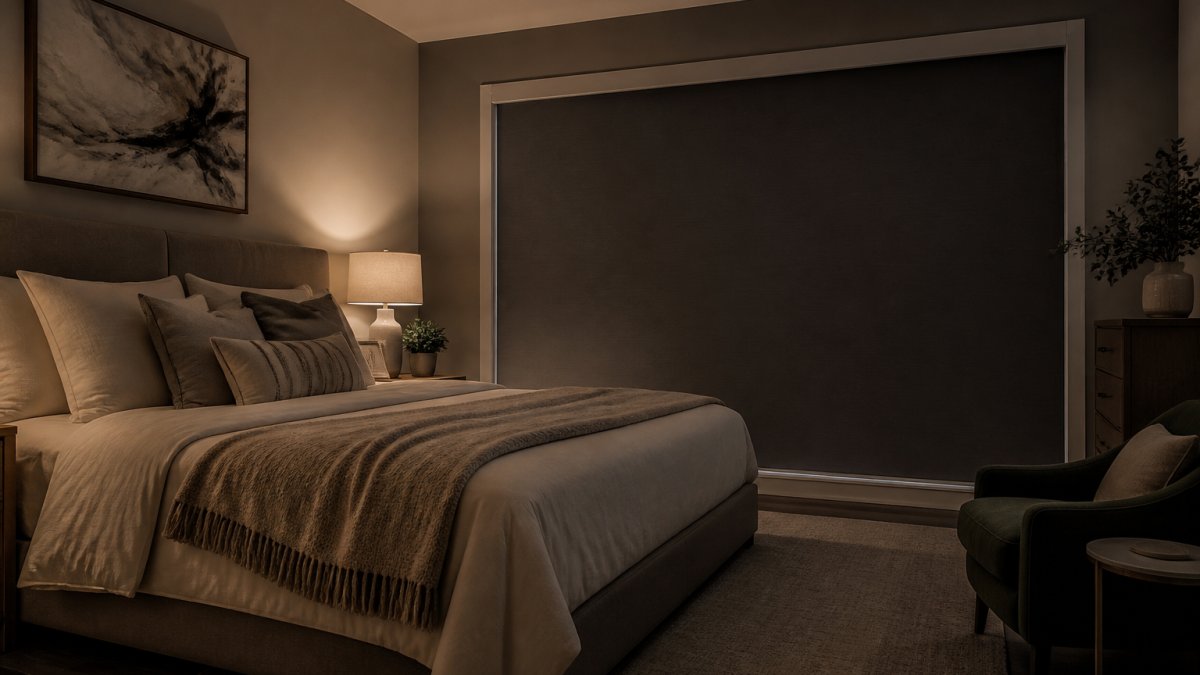
The second check is the edges. Inside-mount shades sit closer to the glass, which cuts side light. Outside-mount shades cover more of the wall and trim but can still leak at the top.
Ask about side channels and top fascia. These small hardware pieces close the gaps that fabric alone can’t.
One honest limitation: true blackout in a bedroom usually means accepting a shade that covers part of your trim. If you love the trim, decide early which matters more.
Battery-Powered Motorized Shades vs. Hardwired and Plug-In
Battery-powered motorized shades are the most common choice for bedrooms because they need no electrician and no wiring inside the wall. Rechargeable lithium batteries typically last several months to a year between charges, depending on how often the shade moves and how heavy the fabric is.
Here’s how the three power options compare on the details that matter in a bedroom:
| Power Option | Best For | Battery / Wiring Reality | Outage Behavior | Ongoing Maintenance |
|---|---|---|---|---|
| Rechargeable battery | Most bedrooms, retrofits, rentals | Months between charges; charging port usually on the motor head or a removable battery pack | Shade stays where it is; no movement until power returns | Recharge on a routine; replace battery pack after several years |
| Plug-in power | Bedrooms with an outlet near the window | Continuous power; visible low-voltage cord to manage | Shade stops; no movement until power returns | Cord management; check plug seating occasionally |
| Hardwired power | New builds and remodels | Wired to a switched circuit; no battery to charge | Depends on circuit; often no movement during an outage | Essentially none beyond dusting |
Hardwired is the cleanest long-term answer if you’re building or remodeling. Plan the wiring before drywall goes up, and decide where the switch will live so it’s reachable from the bed or the door.
Plug-in works well when an outlet sits near the window. You’ll want a cord management plan, especially in a nursery or a bedroom where a toddler can reach the cord. Route the cord behind furniture or use a cord cover, and keep the plug accessible so you can unplug it for cleaning.
Battery access is the detail that decides whether you’ll actually keep up with charging. Ask where the battery or charging port sits before you commit. If the shade is behind a heavy dresser or above a tall headboard, you’ll be climbing to reach it.
Don’t put a battery-powered shade on a window you open daily unless you’ve checked the battery access point. Climbing behind furniture to recharge a shade gets old fast, and a shade you stop charging is a shade that stops working.
Set a charging reminder for the same month each year, and keep a spare battery pack on hand if your motor uses a removable one. That way a dead battery never leaves you with a dark bedroom and no backup.
Power reliability matters over years, not weeks. A rechargeable battery will eventually need replacement, so ask about battery access, replacement parts, and whether the motor reports low battery before it dies. A shade that warns you at 20 percent is easier to live with than one that quits at 6 a.m. on a Saturday.
Smart Shades for Bedroom Windows: Controls, Routines, and Noise
Smart shades for bedroom windows add scheduling, app control, and voice commands to the basic motor. The real benefit in a bedroom is the routine: shades that close at sunset and open gently at wake-up time, without you getting out of bed to do it.
Controls to consider:
- Remote control for simple daily use, kept on the nightstand
- Wall switch for guests and family members who don’t know the app
- Mobile app for scheduling and remote access when you’re away
- Voice control through a smart speaker, useful when your hands are full
- Automation routines tied to sunrise, sunset, or your alarm
Smart-home compatibility matters if you already run a hub. Check that the shade works with your system before you buy, and confirm whether you need a separate hub or bridge to unlock scheduling and voice control.
Motor noise is the detail most buyers forget, and it’s the one that matters most in a bedroom. A quiet motor matters at 6 a.m. and at 10 p.m. Ask to hear a shade operate before you commit, especially for a nursery or a bedroom where one partner wakes easily.
Nighttime operation deserves its own plan. A shade that opens at sunrise is helpful; a shade that opens at 5:40 a.m. in June because you set the schedule in December is not. Use sunrise-linked schedules rather than fixed times, and set the opening time later than you think you need.
Individual window control beats whole-room automation in bedrooms. One sleeper may want darkness; the other may want morning light. Look for motors that let you group windows but still control each one separately, and keep a remote on each nightstand so neither sleeper has to reach across the room.
Test your automation for a week before you rely on it. Set the schedule, let it run, and adjust the opening time until it matches how you actually wake up. A routine you tuned in summer may need a different opening time in winter.
In a bedroom, the best smart feature isn’t the longest list of integrations. It’s a quiet motor, a schedule that respects your sleep, and a remote within arm’s reach.
Measurements, Mounting, and Light-Leak Prevention
Exact measurements decide whether a custom shade fits tight enough to block light. A quarter inch off and you’ll see a bright edge every morning.
Inside mount gives a cleaner look and better side light control. Outside mount covers more of the window and trim, which helps with odd sizes and shapes.
Bedroom installation and light-leak prevention come down to a few details:
- Measure the window depth to confirm the shade fits inside the frame
- Check for handles, cranks, or tilt rods that block an inside mount
- Plan side channels for blackout shades
- Confirm the headrail clears any window treatment already installed
- Account for trim width on outside mounts
Odd-shaped or oversized bedroom windows are where custom fit earns its keep. A standard-size shade will leave gaps a custom one won’t.
This is also where professional measurement pays off. We measure every window in the room, not just the one you’re worried about, because matching shades need matching dimensions.
Safety, Maintenance, and Total Cost of Ownership
Cordless operation is the safety baseline for any bedroom, especially one with children or pets. Motorized shades have no dangling cords by design, which removes a common strangulation hazard.
Maintenance is minimal but real:
- Recharge batteries on a routine, not when the shade dies
- Dust the fabric with a soft brush or vacuum attachment
- Check mounting hardware once a year
- Keep the motor’s remote paired and labeled
Power reliability matters over years, not weeks. A rechargeable battery will eventually need replacement, so ask about battery access and replacement parts before you buy.
Total cost of ownership includes the shade, the motor, the power option, installation, and any future battery replacement. Pricing depends on window size, fabric, and motor choice, so we quote each room individually rather than publish a number that won’t match your windows.
The cheapest motorized shade isn’t the one with the lowest sticker. It’s the one you don’t have to re-measure, re-mount, or replace in three years.
Conclusion: Book a Design Consultation
Picking shades for a bedroom is really a sleep project. Light control, privacy, power, and quiet operation all have to line up, and the details that decide it are easier to see in person than online.
At The Window Fashion Store, our Design Gallery has full-sized displays of every Hunter Douglas, Alta Window Fashions, Norman, and Texton product we sell, so you can see fabrics, colors, and how each shade actually operates. If you’d rather stay home, we bring sample books to you for an in-home design consultation.
We measure exactly, install professionally, and service only the products purchased through our store. Book a free consultation and let’s get your bedroom dark, quiet, and easy to live with.
Frequently Asked Questions
What are the downsides of motorized shades in a bedroom?
The main drawbacks are higher upfront cost than manual shades, reliance on a power source, and the need to plan for motor noise and light gaps before installation. Battery-powered motorized shades need periodic recharging, and hardwired options require an electrician if no wiring exists. Cheap motors can be louder and may not offer slow, quiet travel. Working with a dealer who measures and installs the shades prevents most of these issues, since fit and motor quality are decided before the order is placed.
Are blackout shades a good choice for bedrooms?
Yes, blackout shades are the best choice for most bedrooms because they block the light that disrupts sleep and early-morning wake-ups. The key is fabric density plus edge control: side channels, a fascia, and an inside mount reduce the glow around the edges. If you want some daylight on weekends, choose a blackout fabric with a top-down or dual-shade option so you can open part of the window. A design consultant can show fabric samples against your actual window light.
How do you choose between battery-powered and hardwired motorized shades?
Choose battery-powered motorized shades when there is no wiring near the window, when you rent, or when installation should stay simple. Choose hardwired or plug-in power when the window is easy to reach with an outlet or a low-voltage line, or when you want to avoid recharging altogether. In bedrooms, rechargeable battery shades are common because most windows lack an outlet, and modern lithium batteries last months between charges. Discuss the layout with your installer before ordering.
Can motorized shades be scheduled to open and close automatically?
Yes. Smart shades for bedroom windows can run on scheduled routines through a mobile app or a hub, so they rise at a set time and lower at sunset. You can also group shades, set scenes, and use voice control or a wall switch. Scheduling is especially useful for privacy and light control when you are away or when you want a gradual wake-up. Ask your consultant which hub or app works with the motor brand you choose, and confirm the setup during installation.