


Table of Contents
- Why Odd Shaped Windows Need a Different Measuring Approach
- Best Tools for Measuring Window Dimensions
- Step-by-Step: How to Measure Odd Shaped Windows
- Measuring Arched Windows for Blinds: Templates and Tolerances
- Troubleshooting Out-of-Square and Irregular Frames
- When to Choose Professional Window Measurement Services
- Frequently Asked Questions
Last Updated: September 10, 2026
Why Odd Shaped Windows Need a Different Measuring Approach
Measuring odd shaped windows is the practice of capturing width, height, radius, and angle at specific reference points, then recording them in a fixed order so nothing shifts between your first reading and your last. A standard rectangle gives you two numbers. An arch, circle, or trapezoid gives you five or more, and each one has to be taken from the same plane or the whole set is worthless.
This guide from The Window Fashion Store walks through the tools, the sequence, and the tolerances that decide whether a custom shade actually fits. Below, we’ll show you exactly how to handle arches, circles, and angled frames, plus the two mistakes that ruin most DIY measurements.
Here’s the part most guides skip: an odd-shaped window is rarely a perfect arch or a perfect circle. Real openings are slightly out of square, the drywall return varies in depth, and the frame itself may be racked by a fraction of an inch. Measure for the window you have, not the one on the blueprint.
For reference on how manufacturers define mounting types and clearance, the Window Covering Manufacturers Association guidance is worth reading before you pick up a tape.
The single most common failure is measuring the glass, not the window opening. The glass is smaller than the opening by the width of the frame and sash. Order to the glass and your new shade will be undersized, leaving light gaps on every edge.
Best Tools for Measuring Window Dimensions
The best tools for measuring window dimensions are a steel tape, a laser distance measurer, and a speed square. Add a level and a pencil, and you can handle nearly every irregular opening you’ll meet.
Essential Hand Tools
A 25-foot steel tape is still the workhorse for arches and circles because it flexes into a curve and holds a reading. Cheap tapes with loose hooks will cost you accuracy, so use one that passes a “burn an inch” check: start at the 1-inch mark and subtract it from your reading to avoid hook play.
The speed square is the tool nobody talks about. It confirms a true 90-degree corner at the sill and lets you mark a plumb line on a racked frame. A 24-inch level tells you whether the head and sill are parallel, which matters more on trapezoids than on anything else.
You’ll also want a notepad and a pencil rather than a phone. Screens lock, batteries die, and a paper sketch of the opening with every dimension written in place is the fastest thing to hand a designer.
Digital Measuring Tools
Laser distance measurers cut measuring time on tall windows and vaulted rooms where a tape sags. Point, fire, read. The catch is that a laser needs a flat, reflective surface, so it struggles on deep casing profiles and curved trim.
For arches specifically, a contour gauge or a flexible curve ruler lets you trace the actual curve onto paper. That traced profile becomes your template. Digital angle finders are the other useful addition: place one in the corner of a trapezoid and it reads the angle directly instead of you doing trigonometry.
What most guides miss is that digital tools are a supplement, not a replacement. Take the laser reading, then verify the critical dimensions with a tape. If the two disagree, the tape is usually right.
Step-by-Step: How to Measure Odd Shaped Windows
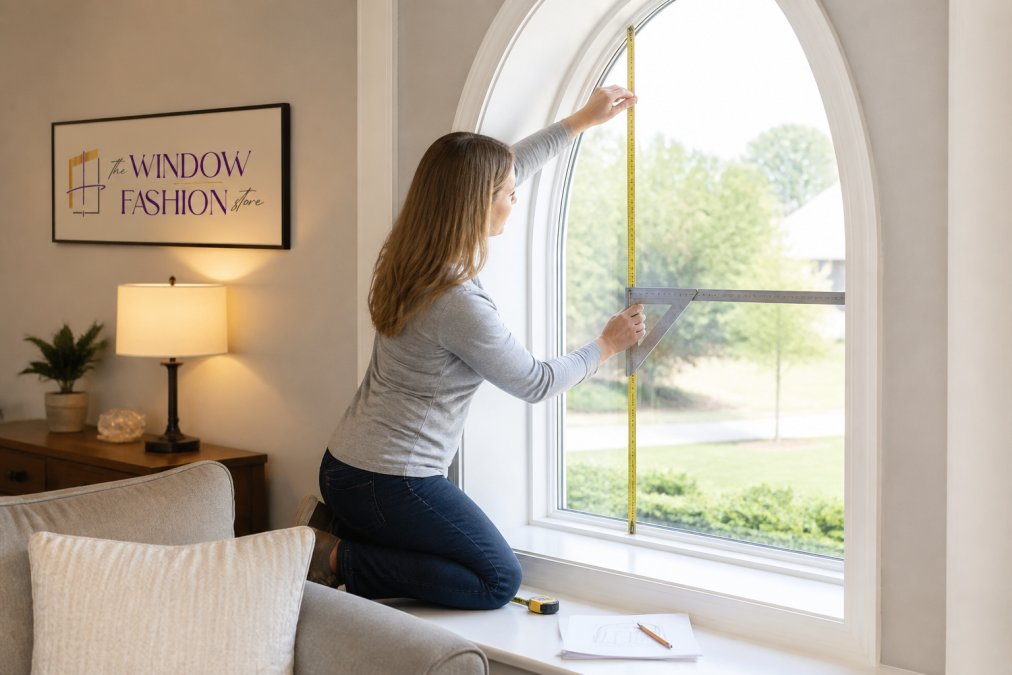
Start every odd-shaped window the same way: sketch the opening on paper, label each edge, and write dimensions directly onto the sketch as you take them. Measuring is the easy part. Recording in a fixed order is what prevents errors.
- Measure the width at the base, at the midpoint, and at the top of the opening
- Measure the overall height at the left edge, the center, and the right edge
- Record the tallest point and the straight-side height separately on any arched window
- Measure the frame depth from the front edge of the casing to the glass
- Check both diagonals corner to corner to test for square
- Note the mounting surface: inside the frame or on the face of the wall
Measuring Arched and Half-Moon Windows
An arched window needs four numbers, not two. Measure the base width across the widest point of the opening. Then measure the straight-side height, which is the vertical distance from the sill to where the curve begins. Finally, measure the tallest point, from the sill to the apex of the arch.
The arch radius is the fourth number, and it’s the one that gets skipped. If the arch is a true half-moon, the radius equals half the base width. If it’s a segmented arch, the radius is larger than half the base and you’ll need to trace the curve to capture it.
For blinds on arched windows, most manufacturers build the product to the rectangular portion and add a separate arch treatment above, so the straight-side height is the dimension that actually drives the order.
Measuring Circular and Round Windows
A circular window needs its diameter measured twice, once horizontally and once vertically. If the two readings differ, the opening is an oval or the frame is out of round, and you should order to the smaller dimension.
Measure the diameter at the widest point in both directions, then measure it again at a 45-degree angle as a cross-check. All three should match on a true circle. When they don’t, note the variance on your sketch so the designer knows the opening isn’t symmetrical.
Frame depth matters more on circles than on any other shape, because a circular shade has to sit flush against a curved surface. Measure depth at four points around the perimeter and use the shallowest reading.
Measuring Triangular and Trapezoidal Windows
A trapezoid has four sides and no right angles, so you need the top width, the bottom width, and the vertical height on both the left and right sides. Measure the base width first, then the top width, then each side height independently.
Triangles are simpler in principle: base width, vertical height, and the two diagonal sides. Measure all three sides even if the window looks symmetrical, because gable-end frames are frequently racked.
The diagonal measurement is your accuracy check on both shapes. On a trapezoid, both diagonals should be equal. If they aren’t, the frame is out of square and you’ll need the scribing approach covered below.
| Window Shape | Dimensions to Capture | Accuracy Check |
|---|---|---|
| Arch / half-moon | Base width, straight-side height, tallest point, arch radius | Radius equals half base width on a true half-moon |
| Circular | Horizontal diameter, vertical diameter, 45-degree diameter, frame depth | All three diameters match |
| Trapezoidal | Top width, bottom width, left height, right height | Both diagonals equal |
| Triangular | Base width, vertical height, two diagonal sides | Side lengths match the sketch |
Measuring Arched Windows for Blinds: Templates and Tolerances
Measuring arched windows for blinds comes down to one question: can you describe the curve in numbers, or do you need to trace it? If the arch is a clean half-moon, numbers work. If it’s a segmented or elliptical arch, make a template.
A template is a physical outline of the opening, traced onto cardboard or heavy paper and cut to shape. Tape it into the opening. If it sits flush against the frame on all sides, your measurements are correct. If it rocks or shows a gap, the frame is irregular and the template becomes the spec the fabricator works from.
Tolerance is the allowance for the difference between your measurement and the actual opening. Most custom window treatments are built with a small tolerance so the product can be adjusted on site. Measure to the nearest eighth of an inch, and never round up on an inside mount, because a shade that’s too wide simply will not fit.
Scribing is the fix for a frame that isn’t flat or square. You hold the product or template against the opening, trace the gap between the two, and trim to the traced line. It’s the difference between a shade that looks custom and one that looks like it was forced into place.
Photograph your sketch next to the window with the tape visible in frame. Designers can spot a misread dimension from a photo far faster than from a written number, and it saves a second site visit.
Troubleshooting Out-of-Square and Irregular Frames
An out-of-square frame is one where the diagonals don’t match. Measure corner to corner in both directions. If the readings differ by more than a small fraction, the opening is racked and a rectangular product will show a wedge-shaped gap along one edge.
The fix depends on the mount. For an outside mount, you can often square the product to the wall and let the casing absorb the difference. For an inside mount, you’ll need to order to the smallest width and height and plan on scribing the edges.
Irregular frames show up in other ways too. A sill that slopes, a head that bows, or a casing that varies in depth all cause gaps. Measure the frame depth at multiple points and use the shallowest figure, because a product that’s too deep for the opening won’t seat.
Safety matters here more than people expect. Working on a ladder near a tall arched window means keeping both hands free, so take the tape up with you but leave the notepad on the floor and call readings down (osha.gov). Never lean out over a sill to reach the far edge of an opening.
If you’re stuck, the honest answer is that some openings can’t be measured accurately from a photo or a phone call. That’s when a professional measurement pays for itself.
When to Choose Professional Window Measurement Services
Professional window measurement services make sense when an opening is irregular, when the window sits above furniture or a stairwell, or when you’re ordering custom treatments you can’t return. The cost of a remade shade almost always exceeds the cost of getting it measured correctly the first time.
At The Window Fashion Store, we’ve measured odd-shaped windows in the area for over 20 years, and the openings that go wrong are almost never the simple rectangles. They’re the arches with a non-standard radius, the trapezoids with racked frames, and the circles that turn out to be ovals.
We sell custom window treatments, take exact measurements, and handle professional installation, so the same team that measures is accountable for the fit. You can also see full-sized displays of every Hunter Douglas, Alta Window Fashions, Norman, and Texton product we carry in our Design Gallery, which makes it far easier to judge fabric and function before you commit.
If you’d rather not climb a ladder with a tape in one hand, the U.S. Consumer Product Safety Commission window covering safety guidance is a useful reminder of why corded and hard-to-reach treatments deserve a professional eye.
Measure to the smallest dimension on any irregular opening, record every number on a sketch, and make a template whenever the curve isn’t a true half-moon. Those three habits prevent nearly every ordering mistake.
Odd-shaped windows punish guesswork. The arch that looks symmetrical usually isn’t, and the frame that looks square rarely is. If you’d rather hand the tape to someone who measures these openings every week, The Window Fashion Store offers in-home design consultations where we bring sample books to your window, take exact measurements, and install the finished product ourselves. We install and service only products purchased through our store, so the measurement, the order, and the fit stay with one team from start to finish. Schedule a free consultation and get your odd-shaped windows measured right the first time.
Frequently Asked Questions
How do you measure windows that are not rectangular?
For non-rectangular windows, measure the widest point for base width, the tallest point for height, and the straight-side height. For arches, measure the arch radius and check the spring line. For circles, measure the diameter at three points. For trapezoids, measure top and bottom widths plus vertical height. Always note the frame depth and check for out-of-square corners before ordering custom treatments.
What tools are required to measure arched or circular windows?
You’ll need a steel tape measure, a laser distance measurer for tall arches, a speed square for checking corners, a level for plumb, and a flexible ruler or contour gauge for curves. For templates, use cardboard or heavy paper. A digital angle finder helps with trapezoids. These tools ensure accuracy for the best tools for measuring window dimensions, especially on irregular shapes.
Can I use a template to measure complex window angles?
Yes. Templates are essential for arched, circular, and trapezoidal windows. Trace the exact window opening onto cardboard, then transfer to paper. Mark the spring line, base width, and tallest point. Cut carefully and test-fit in the window. Templates capture the true shape and help your supplier fabricate a precise fit. This reduces tolerance issues and ensures your custom blinds or shades align perfectly.
Why is professional measurement recommended for custom window treatments?
Professional window measurement services eliminate guesswork on odd shapes. Experts use laser measurers, digital angle finders, and template-making skills to account for out-of-square frames, arch radius, and mounting surface irregularities. They also verify clearance for inside or outside mount. This prevents costly remakes and ensures your custom blinds, shades, or shutters fit correctly the first time.