


Last Updated: October 27, 2026
Quick Summary
To select the right opacity for bedroom shades, first track how you sleep for a week, then match one of the four opacity levels to your needs. Room-darkening is the sensible default for most primary bedrooms, while blackout suits light sleepers and shift workers.
- Shade opacity comes in four levels: sheer, light-filtering, room-darkening, and blackout.
- Light-filtering shades diffuse daylight but let shapes show through at night when the room is lit.
- Blackout fabric only works if fit closes the side, top, and sill gaps where light leaks.
- East-facing bedrooms usually need room-darkening at minimum, with blackout safer for light sleepers.
- If two sleepers disagree by more than one opacity level, split the treatment rather than the fabric.
Table of Contents
- Start With How You Sleep, Not the Fabric Swatch
- Know the Four Opacity Levels Before You Shop
- Light-Filtering Shades: Soft Daylight Without the Glare
- Room-Darkening Shades: The Middle Ground Most Bedrooms Need
- Blackout Shades for Bedroom Darkness That Actually Holds
- Test Nighttime Privacy Before You Commit
- How to Measure Windows for Custom Blinds So Opacity Works
- Match Opacity to Window Direction and Shared Bedrooms
- Frequently Asked Questions
Start With How You Sleep, Not the Fabric Swatch
Most people shop for bedroom shades by picking the prettiest fabric.
At The Window Fashion Store, we have over 20 years of experience in the Kansas City area. If you would rather sort through fabric options with an expert at home, read about the benefits of in-home design consultations.
Here are some questions to consider:
- Light sensitivity: Do you wake at first light, or sleep through it?
- Sleep schedule: Does everyone in the room go to bed and wake at the same time?
- Naps and shift work: Does anyone sleep during daylight hours?
Answer those four questions and the fabric decision gets much easier.
Know the Four Opacity Levels Before You Shop
Shade opacity measures how much light a fabric lets through, in four levels: sheer, light-filtering, room-darkening, and blackout. Each level changes both the daylight in the room and your nighttime privacy.
Here is how the four levels compare in practice:
| Opacity Level | Light Let Through | Privacy (Day) | Privacy (Night) | Best For |
|---|---|---|---|---|
| Sheer | Most daylight, softened | Low | Very low | Living rooms, layered windows |
| Light-filtering | Soft, diffused daylight | Moderate | Low to moderate | Kids’ rooms, home offices |
| Room-darkening | Noticeably reduced light | High | High | Most primary bedrooms |
| Blackout | Almost no light | Highest | Highest | Light sleepers, shift workers |
The jump from sheer to blackout is not just a color change. It changes how a room feels at 7 a.m. and how much heat comes through the glass in summer.
Sheer and Light-Filtering Shades
Sheer fabrics soften harsh daylight without shutting it out, suiting rooms where you want brightness and a view. Light-filtering shades cut glare while keeping a soft glow. Both layer well under drapes in a bedroom you use mostly in the evening.
Room-Darkening and Blackout Shades
Room-darkening shades block most incoming light but let a faint glow around the edges; blackout shades block nearly all of it. In a bedroom, that is the difference between sleeping until 7 and waking at 5:30.
If you want to see how these fabrics look in person, browse our full range of shades and compare colors and weaves side by side.
Light-Filtering Shades: Soft Daylight Without the Glare
Light-filtering shades are the right pick when you want to wake with the sun but not be blinded by it. The fabric diffuses direct rays into a soft, even glow, so a east-facing bedroom feels bright without the harsh stripe of light across the bed.
These shades suit a few specific situations:
- A bedroom you use mostly at night but want bright in the morning
- A guest room where comfort matters more than total darkness
- A room where you want to see the sky, not block it
The trade-off is privacy: light-filtering fabric lets shapes show through at night when the room is lit. If your bedroom faces a neighbor’s window or a sidewalk, test that before you commit.
Room-Darkening Shades: The Middle Ground Most Bedrooms Need
Room-darkening shades are the sensible default for most primary bedrooms. They cut the bulk of incoming light, keep the room cool in summer, and give solid privacy without turning the room into a cave.
A common mistake is assuming room-darkening means blackout. Expect a soft halo around the edges and a dim, not pitch-black, room. For many sleepers that is plenty; for a light-sensitive sleeper or night-shift worker, it is not enough.
Where room-darkening shines:
- Bedrooms with moderate morning light
- Rooms where you want darkness but still want to find your way at night
- Households that want privacy without a sealed-in feel
Blackout Shades for Bedroom Darkness That Actually Holds
Blackout shades are for people who need real darkness. They block nearly all incoming light and suit light sleepers, babies’ rooms, shift workers, and anyone whose window catches a streetlamp or early sun.
But blackout fabric is only half the job. Light sneaks in around the sides, top, and sill, which is why fit matters as much as fabric.
A few things separate real blackout performance from a dark-ish room:
- Side channels that hold the shade tight to the frame
- Outside mount where the window recess is shallow
- Overlap at the edges so no light slips past
Blackout shades also help with heat gain and UV protection, which matters in rooms with direct afternoon sun. And if you are weighing a custom fit against a ready-made option, our guide to fixing light gaps walks through where light escapes and how to close it.
Test Nighttime Privacy Before You Commit
Daytime privacy tells you almost nothing. The real test happens at night, when your room is lit and the street is dark. That is when a fabric that looked opaque at noon turns transparent.
Here is a simple in-home test we recommend before you order:
- Turn on every light in the bedroom after dark.
- Stand outside the window at street level.
- Look for shapes, silhouettes, and glow through the fabric.
- Repeat with a sample held against the glass.
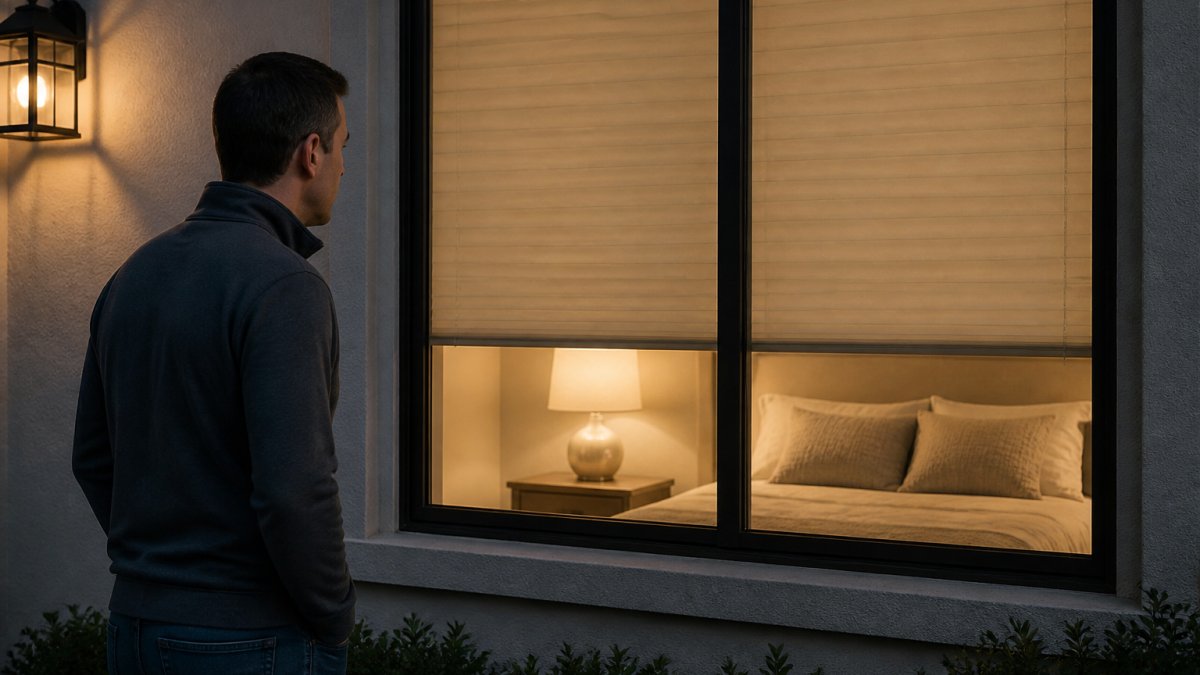
If you can see movement or read the room from outside, the fabric is not private enough for a bedroom. Selecting the right opacity also requires careful attention to matching decor colors to ensure your new shades harmonize seamlessly with the existing palette of your bedroom.
How to Measure Windows for Custom Blinds So Opacity Works
Even the best blackout fabric fails if the shade does not fit. Darkness in a bedroom is a function of fabric plus fit: a blackout shade with a half-inch gap at each side and a finger-width opening at the top will leak more light than a room-darkening shade mounted tight.
Why Fit Beats Fabric
Light does not only pass through fabric. It goes around it. The three leak points in a bedroom are the sides, the top, and the sill, and each one has a different fix:
- Side gaps: The space between the shade edge and the window frame. On an inside mount, this gap is built in by the frame depth and the shade hardware. Side channels or a tight inside mount reduce it; a loose inside mount makes it worse.
- Top gap: The opening between the headrail and the top of the window recess. A shallow recess leaves a visible strip of glass above the shade, and no fabric can cover what the hardware does not reach.
- Sill gap: The opening at the bottom, especially on a shade that stops short of the sill. A bottom rail that meets the sill or a small overlap closes it.
This is why the same blackout fabric can produce a pitch-black room in one house and a glowing halo in another.
Inside Versus Outside Mount
The mount decision drives how much of the leak you can close:
- Inside mount: The shade sits within the window recess. It looks clean and preserves the trim, but it depends on recess depth. A shallow recess forces the shade forward, leaving a top gap and side gaps that light slips through. Inside mount works best when the recess is deep enough to hold the hardware and the shade sits close to the glass.
- Outside mount: The shade mounts to the wall or trim and overlaps the window opening. It covers the top and sides of the frame, which closes the gaps an inside mount leaves behind. Outside mount is the better choice for blackout in a shallow recess, on a window with no real recess, or when the goal is maximum darkness.
A common pattern in bedrooms is an outside mount with a small overlap on all sides, paired with side channels where the hardware allows. That combination is what turns a blackout fabric into a blackout room.
How to Measure Each Window
Measure every window individually, even in the same room. Windows are rarely identical, and a quarter inch of difference shows up as a light gap at the edge of a shade. Record three numbers per window:
- Width at the top, middle, and bottom of the opening, and use the narrowest measurement for an inside mount.
- Height at the left, center, and right, and use the longest measurement for an inside mount so the shade covers the full opening.
- Depth of the recess, measured from the glass to the face of the wall or trim. Depth decides whether an inside mount can sit close enough to the glass to minimize the top gap.
For an outside mount, measure the width and height you want the shade to cover, including the overlap on each side and above the opening. The overlap is what seals the light path.
The most common measuring mistake is guessing the depth. A shade mounted too shallow leaves a gap at the top that no blackout fabric can fix. Measure depth at the shallowest point of the recess, not the deepest.
For a full walkthrough of where to place the tape and how to record dimensions, follow our step-by-step guide on how to measure windows for custom blinds. Our professional design and installation services include exact measurements for custom window treatments.
Match Opacity to Window Direction and Shared Bedrooms
Window direction changes more than most shoppers expect. The same room-darkening fabric that feels perfect on a north wall can leave an east-facing bedroom glowing at 5:45 a.m. in June.
Here is how orientation plays out in a bedroom:
- North: Soft, even light all day with little direct sun. Light-filtering or room-darkening is usually enough; full blackout is often overkill unless a streetlight or neighbor’s window sits close.
- East: Harsh, low-angle morning sun that lands directly on the bed. Room-darkening is the floor, and blackout is the safer pick for light sleepers, early risers who want to sleep in, or anyone whose window catches the summer sunrise before 6 a.m.
- South: Steady daylight and passive heat gain through the middle of the day. Room-darkening handles most bedrooms; add blackout if the room overheats or if naps happen in the afternoon.
Season matters too. A window that feels fine in December can flood the room in June because the sun rises earlier and at a different angle. If you are deciding in winter, ask where the summer sun will land, not where it lands today.
When Two Sleepers Want Different Things
Shared bedrooms are where a single opacity recommendation falls apart. One person rises at 5 a.m. for a shift; the other sleeps until 8. Recommending one fabric for both usually means one of them loses.
A few patterns work better than a single compromise fabric:
- Dual or split shades: Two independent shades on one headrail let each side of a wide window be set differently, so the early riser can open their half without flooding the other side.
- Layered treatments: A blackout layer behind a light-filtering or sheer layer lets the room shift from soft daylight to full darkness without swapping hardware. The blackout layer does the sleep work; the front layer handles daytime look and privacy.
- Motorized control: A motorized blackout shade lets the early riser raise the shade partway or open it on a schedule without the noise and light spill of a manual pull. It also helps when the window is behind furniture or out of easy reach. See our Motorized Blinds & Shades.
A practical rule: if the two sleepers disagree by more than one opacity level, do not split the difference on fabric, split the treatment instead.
Before you commit to a shared-bedroom setup, run the nighttime privacy test with each proposed fabric and check how the shade operates from each side of the bed. A motorized or split configuration that is awkward to use at 5 a.m. will not get used.
To discuss your window treatment needs, schedule an appointment. You can also visit our Design Gallery to see full-sized displays of every Hunter Douglas, Alta Window Fashions, Norman, and Texton product we sell, and compare fabrics, colors, and operating options in person.
Frequently Asked Questions
What opacity is best for bedroom shades?
The right opacity depends on your sleep schedule and window direction. Visit our Design Gallery to see full-sized displays and compare fabrics, or schedule an in-home design consultation with small sample books.
Do blackout shades make a bedroom completely dark?
Whether a shade provides the darkness you want depends on the product and its fit. Schedule a consultation to discuss your window treatment needs.
What shade opacity provides privacy at night?
To discuss privacy and light-control needs for your bedroom, schedule a consultation and view products in the Design Gallery.
How do you choose bedroom shades for morning sunlight?
Window direction is one factor to consider when choosing bedroom shades. Bring your questions to a design consultation to discuss window coverings for your needs.
