


Table of Contents
- Why Layer Custom Drapery With Window Blinds
- Understanding Layering Window Treatments
- Best Blinds for Layering With Curtains
- Drapery and Blind Color Combinations
- Drapery Length and Width Guide
- Measuring and Installing Your Layered Window Treatments
- Styling Tips for Different Room Types
- Frequently Asked Questions
Last Updated: October 13, 2026
Why Layer Custom Drapery With Window Blinds
Understanding how to style custom drapery with window blinds transforms how your rooms look and function, giving you control over light, privacy, and style that neither treatment delivers alone. Pairing them creates depth, visual interest, and practical benefits that make your windows work harder.
The real advantage is flexibility: blinds handle everyday light control and privacy, while draperies add the design statement and soften hard lines. Together they solve problems single treatments can’t.
At The Window Fashion Store, we help homeowners discover how layering transforms their rooms, choosing exactly how each layer works and how they look together.
Layering works best when you plan both treatments at the same time. Measure your windows for both, then choose colors and fabrics that complement each other from the start. This prevents costly remeasuring or returns later.
Understanding Layering Window Treatments
Layering window treatments means combining two or more coverings on the same window for better light control, privacy, and visual appeal. Blinds sit closer to the glass; draperies hang outside, creating distinct visual and functional layers.
This approach solves real problems: privacy without sacrificing style, precise light control, and texture and color that make a room feel finished.
Common layering combinations include:
- Roller shades or cellular shades with drapery panels
- Plantation shutters with decorative curtains
- Vertical blinds paired with flowing draperies
- Roman shades layered under floor-length drapery
Each combination works differently depending on your room, window size, and design goals. The key is understanding how the two layers interact, visually and functionally.
Layering gives you the best of both worlds: functional light control from blinds and decorative style from draperies. Neither treatment alone delivers the same result.
Best Blinds for Layering With Curtains
Not all blinds layer equally well with draperies; the best choice depends on your window style, light control needs, and desired look.
Cellular shades are popular for layering because they’re slim and don’t add bulk, providing insulation and light control without competing visually with draperies. They suit bedrooms and living rooms where you want soft, diffused light.
Roller shades offer clean lines and sit flat against the window, disappearing behind draperies when raised. Choose blackout roller shades for complete light blocking in bedrooms or media rooms.
Plantation shutters create a classic layered look. They pair beautifully with traditional or formal draperies. Their wider louvers let you tilt for light control while keeping the window frame visible and elegant.
Vertical blinds work well in contemporary spaces with floor-to-ceiling windows or sliding glass doors, paired with modern drapery panels for a simplified look.
The right choice depends on your space. We recommend visiting our Design Gallery to see how these blinds look with different drapery styles before deciding.
Drapery and Blind Color Combinations
Color harmony makes layered window treatments feel intentional rather than mismatched. The most successful combinations follow a few simple principles.
Matching or near-matching colors create a cohesive, sophisticated look, warm white blinds with cream draperies, for example, making the window feel unified and calm.
Complementary contrast adds visual interest: neutral blinds with a bold drapery color or pattern, like white roller shades with deep blue draperies, creates drama without looking confused.
Textural contrast works when colors stay close: smooth, matte blinds with textured drapery fabric. An ivory cellular shade with cream linen draperies creates depth through texture alone.
Pattern layering requires restraint: if draperies have a pattern, keep blinds solid, and vice versa. Too many patterns compete for attention and make the window feel busy.
The strongest combinations follow the 60-30-10 rule: 60% dominant color (usually the drapery), 30% secondary color (the blinds), and 10% accent color if you’re adding a third element like a valance or cornice.
Avoid pairing two bold patterns or highly contrasting colors unless your design is specifically modern or eclectic. Clashing colors make even quality treatments look unfinished.
Drapery Length and Width Guide
Custom drapery lives or dies on its specifications. Two panels in the same fabric can look completely different depending on fullness, header style, lining, and length, this is where the ‘custom’ in custom drapery earns its keep.
Fullness ratio. Fullness is total fabric width divided by window (or rod) width. Common ratios:
- 1.5x, a flat, tailored look. Works for modern and minimalist rooms, but panels hang straighter and show fewer folds.
- 2x, the standard for a classic, gathered look. This is what most designers default to for pinch pleats and goblet pleats.
- 2.5x to 3x, a deep, luxurious drape. Best for formal rooms and heavy fabrics like velvet or interlined silk.
Header type. The header is how the panel top attaches to the rod, changing both the look and required fullness:
- Pinch pleat, tailored, formal, holds a crisp fold. Needs 2x to 2.5x fullness.
- Goblet pleat, a cup-shaped pleat, dressy and traditional. Needs 2.5x fullness.
- Ripplefold (wave), a modern, uniform S-curve on a track. Uses a snap-tape system and a fixed 60-120% fullness depending on the carrier spacing.
- Rod pocket, casual, shirred on the rod. Needs 2x to 3x fullness because the fabric bunches.
- Grommet (eyelet), casual and contemporary, slides easily. Uses 1.5x to 2x fullness.
- Back tab, clean, hidden header. Uses 1.5x to 2x fullness.
Lining. Lining isn’t just a finishing touch, it changes how the drapery performs:
- Unlined, lightest and least expensive, but fabric fades faster and light glows through.
- Standard lining, adds body, protects fabric from UV, and improves drape.
- Blackout lining, blocks light and adds thermal insulation. Common in bedrooms and media rooms.
- Interlining, a flannel layer between fabric and lining. Adds weight, luxury, and insulation; standard in high-end formal drapery.
Length and break. Length is measured from the bottom of the rod (or ring) to the desired floor point:
- Floor-length (touching), panel just kisses the floor. Clean and classic.
- Break (1/4 to 1/2 inch), panel rests lightly on the floor with a slight bend. Most forgiving of minor floor irregularities.
- Puddle (1 to 3 inches), fabric pools on the floor. Formal and dramatic; not ideal in high-traffic rooms.
- Sill, apron, or café length, ends at the sill, just below it, or at the lower window trim. Common in kitchens and casual spaces.
Panel count and stack. Two panels are standard for a single window; wide windows or sliding doors need three to five to distribute weight and stack cleanly.
Returns and overlap. A return is the fabric wrapping from the panel front back to the wall, blocking side light and hiding the rod end. Overlap is the extra fabric at the center where panels meet so they close without a gap. Both are specified at order and easy to forget.
When you work with us for custom drapery, we handle all of these specifications during your consultation, fullness, header, lining, length, panel count, returns, and overlap, and take exact measurements so your draperies arrive cut and sewn to your window, not to a generic size chart.
Measuring and Installing Your Layered Window Treatments
Accurate measurements are the foundation of layered window treatments.
Step 1: Measure the window opening. Take width and height at the top, middle, and bottom.
Step 2: Decide the blind mount. Inside-mounted blinds sit within the frame; outside-mounted blinds sit on the wall or trim.
Step 4: Check depth clearance. Cellular and roller shades add depth. Measure from the front face of the blind to the wall, then add your drapery hardware depth.
Step 5: Run the compatibility checks. This is the step most guides skip, and where layered treatments fail in real rooms:
- Blind controls. Cord loops, wand tilts, and continuous cord loops need to be reachable when the drapery is closed. If the drapery panel will cover the control, plan for a cordless or motorized blind, or position the panel so the control stays accessible.
- Window handles and cranks. Casement and awning windows have cranks that protrude into the room. Measure the crank’s throw and make sure the drapery stack clears it.
- Radiators and baseboard heat. Draperies that hang over a radiator can block heat and be damaged by rising warm air. Shorten the panel or shift the stack so fabric does not sit directly above the heat source.
- Wall space. A rod that extends 12 inches past each side of the window needs that much clear wall. Check for light switches, outlets, and adjacent trim before ordering.
- Sliding doors and wide openings. These often need a single track or a wide rod with three to five panels rather than two, and the stack must clear the door’s travel path.
Installation order. Install blinds first, then drapery hardware, then hang the draperies.
Bracket placement. Anchor rod brackets into studs or wall anchors rated for the drapery’s weight. A center support bracket is often required on wider rods to prevent sag.
Get professional measurements done. Have a professional measure your windows during a consultation.
Our team measures every window in our service area before installation, verifying measurements on-site and confirming clearance, control access, and fit before your custom drapery is sewn.
Take photos of your windows from multiple angles before measurements, and note where the blind controls, handles, and any heat sources sit. These details help your designer confirm the layering will work in your specific room.
If a blind control, window crank, or radiator sits where the drapery stack needs to go, resolve that conflict before ordering hardware. Moving a bracket after the fact is far harder than planning around it up front.
Styling Tips for Different Room Types
Different rooms benefit from different layering approaches. What works in a formal living room won’t feel right in a casual family room or bedroom.
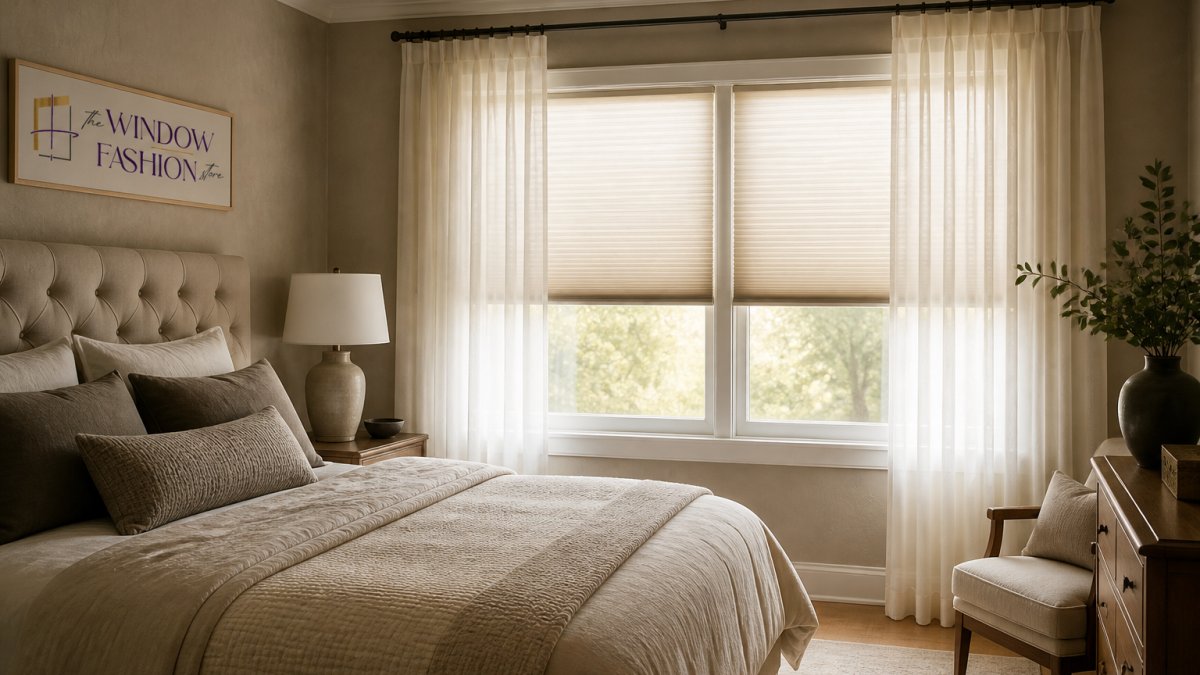
Master bedrooms benefit from maximum light control and privacy. Layer blackout cellular shades with floor-length draperies in soft, luxurious fabric to block light completely for better sleep while adding elegance.
Living rooms and family rooms need flexibility.
Home offices require functional layering: cellular shades for light diffusion and glare control with neutral, professional-looking draperies. This reduces screen glare while maintaining a polished appearance.
Dining rooms work well with plantation shutters layered under formal draperies, shutters provide light control throughout the day, while draperies add formality and elegance for entertaining.
Nurseries and children’s rooms need safety and softness. Choose cordless cellular shades with draperies in calming colors and soft textures, avoiding long cords and heavy hardware that could pose hazards.
Each room has different light, privacy, and design needs.
Learning how to style custom drapery with window blinds gives you control, style, and function single treatments can’t match. Visit our Design Gallery to see full-sized displays of every Hunter Douglas, Alta Window Fashions, Norman, and Texton product we carry, and see how these treatments work together in real settings. Schedule a free consultation with our team, and we’ll bring sample books to your home so you can choose the perfect layering combination.
Frequently Asked Questions
Can you put drapes over window blinds?
Yes. Pairing custom drapery panels with blinds creates both style and function. The blinds handle light control and privacy, while decorative curtains frame the window and add visual interest. Make sure your window frame has enough depth and clearance for both layers, and ensure the drapery rod sits high enough that curtain panels don’t interfere with blind operation. This combination works especially well in bedrooms and living rooms where you want flexible light management.
How do you choose drapery to go with blinds?
Start by selecting blinds based on function: blackout shades for bedrooms, light-filtering options for living spaces. Then choose drapery that complements without matching exactly. If your blinds are neutral, consider a pattern or deeper color in the curtains. If blinds are textured or patterned, keep drapery simpler. Coordinate the overall color palette across both layers, and balance visual weight by pairing heavier fabrics with lighter blinds, or vice versa. Visit our Design Gallery to see how different combinations work together.
What blinds work best behind curtains?
Roller shades, cellular shades, and vertical blinds work well behind custom drapery because they operate smoothly without interfering with curtain panels. Roller shades take up minimal space when raised, and cellular shades provide excellent insulation. Avoid heavy wood blinds if your drapery is delicate, as the weight combination can strain hardware. The best choice depends on your light control needs, room function, and the thickness of your drapery fabric. A design consultation helps match blinds to your specific window dimensions and style.
Should blinds and drapes match or contrast?
Contrast creates visual interest and allows each layer to serve its purpose without competing. Matching can work if you use different textures or shades of the same color family. For example, pair white roller blinds with cream or ivory drapery, or coordinate a neutral blind with patterned curtains in complementary tones. Avoid exact matches in both color and pattern, which can flatten the look. The key is balance: if blinds are bold, keep drapery subtle, and vice versa.