


Table of Contents
- Why Privacy and Darkness Matter in Modern Homes
- Blackout and Room-Darkening Shades for Complete Light Control
- Light-Filtering Shades for Privacy Without Total Darkness
- Layered Window Treatments for Maximum Versatility
- Cellular Shades with Side Channels: Eliminating Light Gaps
- How to Measure Windows for Custom Blinds and Shades
- Smart and Motorized Window Treatments for Modern Living
- Choosing the Right Treatment for Your Room and Lifestyle
- Frequently Asked Questions
Last Updated: October 20, 2026
Why Privacy and Darkness Matter in Modern Homes
Privacy and darkness aren’t luxuries, they’re essentials, and the right window treatments privacy darkness solutions deliver both.
At The Window Fashion Store, we’ve worked with hundreds of Kansas City area homeowners whose windows were working against them: glare ruining afternoon productivity, street lights seeping in at night, and no coverage keeping outsiders from seeing into private rooms.
Today’s window treatments do far more than block light. They combine style, functionality, and precision engineering to solve both problems at once. Here are the specific options that deliver real results.
The difference between a treatment that “sort of works” and one that delivers is usually installation detail. Custom treatments from manufacturers like Hunter Douglas and Alta are engineered to fit your exact window dimensions, eliminating the light gaps that cheap solutions can’t fix.
Blackout and Room-Darkening Shades for Complete Light Control
When darkness is the goal, blackout and room-darkening shades are the most direct solution: engineered fabrics designed to block nearly all incoming light.
Blackout shades use layered fabric construction: an opaque outer layer with a light-blocking backing that stops light while maintaining structural integrity.
Both options work best with proper installation, since light leakage around shade edges defeats the purpose.
Blackout shades are your best choice if you need near-total darkness for sleep, shift work, or light-sensitive activities. Room-darkening shades work better if you want flexibility to let some light in during the day.
Light-Filtering Shades for Privacy Without Total Darkness
Not every room needs complete darkness. Many homeowners want daytime privacy while still enjoying natural light, and light-filtering shades deliver, but with an important catch most idea lists skip: daytime privacy and nighttime privacy are not the same thing.
Light-filtering fabrics use a semi-opaque weave that softens incoming light while blocking direct views. During the day, the sun outside is brighter than your interior, so the fabric scatters the view and outsiders see a soft glow rather than your living room.
Why Sheers and Light-Filtering Shades Fail After Dark
Once the sun goes down, the lighting relationship flips. With interior lights on and darkness outside, a sheer or lightly woven shade becomes close to transparent from the street, and a neighbor at the curb can often make out furniture, silhouettes, and movement.
A practical rule of thumb:
- Sheers and very open weaves: excellent daytime privacy, weak nighttime privacy when interior lights are on.
- Light-filtering shades (semi-opaque): good daytime privacy, moderate nighttime privacy, especially in rooms that are dimly lit after dark.
- Room-darkening shades: strong daytime and nighttime privacy, with a soft glow rather than true blackout.
If a room is visible from the street or a neighboring window and you use it with lights on in the evening, pair the light-filtering layer with a second, more opaque layer, or choose a denser weave.
Matching the Weave to the Room
Performance varies by fabric: lighter weaves filter more light but offer less privacy, while denser weaves provide stronger privacy but reduce brightness. The right choice depends on your room’s orientation and natural light.
- Kitchens and living rooms facing the street: a denser light-filtering weave keeps the room bright while holding up after dark.
- Bathrooms: prioritize a denser weave or a top-down/bottom-up shade so you can raise the bottom for light while keeping the eye-level band covered.
- Home offices: a light-filtering shade cuts screen glare without turning the room cave-like during the workday.
Judge a light-filtering shade by two tests, not one: how it looks at noon and how it looks at 9 p.m. with the lights on. If evening privacy matters, step up to a denser weave or layer it.
To see how different weaves read in person, our Design Gallery displays full-sized Hunter Douglas, Alta Window Fashions, Norman, and Texton products so you can compare fabric density, color, and function side by side before you commit.
Layered Window Treatments for Maximum Versatility
The smartest approach combines two treatments on the same window. Layered window treatments give you flexibility no single product can match.
Combining Sheer and Opaque Layers
Pairing a sheer layer with a blackout layer creates a system you can adjust for any time of day.
This solves the real-world problem most homeowners face: needs change throughout the day.
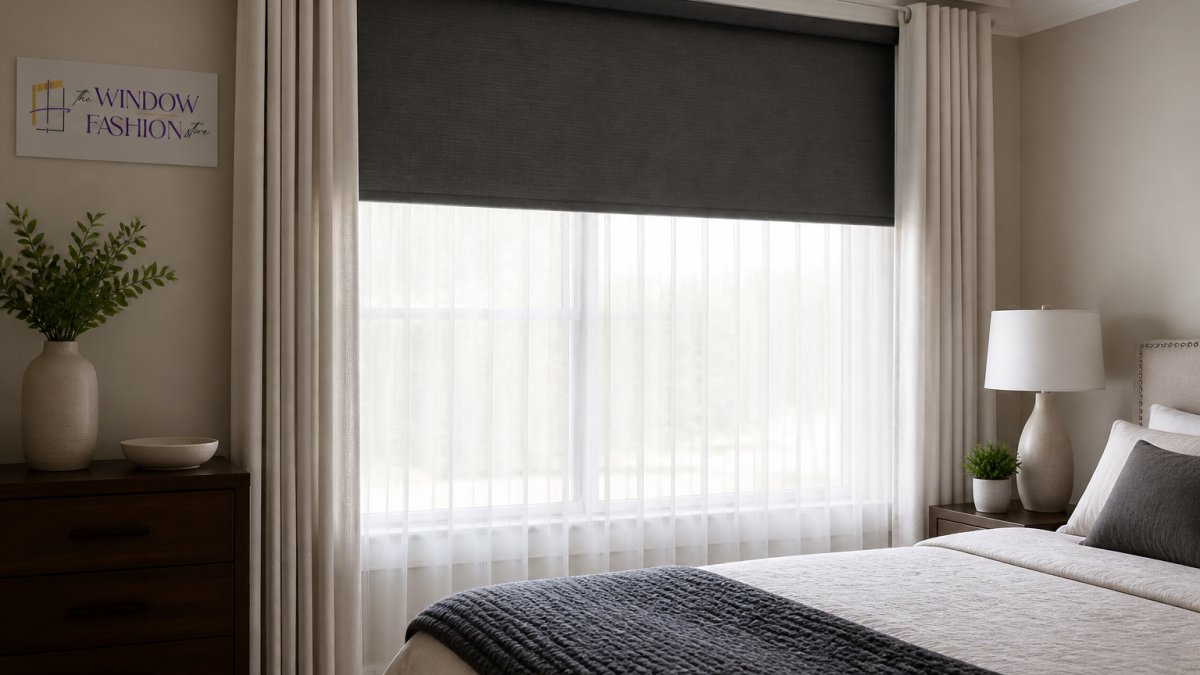
Dual Shades for Day and Night Flexibility
Dual shades combine light-filtering and blackout fabrics into a single product. Two separate fabrics operate on the same roller system, letting you lower either one independently, giving you layered flexibility in a cleaner package.
Dual shades work particularly well in bedrooms and master bathrooms: daytime privacy with natural light, and nighttime darkness without switching between two separate treatments. Just raise or lower the shade you need.
Dual shades require precise measurement and professional installation to operate smoothly. Misaligned tracks or incorrect tension can cause binding or uneven operation. This is why working with experienced professionals matters.
Cellular Shades with Side Channels: Eliminating Light Gaps
One of the most common complaints about window treatments is light leakage around the edges.
Side channels are tracks installed on the sides of your window frame that guide the shade edges flush against the frame, eliminating the gaps where light escapes.
Cellular shades add another benefit: honeycomb construction traps air, insulating the room and helping reduce heating and cooling costs while blocking light and providing privacy.
The Hunter Douglas Duette line, for example, uses cellular construction specifically engineered for bedroom windows.
How to Measure Windows for Custom Blinds and Shades
Getting measurements right is critical, but the reason most treatments still leak light isn’t a bad tape measure. It’s a mounting decision made before anyone measures. Inside versus outside mount, plus how the edges are finished, determines whether your shade actually delivers darkness or just approximates it.
Inside Mount vs. Outside Mount: The Decision That Controls Light Gaps
- Inside mount places the treatment within the window frame. It looks clean and modern and preserves your trim, but it leaves a small gap at each side and along the top where light escapes. The deeper your frame, the more room the shade has to sit back, and the more light can spill around it.
- Outside mount places the treatment on the wall or trim, overlapping the opening on all sides. Because the fabric extends past the window edges, it covers the gaps an inside mount leaves behind. For a bedroom where darkness is the priority, an outside mount with generous overlap is often the more effective choice.
A common pattern among installers: inside mount for a finished, architectural look in living spaces, outside mount where light control is the whole point. Neither is wrong, but the choice should be deliberate, not accidental.
Overlap, Side Channels, and the Details That Seal the Edges
Even a well-measured shade leaks at the perimeter unless the edges are addressed:
- Side channels are tracks mounted on the window frame that guide the shade edges flush against the frame, closing the side gaps. Combined with a top seal or cassette, they create a nearly light-tight fit. This is the single biggest upgrade for room darkening.
- Overlap on an outside mount should extend past the opening on the sides and top, not just meet the trim. Too little overlap and light wraps around the edge.
- Bottom sealing matters in bedrooms; a floating bottom edge lets light pool on the floor.
- Frame depth and obstructions decide whether an inside mount is even feasible. Crank handles, deep trim, and tilt-in windows can rule it out.
What Professional Measurement Actually Checks
Proper measurement requires checking multiple points on each window. Width varies from top to middle to bottom on older homes, and height needs checking at the left, center, and right.
Professional installers also account for frame depth, existing trim, and how the treatment will interact with furniture. A measurement that looks right on paper can fail in practice if these details aren’t considered.
This is where our in-home design consultations make a real difference.
If total darkness is the goal, decide inside versus outside mount and whether you want side channels before you fall in love with a fabric. Those two choices do more for darkness than the fabric itself.
Smart and Motorized Window Treatments for Modern Living
Motorized shades represent the modern approach to window treatment control: raise and lower shades with a remote, smartphone app, or voice command.
The benefits go beyond convenience. Motorized treatments let you automate your privacy and darkness schedule: bedroom shades that close at sunset and open gradually in the morning, office shades that close during afternoon glare without you leaving your desk.
Smart motorized shades integrate with home automation systems, working with voice assistants and triggered by time, light sensors, or other smart home events.
The Window Fashion Store offers motorized solutions through our Motorized Blinds & Shades service. Professional installation ensures reliable operation and proper integration with your home’s systems.
Choosing the Right Treatment for Your Room and Lifestyle
The best window treatments privacy darkness solution depends on three factors: your room’s purpose, your privacy needs, and how much darkness you require.
Bedrooms almost always benefit from blackout or room-darkening shades. Sleep quality improves dramatically when light is controlled.
Living rooms and kitchens typically need daytime privacy without total darkness.
Bathrooms and bedrooms facing busy streets benefit most from cellular shades with side channels. The combination of fabric opacity and edge sealing eliminates the light gaps that create privacy problems.
Your lifestyle matters too. If you travel frequently or have irregular sleep schedules, motorized treatments add convenience.
Homeowners who’ve recently purchased new construction or are renovating their interior spaces and want professional guidance on selecting treatments that match both their design vision and their practical privacy and darkness needs.
The Window Fashion Store can help you evaluate all these factors. Our design consultants visit your home, see your windows in person, and recommend treatments suited to your space. Visit our Design Gallery to see full-sized displays of Hunter Douglas, Alta Window Fashions, Norman, and Texton products, so you’ll see exactly how each option looks and functions before deciding.
Privacy and darkness control shouldn’t require compromising style for function.
Frequently Asked Questions
What window treatments provide the most privacy and darkness?
Cellular shades with side channels and blackout fabrics deliver the strongest performance for both privacy and darkness. Layered window treatments, combining a light-filtering shade with a blackout layer, offer flexibility: you can adjust them for daytime privacy while retaining natural light, or close them completely for total darkness at night. Room-darkening shades block 95% of light without side gaps, while true blackout options eliminate nearly all incoming light. For maximum control, motorized treatments let you adjust privacy and darkness instantly without manual operation.
What is the difference between room-darkening and blackout window treatments?
Room-darkening shades reduce light but allow a small amount of filtered light to pass through the fabric, making them ideal for daytime privacy while maintaining some natural illumination. Blackout treatments block virtually all light and are designed for bedrooms, media rooms, or shift workers who need complete darkness. The key difference lies in fabric weight and opacity. Room-darkening shades work well for living spaces where you want privacy without feeling like you’re in a cave; blackout options are essential when darkness is the primary goal.
Which modern window treatments offer privacy without blocking all natural light?
Light-filtering shades for privacy are your best choice for daytime privacy with natural light. These include light-filtering roller shades, cellular shades with semi-opaque fabrics, and privacy sheers like Silhouette Window Shadings. They prevent outside views during the day while allowing diffused sunlight to enter, creating a softer ambiance. Layered window treatments also work well, pair a light-filtering shade with a sheer curtain for adjustable privacy. This approach is popular in living rooms, home offices, and bathrooms where you want to see out or enjoy natural light without sacrificing daytime privacy.
How do you measure windows for custom blinds and shades?
Accurate measurements are critical for custom window treatments to fit properly and eliminate light gaps. Measure the width at three points (top, middle, bottom) and the height at three points (left, center, right), using the smallest width and height for inside-mount installations. For outside-mount treatments, measure the full area you want to cover. Record all measurements in inches. If your windows are an unusual shape or size, professional measurement during a consultation ensures perfect fit and prevents costly gaps that compromise privacy and darkness. Many homeowners benefit from having a specialist verify measurements before ordering.