


Table of Contents
- What Drives Motorized Window Shades Installation Cost
- Motorized Shade Power Options: Hardwired vs Battery vs Solar
- The Hidden Costs of Smart Home Integration
- How Energy Efficient Shades for Homes Change the Math
- Professional Installation vs DIY: What You Actually Save
- Your Custom Window Treatment Consultation: From Measurements to Estimate
- Maintenance, Battery Replacement, and Long-Term Ownership
- Frequently Asked Questions
Last Updated: September 14, 2026
What Drives Motorized Window Shades Installation Cost
Motorized window shades installation cost is not a single line item. It is the sum of several variables, and understanding each one is the difference between a realistic budget and a surprise invoice. At The Window Fashion Store, we have spent over 20 years helping homeowners and business owners break that number down before a single bracket goes up.
The biggest cost driver is rarely the motor itself. It is the combination of labor, window dimensions, and mounting hardware.
Labor Rates, Window Dimensions, and Mounting Hardware
Professional installation labor typically scales with three things: how many windows, how high they are, and how complex the mounting surface is.
- Window dimensions: Taller and wider windows need heavier shade fabric, stronger motors, and more mounting hardware. A shade over a standard double-hung window is a straightforward job; a two-story great room window is not.
- Mounting hardware: Inside-mount shades need less hardware. Outside-mount shades, corner windows, and windows set into deep trim require brackets, spacers, and sometimes custom fabrication.
- Labor rates: Rates vary by region and by the complexity of the job. A single-story home with standard windows costs less to outfit than a multi-level home with irregular openings.
The honest answer to “how much per window” is that it depends on scope. A project estimate should itemize each of these factors rather than quote a flat per-window figure.
The most common budgeting mistake is comparing a per-window price from one company to a total project quote from another. One may include hardware and labor; the other may not. Always compare itemized estimates side by side.
Motorized Shade Power Options: Hardwired vs Battery vs Solar
Power source is the single biggest fork in the road for motorized shade cost and long-term ownership. Each option trades upfront complexity for ongoing convenience, and the option that looks cheapest at the quote stage is rarely the cheapest over the life of the shade.
Hardwired motors draw power from your home’s electrical system. They require an electrician to run wiring to each window, which adds labor and planning, but they never need a battery change and deliver consistent motor torque for large or heavy shades (Homeowner’s Guide to Solar). The catch is timing: hardwiring is far easier to plan into a new build or a room that is already opened up for renovation than to add to a finished wall. If you are weighing hardwired shades, raise it during your consultation so wiring can be scoped alongside the shade order rather than after.
Battery-operated shades are the most common choice for retrofits and existing homes. They install without new wiring, which keeps the initial project simpler. The trade-off is periodic battery replacement, and the interval varies widely with how often the shade runs, the weight of the fabric, and the motor’s efficiency. A shade that cycles twice a day on a lightly used window behaves very differently from one that runs a full open-close cycle every morning and evening on a large, heavy panel. Across a whole home, that recurring cost is real and worth planning for rather than discovering later.
Solar-powered shades pair a small panel with a battery, using daylight to extend time between charges. They work best on windows that receive consistent sun and are a poor fit for shaded exposures, north-facing glass, or rooms where furniture or landscaping blocks the panel. When they fit the exposure, they reduce, but do not eliminate, battery changes. Integrating these systems often prompts homeowners to consider whether solar window screens offer a more effective long-term solution for managing heat gain and light control.
| Power Option | Upfront Complexity | Ongoing Maintenance | Best For |
|---|---|---|---|
| Hardwired | High (requires electrician) | None | New builds, large or heavy shades, rooms already opened for renovation |
| Battery-operated | Low | Periodic battery replacement | Existing homes, retrofits, room-by-room projects |
| Solar-powered | Low to moderate | Reduced battery changes | Sunny exposures, hard-to-reach windows |
Retrofit Kits for Existing Manual Shades
If you are motorizing a home room by room, decide your power strategy before the first order. Mixing hardwired and battery systems across rooms is workable, but it usually means two different control approaches and two different maintenance rhythms.
Compare power options on total cost of ownership, not sticker price. Hardwired costs more upfront and less over time; battery costs less upfront and more over time; solar sits in between and depends on your exposure.
The Hidden Costs of Smart Home Integration
Smart home integration is where budgets quietly expand, and it is the line item most often missing from an initial quote. The motor is only half the system; the automation hub, remote control, and app connectivity are the other half, and they are priced and purchased separately from the shades themselves.
Some motorized shades include built-in smart home compatibility. Others need a separate automation hub or bridge to connect with voice control platforms or a broader home automation setup. That hub is an added line item, and its cost scales with how many shades you intend to control and how many ecosystems you want to reach. A single-room setup may need nothing beyond the motor and a remote. A whole-home system that ties into a broader automation platform usually needs at least one hub, sometimes more.
Ask two questions before you commit:
- Does the motor connect directly to your smart home platform, or does it require a bridge or hub?
- How many shades can one hub control, and will you need more than one?
The second question is the one that catches people. Hubs have a device limit, and a home with a dozen or more motorized shades can exceed a single hub’s capacity. When that happens, you either add a second hub or accept that some shades fall outside the automation group. Either way, it is a cost that should appear in the estimate, not on the invoice after installation.
Planning the Ecosystem Before You Buy
Integration choices also lock in future spending. If you start with one manufacturer’s hub and later add shades from a different line, you may end up running two apps, two remotes, or two automation routines for what should be a single system. The cleanest path is to decide your automation platform, voice assistant, app, or whole-home system, before the first shade is ordered, then choose motors and hubs that speak to it natively.
A related consideration is scheduling and scene control. Basic motorized shades open and close on command. Shades tied into a hub can run on schedules, respond to sunrise and sunset, and join scenes with lighting and thermostats. That capability is what most homeowners actually want when they say “smart,” and it is a function of the hub, not the motor. Budgeting for the hub is therefore not an optional upgrade, it is the difference between a remote-controlled shade and a genuinely automated one.
If you plan to motorize shades room by room over time, choose a system with a hub that scales. Buying a hub twice because the first one maxed out is a cost nobody budgets for, and switching ecosystems mid-project usually means replacing remotes and reprogramming routines.
The most common integration surprise is discovering after installation that the shades need a hub the homeowner did not buy. Confirm hub requirements, device limits, and platform compatibility during your consultation so the estimate reflects the full system.
How Energy Efficient Shades for Homes Change the Math
Energy efficient shades for homes do more than lower a utility bill. They change how you should think about the total cost of ownership.
Cellular and dual-layer shades trap air between the window and the room, reducing heat gain in summer and heat loss in winter (energy.gov). For west- and south-facing windows, that can meaningfully reduce the load on your HVAC system. Motorized operation adds a second layer of savings: scheduled shades that close automatically during peak sun hours work even when nobody is home to close them manually.
The U.S. Department of Energy guidance on window treatments notes that properly selected window coverings can reduce heating and cooling needs. The practical takeaway is that a slightly higher upfront spend on better shade fabric quality and motorization can pay back over years of ownership, not months.
Professional Installation vs DIY: What You Actually Save
DIY looks cheaper on paper. In practice, the savings are smaller than most people expect, and the risk is higher.
Here is what DIY actually involves: precise measurement of every window, correct motor sizing for shade width and height, mounting hardware selection for your wall type, and programming the remote control or hub. Get the measurements wrong and custom fabrication is wasted. Get the mounting wrong and a heavy motorized shade can pull free of the wall.
Professional installation bundles exact measurements, correct hardware, and warranty coverage into the project. It also protects the investment: a shade installed incorrectly can void the manufacturer’s warranty.
| Factor | DIY | Professional Installation |
|---|---|---|
| Measurement accuracy | Your responsibility | Handled by installer |
| Motor sizing | Easy to get wrong | Matched to shade |
| Warranty protection | At risk if installed incorrectly | Preserved |
| Time investment | Significant | Minimal |
| Best for | Simple, standard windows | Custom, large, or multi-window projects |
Your Custom Window Treatment Consultation: From Measurements to Estimate
A custom window treatment consultation is the step that turns a vague budget into a real project estimate. It is also where the details that drive cost actually surface.
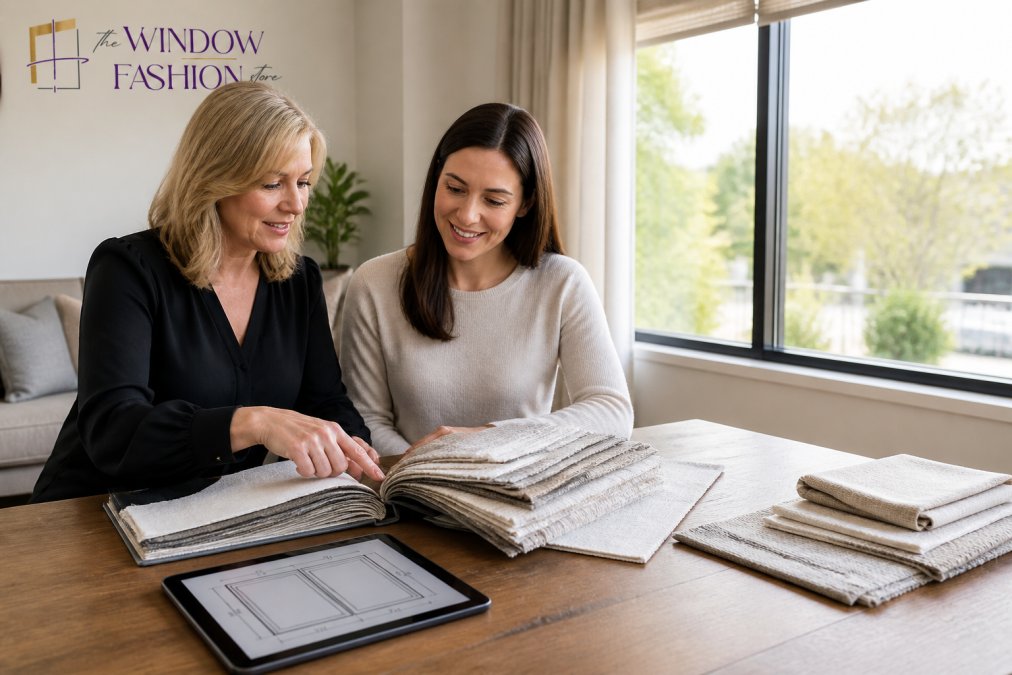
During the consultation, a consultant measures each window, notes the mounting surface, and reviews power options. You see fabric, color, and function choices in person rather than on a screen. For homeowners who want to compare full-sized displays before deciding, our Design Gallery shows every Hunter Douglas, Alta Window Fashions, Norman, and Texton product we sell. In-home consultations bring smaller sample books to your windows so you can judge light filtering and blackout options in the actual room.
The output is an itemized estimate covering shades, motors, hardware, and installation labor. That document is what you compare against other quotes.
Maintenance, Battery Replacement, and Long-Term Ownership
Total cost of ownership includes what happens after installation. Motorized shades are low-maintenance, but not zero-maintenance.
Battery-operated shades need periodic battery replacement. The interval depends on how often the shade runs and the motor’s efficiency. Hardwired shades skip this entirely. Across a whole home, battery replacement is a recurring cost worth factoring into your budget rather than discovering later.
Beyond batteries, maintenance is minimal: occasional dusting of the shade fabric and a check that brackets remain secure. Well-made custom shades from established manufacturers are built to last many years, which is the real argument against cheap alternatives that need replacing far sooner.
The cheapest shade is rarely the least expensive to own. Factor in motor quality, battery replacement, and warranty coverage before you compare two quotes.
Budgeting for motorized window shades is really a question of scope: how many windows, what power source, and how much of the work you hand off to a professional. The Window Fashion Store has guided homeowners and business owners through that math for over 20 years, with personalized consultations, exact measurements, and professional installation backed by an A+ rating with the Better Business Bureau. We exclusively install and service the Hunter Douglas, Alta, Norman, and Texton products we sell, so every project gets matched hardware, correct motor sizing, and full warranty support. Schedule a free consultation with The Window Fashion Store and get an itemized estimate built around your actual windows.
Frequently Asked Questions
What factors influence the total cost of motorized shade installation?
The biggest factors are window dimensions and count, motor type (hardwired, battery, or solar), fabric and shade style, and whether your home needs new wiring. Labor rates and service call fees vary by region, and smart home integration can add hub or adapter costs. Because every custom residential project is measured individually, the only accurate number comes from an on-site consultation and written project estimate.
Are motorized shades worth the investment for my home?
For hard-to-reach windows, rooms with harsh sun exposure, or homeowners who want voice control and scheduling, motorized window treatments often justify the added cost through daily convenience and energy efficiency. Battery-operated shades avoid wiring work, while hardwired motors last longer. Whether it pays off depends on how many windows you automate and how long you plan to stay in the home.
Do motorized shades require professional installation?
Hardwired systems generally do, because they involve electrical connections and local code requirements. Battery-operated and solar-powered shades are simpler to mount, but correct bracket placement, shade width, and level alignment still affect how well they operate. Professional installation also protects your warranty coverage and ensures the motor torque matches the weight of your shade fabric.
How do smart features impact the cost of window treatments?
Smart features add cost through the automation hub, bridge, or adapter needed to connect shades to your home automation system, plus any remote control or wall switch you add. Some motors include built-in smart home integration; others need a separate hub. If you already run a smart home platform, check compatibility before ordering so you don’t pay twice for hardware you can’t use.