


Table of Contents
- Quick Comparison: Blind Broker Alternative Options
- Custom Window Treatments vs Store Bought
- The Window Treatment Design Consultation Process
- Product Alternatives: Shades, Shutters, and Drapery
- Smart Home Integration and Motorized Options
- Rental-Friendly and Non-Permanent Alternatives
- Why Choose a Local Specialist Over a Big-Box Alternative
- Conclusion: Finding Your Best Blind Broker Alternative
- Frequently Asked Questions
Last Updated: September 19, 2026
Quick Comparison: Blind Broker Alternative Options
Shoppers searching for the blind broker alternative options want custom window treatments without the chain-store feel. At The Window Fashion Store, we have spent more than 20 years helping homeowners compare real choices instead of guessing from a thumbnail.
Here is the honest version of what is out there.
| Option | Best For | Coverage | Installation |
|---|---|---|---|
| Local design gallery | Whole-home projects | Full product range | Professional, in-house |
| Online retailer | Single rooms | Broad catalog | Third-party or DIY |
| Retail store | Tight budgets | Limited sizes | DIY |
| Smart device for existing blinds | Existing blinds | Tilt only | DIY |
| Local specialist | Odd sizes, light gaps | Custom-built | Professional |
The difference between these paths shows up in three places: fit, fabric, and who shows up when something is wrong. A local specialist handles all three; an online cart handles none.
Custom Window Treatments vs Store Bought
Custom window treatments are made to your exact window dimensions, while store-bought options come in a handful of standard sizes that rarely match a real opening.
A stock shade on a 47-inch window either overlaps the frame or leaves a light strip down one side. Custom window treatments close that gap completely.
The trade-off is straightforward:
- Store bought: lower upfront cost, immediate pickup, limited colors, no fit guarantee
- Custom: exact measurements, fabric and opacity choices, professional installation, longer lead time
Store-bought shades often get replaced within a few years, which erases the savings. Custom window treatments are built to the opening, so they stay put and stay square.
Measure the window opening in three places, top, middle, and bottom. If those numbers differ by more than a quarter inch, a stock size will always show a gap.
The Window Treatment Design Consultation Process
A window treatment design consultation is a scheduled visit where a designer reviews your windows, light direction, and room style, then narrows the list to two or three workable options.
At The Window Fashion Store, that visit can happen in our Design Gallery, where full-sized displays of every Hunter Douglas, Alta Window Fashions, Norman, and Texton product let you see function, fabric, and color in person. We also offer in-home consultations with small sample books, so you can hold the fabric against your own wall in your own light.
Here is how the process runs:
- Room walkthrough. We note window orientation, ceiling height, and how each room gets used.
- Light and privacy review. We identify which rooms need blackout capabilities and which need light filtering only.
- Sample review. You compare fabric opacity, texture, and color against your existing finishes.
- Measurement. We take exact measurements on site, including depth and mounting surface.
- Quote and timeline. You get a written scope before anything is ordered.
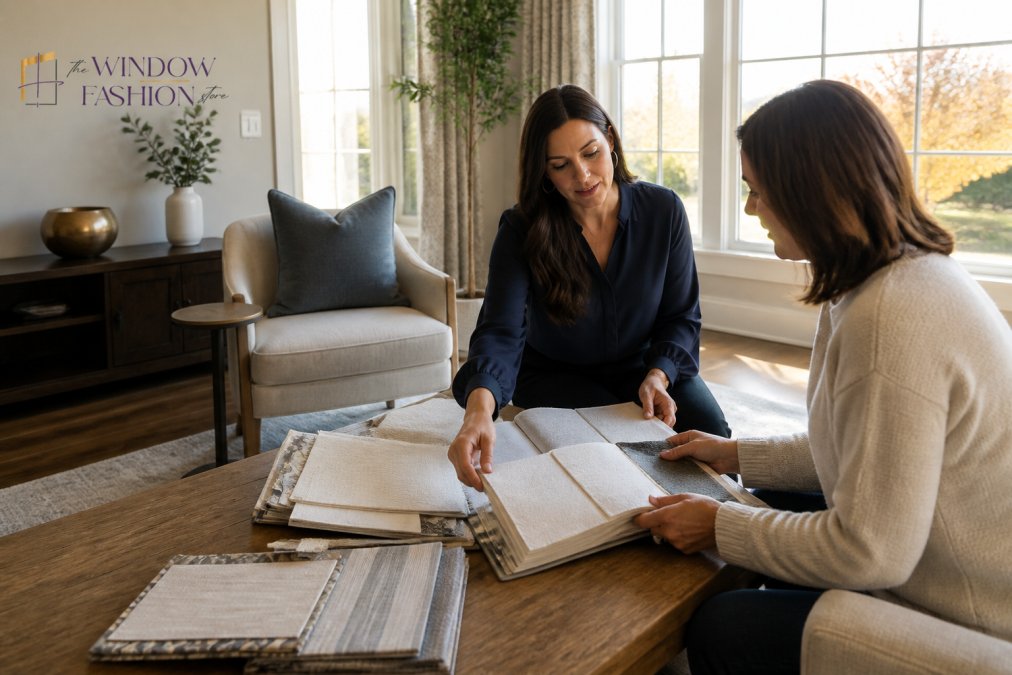
Nothing gets ordered until you have seen the material and approved the plan, which prevents most of the regret people describe after buying window coverings sight unseen.
Product Alternatives: Shades, Shutters, and Drapery
The main product alternatives are roller shades, cellular shades, Roman shades, panel tracks, shutters, and drapery panels. Each solves a different problem, and most homes end up using more than one.
Roller shades are the cleanest option for modern home decor. A single panel rolls tight at the top, keeping sightlines open. Choose light filtering for daytime glare or blackout for bedrooms.
Cellular shades use a honeycomb structure that traps air at the window, making them the usual pick when energy efficiency and thermal insulation matter, especially on older single-pane windows.
Roman shades fold into soft horizontal pleats when raised. They carry more visual weight than a roller, suiting traditional interiors and rooms where the window is a design feature.
Panel tracks slide rather than lift, making them the practical answer for sliding glass doors and wide openings. Panels stack to one side and clear the glass completely.
Shutters are a permanent alternative. They mount inside or outside the frame, tilt for light control, and hold up in kitchens and bathrooms where humidity swings.
Drapery panels add fabric, color, and acoustic softening. Layering drapery over a shade gives you adjustable privacy through the day.
| Product | Light Control | Best Room | Notes |
|---|---|---|---|
| Roller shades | Good | Living, office | Sleek profile |
| Cellular shades | Excellent | Bedroom, west-facing | Insulating |
| Roman shades | Good | Dining, living | Fabric-forward |
| Panel tracks | Moderate | Sliding doors | Clears glass |
| Shutters | Excellent | Kitchen, bath | Permanent |
| Drapery | Adjustable | Any | Adds softness |
For a whole-home project, mixing two or three of these usually beats forcing one product everywhere.
Smart Home Integration and Motorized Options
Motorized window coverings let you schedule, dim, and group shades through an app, a remote, or a voice assistant. The real benefit is the windows you cannot reach: the two-story foyer, the window behind the sofa, the row of transoms above a slider. Motorization solves those without a ladder.
What most guides skip is how motorization actually connects to a smart home. There are three integration layers, and they are not interchangeable.
Layer 1: The motor itself. Factory motorization is built into the shade at the headrail. It can be battery powered (rechargeable lithium packs that last months between charges depending on daily cycles) or hardwired, which requires an electrician or an existing power source near the window. Hardwired suits whole-home projects; battery suits retrofits and rentals.
Layer 2: The control bridge. This turns a motor into a smart device. Some manufacturers sell a proprietary hub that connects shades to your Wi-Fi network; others build the radio into the motor so it talks to a bridge you already own. Without a bridge, you get a remote and a Bluetooth app, useful, but not automatable from outside the room.
Layer 3: The ecosystem. This is where compatibility matters most, and where most buying guides go silent. The three major ecosystems behave differently:
- Apple HomeKit: Requires the shade or its bridge to be HomeKit-certified. Once paired, shades appear in the Home app alongside lights and thermostats, and can be triggered by scenes, geofencing, or Siri. HomeKit is the strictest about certification, so the compatible product list is shorter.
- Amazon Alexa: Works through a manufacturer skill or a certified bridge. Voice control and routines are supported, and shades can be grouped with other Alexa devices. Setup is generally the most forgiving of the three.
- Google Home: Similar to Alexa in structure, with routines and voice control. Compatibility depends on whether the manufacturer has published a Google integration, which varies by product line and sometimes by motor generation.
Homeowners often buy a motorized shade, assume it works with their existing assistant, and discover the integration only exists on a newer motor or different product line. Before you commit, confirm in writing: the exact motor model, whether a bridge is required, and which ecosystems that model supports.
Retrofit devices are a separate category. A small unit attaches to existing horizontal blinds and controls tilt only. They cost the least and install in minutes, but they cannot raise or lower a shade. For full control, choose factory motorization.
U.S. Department of Energy guidance on window coverings and energy use notes that how a covering is operated day to day affects performance as much as which product you choose. Automation removes the human variable, but only if the automation actually runs on the schedule you set, which is why ecosystem compatibility is not a footnote.
Ask for the motor model number and the supported ecosystems before you order. “Works with smart home” is not a specification.
Rental-Friendly and Non-Permanent Alternatives
Renters and anyone in a temporary space have options for window coverings that do not require drilling. The trade-off is fit and durability.
For renters planning to stay a few years, a conversation with a local specialist is worth having. The key is to measure the window opening in three places, top, middle, and bottom, before choosing any non-permanent option, because tension and adhesive both depend on a square frame.
Why Choose a Local Specialist Over a Big-Box Alternative
A local specialist measures on site, orders to your exact dimensions, and installs the product, which means one point of contact if anything is off.
Window coverings are a fit product: a quarter-inch error on a wide window is visible from across the room. When the same team measures and installs, there is no gap between who is responsible and who fixes it.
The Window Fashion Store is a family-owned business with an A+ rating and accreditation from the Better Business Bureau.
Conclusion: Finding Your Best Blind Broker Alternative
The hardest part of replacing window coverings is not choosing a color. It is trusting that the measurements, fabric, and installation will hold together once the boxes are gone.
Frequently Asked Questions
How do custom window treatments differ from big-box store options?
Custom window treatments are made to your exact window dimensions, eliminating light gaps and ensuring a perfect fit. Big-box options come in standard sizes, which can lead to poor coverage and a less polished look. Custom treatments also offer a wider selection of fabrics, colors, and motorization features, plus professional measuring and installation for a seamless finish.
What are the benefits of a professional in-home design consultation?
An in-home consultation lets a designer see your space, lighting, and window shapes firsthand. They bring sample books so you can compare fabrics and colors in your own light. This process helps you choose the right opacity, style, and functionality for each room, avoiding costly mistakes and ensuring a cohesive look throughout your home.
What types of window treatments offer the best privacy and light control?
For privacy and light control, consider cellular shades with top-down/bottom-up operation, Roman shades with blackout liners, or panel tracks for sliding glass doors. Motorized shades with smart home integration let you schedule adjustments for privacy and energy efficiency. A design consultant can help you balance these needs room by room.
Can I get motorized shades that work with my smart home system?
Yes, many custom shade lines offer motorized options compatible with major smart home platforms. You can control them via remote, app, or voice commands, and set schedules for privacy and energy savings. Professional installation ensures proper wiring and integration, so your shades work reliably with your existing system.