


Table of Contents
- Why Showroom Appointments Beat Shopping Online
- What You Can See and Touch in Our Design Gallery
- How to Choose the Right Blinds and Shades for Your Home
- What to Expect From a Custom Window Treatment Design Consultation
- The Value of Professional Measurement and Installation
- Why Professional Installation Matters for Custom Treatments
- Your Showroom Visit: A Step-by-Step Guide
- Start Your Window Treatment Project With a Showroom Visit
- Frequently Asked Questions
Last Updated: September 6, 2026
Choosing window treatments often starts with hours of scrolling online, yet showroom appointments remain the best place to start because they let you see, touch, and operate the actual products before you commit a dollar. At The Window Fashion Store, our Design Gallery is built around this idea: you explore full-sized displays, test the mechanisms, and compare fabrics in real light. Below, we walk through what a visit involves, how to prepare, and why this hands-on step saves time, money, and frustration.
Why Showroom Appointments Beat Shopping Online
The biggest mistake homeowners make is ordering custom window treatments from a screen. Photos flatten texture, hide true color depth, and tell you nothing about how a shade operates when mounted. A showroom appointment solves this by putting the physical product in front of you.
Online catalogs cannot convey the difference between a crisp linen weave and a soft polyester blend until both are in your hand, nor can they demonstrate the smoothness of a cordless lift or the quiet operation of a motorized blind. In the gallery, you can pull the cords, raise the shades, and see how light filters through each material.
Bring photos of your rooms, including your trim color and floor samples. Matching those in person against actual fabrics beats guessing from memory and prevents costly mismatches.
What You Can See and Touch in Our Design Gallery
A well-stocked design gallery is a working library of every product you are considering. Our gallery features full-sized displays of every Hunter Douglas, Alta Window Fashions, Norman, and Texton product we sell, mounted on real windows so you can judge function, choices, and fabric options in a realistic setting.
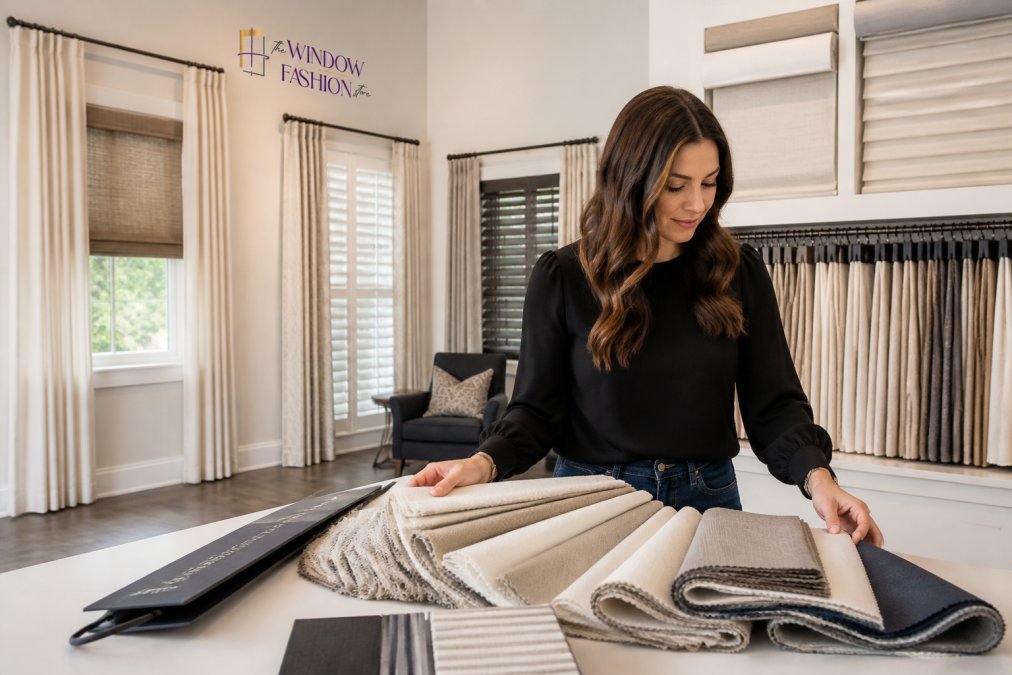
You are not looking at tiny samples pinned to a board; you are examining complete installations, which reveals details like mounting depth, valance profiles, and how hardware integrates with the window frame.
Fabric Textures, Colors, and Light Filtering in Person
Color matching is where online shopping fails most often. A shade that looks warm beige on your monitor can appear gray or pink next to your wall paint. In the gallery, you hold the actual fabric against your own photos and samples, checking for aesthetic cohesion in person.
Light filtering is equally hard to judge remotely, as a “light filtering” shade can mean anything from a soft glow to near-room-darkening. Operating a full display lets you see the true difference between sheer, light filtering, blackout, and room darkening options.
How to Choose the Right Blinds and Shades for Your Home
Choosing the right blinds and shades comes down to deliberate trade-offs, not just picking a style. A showroom appointment is where you can test those trade-offs physically.
Start with Light Control, Then Privacy, Then Operation
Most homeowners begin with aesthetics, but function should anchor the decision. Ask yourself three questions in order:
- How much light do I want in this room at different times of day? A west-facing living room at 4 p.m. is a different problem than a north-facing bedroom at 7 a.m.
- What is the privacy threshold? Can you see into the room from the street or a neighbor’s window? Do you need see-out privacy during the day, or only at night?
- How will I operate the treatment? Will a child’s bedroom need a cordless system for safety? Is the window behind a sofa where a motorized lift is the only practical option?
The Key Differences Between Product Categories
Here is what you should actually test in the gallery for each major category:
- Honeycomb (cellular) shades: Test the cell size. A single-cell shade offers basic insulation, but a double-cell traps more air (energy.gov). Run your hand along the fabric to feel the difference in density. Check the cordless lift mechanism, does it stop smoothly at any height, or does it lock in preset positions? For a patio door or large window, ask to see a motorized option with a battery wand, which avoids visible wiring.
- Woven wood shades: Look at the material consistency. Natural grasses and bamboos vary from batch to batch, so the sample you see is an approximation, not a guarantee. Test the lining options, a white vinyl backing blocks light and provides privacy, while an open weave without lining is purely decorative. Ask about light gaps at the edges; woven woods are often mounted outside the frame to minimize them.
- Shutters: The two main decisions are material (wood vs. composite) and louver size. A 2.5-inch louver offers a more traditional look and a wider view when open, while a 3.5-inch louver reads more contemporary and lets in more light when tilted (hunterdouglas.com). In the gallery, open and close a full-size shutter panel to feel the weight and check the tilt rod operation, some prefer a hidden tilt rod for a cleaner look, but it changes the mechanics.
- Drapery: This is about fabric weight and lining. Hold a drapery panel up to the light to see how much it filters. A blackout lining will feel heavier and stiffer, while a cotton blend drapes more fluidly. Test the pleat style, pinch pleats offer a tailored look, while grommet tops are more casual and slide more easily on a rod.
A Practical Room-by-Room Starting Point
| Room | Primary Need | Treatment Direction | Key Feature to Test |
|---|---|---|---|
| Nursery | Sleep + safety | Blackout honeycomb or roller shades | Cordless or motorized lift; verify no light leaks at edges |
| Home Office | Glare + screen comfort | Light filtering honeycomb or sheer | Adjustable opacity; test how much UV protection the fabric offers |
| Living Room | View + ambiance | Sheer or layered drapery | Motorization for hard-to-reach windows; hardware weight and finish |
| Master Bedroom | Privacy + darkness | Room darkening shades or shutters | Full-extension light seal; test the side channels on a shade |
| Kitchen | Durability + moisture | Faux wood blinds or roller shades | Wipeability of the material; check how the lift mechanism handles daily use |
Bring a list of your window measurements and the room’s orientation (north, south, east, west). Our designers can immediately rule out products that won’t perform well in that specific light.
When to Consider Motorization and Smart Home Integration
Motorization is a practical solution for windows that are tall, positioned behind furniture, or part of a daily routine. In the gallery, operate a motorized shade yourself and notice the noise level, some motors are nearly silent, others have a distinct hum. Ask about the power source: battery wands are simpler to retrofit, while hardwired options require an electrician but eliminate battery changes.
If you use a smart home system, verify compatibility during your appointment. Most major motorized lines from Hunter Douglas and Norman integrate with common platforms, but the setup process varies. A designer can confirm whether the product you like will work with your existing ecosystem before you commit.
Match the treatment to the room’s job first, then the style. Function drives satisfaction; aesthetics drive delight. Both matter, but order matters more.
What to Expect From a Custom Window Treatment Design Consultation
A custom window treatment design consultation is a guided conversation where a designer helps you translate your needs into a concrete product plan.
During the session, the designer reviews your window measurements, discusses your style preferences, and addresses odd-size windows that often cause light gaps with stock products. You will look at fabric swatches together and narrow hundreds of options to a shortlist that fits your home and budget.
For those who prefer staying home, we also offer in-home design consultations where we bring small sample books directly to you, ideal for seeing how options interact with your existing furnishings and natural light.
The Value of Professional Measurement and Installation
Accurate window measurements are the difference between a polished look and a drafty, uneven result. A common mistake is assuming your windows are perfectly square; most are not. Professional measuring accounts for slight variations in your window architecture, ensuring a precise fit that eliminates light gaps.
Do not rely on DIY measurements for custom treatments. A fraction of an inch off can mean a shade that binds, gaps at the edges, or an inside mount that will not fit at all.
What a Professional Measure Covers That You Might Miss
A professional measure is not just about width and height. It involves checking for:
- Squareness: Measuring diagonally from corner to corner to detect a window that is out of square.
- Plumb: Verifying the window frame is vertically straight, not leaning.
- Depth: Confirming there is enough recess depth for an inside mount, especially for honeycomb shades or shutters that require specific clearance.
- Obstructions: Identifying window cranks, handles, or locks that could interfere with the treatment.
- Drywall returns: Measuring the distance from the window frame to the wall to determine the correct outside mount width.
A trained installer takes three measurements, top, middle, bottom, and uses the narrowest for an inside mount to guarantee a fit, preventing the most common callbacks: shades that bind, light gaps at the edges, or treatments that will not mount.
The Warranty and Post-Purchase Advantage of Buying Through a Showroom
When you purchase through a showroom, you are not just buying a product; you are buying a relationship that supports the warranty over the life of the treatment.
We exclusively install and service products purchased directly through our store, including Hunter Douglas, Alta, Norman, and Texton. When a product is installed by our certified team, the manufacturer’s warranty is validated. If a cord mechanism fails, a fabric fades prematurely, or a motor stops working, you have a local team that knows the product line, its tolerances, and its quirks, and we handle the warranty claim process with the manufacturer on your behalf.
Contrast that with an online-only purchase, where you must diagnose the issue, package the product, ship it back, and wait for a replacement, often without a local expert to confirm whether the problem is a defect or an installation error. And if you bought from a big-box store or an outside brand, we cannot service it.
Why Installation Expertise Protects Your Investment
A custom shade is only as good as its installation. Even the finest Norman shutter will underwhelm if it is mounted crooked or pulls away from the frame. Our installers understand mounting depth, inside vs. outside mount decisions, and how to handle drapery hardware, valances, and cornices correctly.
Professional measurement and installation are not an upsell; they are the mechanism that protects your warranty and ensures the product performs exactly as designed. Ask about the installation process during your showroom appointment so you know what to expect.
Why Professional Installation Matters for Custom Treatments
Your Showroom Visit: A Step-by-Step Guide
Walking into a showroom with a plan makes the visit productive. Here is how to get the most from your appointment:
- Gather your room photos, window measurements, and any fabric or paint samples.
- Arrive with a list of priorities: light control, privacy, motorization, and style.
- Tour the full displays first to see the range of what is possible.
- Ask to operate the cordless and motorized options to feel the difference.
- Compare fabrics in natural light near a window, not under showroom lighting alone.
- Discuss your budget openly so the designer can guide you to the right options.
- Book a follow-up for in-home consultation if you need to see options in your space.
Start Your Window Treatment Project With a Showroom Visit
Showroom appointments are the best place to start your search for window treatments because they replace guesswork with certainty. You see the real products, feel the materials, test the function, and get expert guidance on how to choose the right blinds and shades for your home.
The Window Fashion Store has over 20 years of experience helping Kansas City homeowners and businesses elevate their interiors. Our family-owned team offers personalized one-on-one service, professional design and installation, and access to high-quality manufacturers. We are accredited by the Better Business Bureau with an A+ rating, so you can trust the process from first visit to final install (bbb.org).
Frequently Asked Questions
What factors should I consider when choosing window treatments?
Start with how you use each room. Do you need privacy, light control, or energy efficiency? Then consider the style of your decor and the window’s shape and size. A showroom appointment helps you see how different materials filter light and how colors look in person. You can also compare cordless options for child safety and explore motorized blinds for hard-to-reach windows. An expert can guide you through these decisions.
What are the benefits of visiting a window treatment showroom versus shopping online?
Online photos can’t show you how a fabric catches light or how a shade operates. In a showroom, you can touch materials, test cordless lift systems, and see full-sized displays of products from Hunter Douglas, Alta, Norman, and Texton. You get immediate answers about light filtering, privacy levels, and mounting options. Seeing products in person prevents costly mistakes and helps you feel confident in your choices.
How should I prepare for a window treatment design consultation?
Bring photos of your rooms and note your priorities for each window, such as light control, privacy, or insulation. Measure your windows roughly, but know that professional measurement comes later. Think about your style preferences and any functional needs like motorization. During the consultation, ask about fabric durability, cleaning, and warranty coverage. The more details you share, the better your design consultant can guide you.
What is the difference between big-box store products and professional custom window treatments?
Big-box stores sell limited sizes and styles that may not fit your windows properly, often leaving light gaps. Professional custom window treatments are made to your exact measurements, ensuring a precise fit. You also get expert guidance on fabric, function, and style. While custom options cost more upfront, they tend to last longer and perform better. Showroom appointments let you see the quality difference firsthand.
Choosing window treatments does not have to be overwhelming. Start with a visit to our Design Gallery, where full-sized displays and expert guidance make the decision clear. Schedule your showroom appointment today and see the difference that seeing in person makes.